


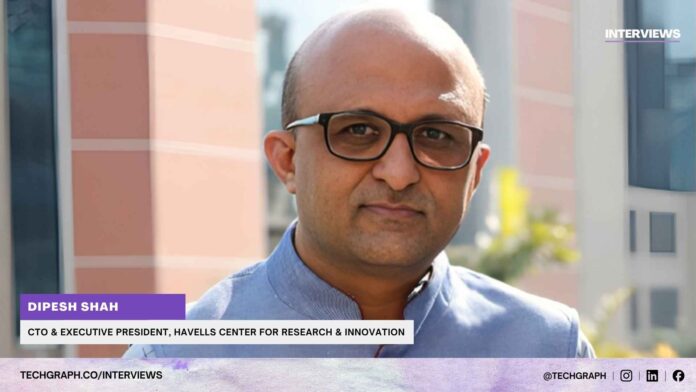

Speaking with TechGraph, Dipesh Shah, CTO & Executive President, Havells Center for Research & Innovation, discussed how sustainability has become a core design principle at Havells as the company integrates durability, reparability, and recyclability into product development, and how this approach is helping reduce lifecycle impact while strengthening consumer trust and long-term relevance in India’s evolving smart home appliances market.
Shah also spoke about how Havells is embedding circular practices across manufacturing and sourcing through zero-waste operations, responsible materials, and modular product architectures that keep costs efficient for price-sensitive consumers while supporting India’s broader transition to clean energy and responsible consumption.
Read the interview in detail:
TechGraph: Havells has been at the centre of India’s electrical and consumer durables story for decades. As green technologies and renewable energy begin to define the future of responsible business, how are you reshaping the company’s innovation pipeline so that sustainability becomes a core driver of product design and not just a feature layered on top?
Dipesh Shah: Product stewardship is central to Havells’ dedication to sustainability. By promoting responsible design, production, usage, and disposal of our products, our product stewardship initiatives minimize environmental impact across the product life cycle, alongside enhancing customer trust and market differentiation.
Havells employs Design for Sustainability as one of its central strategies. The strategy emphasizes integrating durability, reparability, and recyclability of products as crucial factors into the design process itself. By adopting modular designs and using eco-friendly materials, the Company ensures that its products can be easily disassembled, repaired, and recycled at the end of their lifecycle, thus minimizing waste and maximizing resource utilization. Last year, we achieved a 50% increase in energy-efficient products (across applicable categories).
TechGraph: R&D by itself cannot deliver meaningful change without rethinking how products are made. What structural shifts are you implementing across Havells’ factories, supply chains, and sourcing practices to embed sustainability end to end, and how do you balance cleaner processes with the need to keep products affordable in a price-sensitive market like India?
Dipesh Shah: At Havells, we emphasise sharing, leasing, reusing, repairing, refurbishing, and recycling existing materials and products as long as possible, effectively extending product lifecycle and minimising waste. By implementing the principles of circular economy across all aspects of our operations, we aim to transform our business model into one that is regenerative, sustainable, and resource-efficient.
For our operations, we have achieved Zero waste to landfill, 42% of water recycling, 32% reduction in Scope 1 emissions vs last year, and 36% increase in energy consumption from renewable sources vs last year. We actively engage with our suppliers to ensure responsible sourcing of materials, as well as conduct regular supplier assessments to promote sustainable manufacturing practices.
We recognize that sustainability should also make our products more competitive in a price-sensitive market like India. One example here is the use of engineered plastics in products that are more sustainable and cost-efficient at the same time.
TechGraph: Consumers today look beyond star ratings and energy labels, expecting products that are both intelligent and efficient. How are you translating your research into tangible innovations that respond to this behavioural shift, whether through renewable integration, smart systems, or the use of new sustainable materials?
Dipesh Shah: Consumers today want products that are both smart and sustainable. Our R&D teams are working on connected, AI/ML-based, and energy-efficient solutions — from smart lighting to connected appliances — that give users better control over energy usage. We also focus on recyclable materials and designs that last longer, aligning with our vision of responsible innovation.
Our focus is towards creating energy efficient connected solutions that go deeper into consumer homes, bringing ease to their life so as to accelerate adoption. One such example is the BLDC+ range of Fans, which, at its core, is energy efficient and, with the combination of features like premium designs, direct voice control, IoT-enabled etc. increases its adoption across consumer groups.
TechGraph: India’s regulatory push on efficiency and renewable adoption is becoming sharper, with stricter norms and new incentives for clean technologies. In this environment, how do you see Havells’ role in not only meeting compliance standards but also raising the bar and shaping what responsible manufacturing should look like for the entire FMEG sector?
Dipesh Shah: For us, compliance is the starting point, not the finish line. We align with BEE and global ESG frameworks and undergo independent assurance for transparency. Beyond that, we collaborate with policymakers, industry groups, and suppliers to raise sustainability standards across the FMEG sector. Our aim is to make responsible manufacturing the industry norm, not an exception.
Havells is fully dedicated to India’s goal of Carbon Net Zero by 2070. While the Net-Zero Journey is a significant multi-decade commitment, it is important to remember that alongside climate protection, it brings a multitude of benefits for the business, shedding light on the entire operations of a company. Aiming to set a definitive net-zero target year, we are strategically aligning our future roadmap with the Science Based Targets initiative (SBTi) framework. This proactive approach underscores Havells’ dedication to reducing greenhouse gas emissions for generations to come.
TechGraph: Around the world, companies are racing ahead with energy storage, smart grids, and large-scale electrification. Given India’s unique infrastructure constraints and affordability challenges, how are you balancing the need to stay aligned with global innovation while building solutions that can work at scale for Indian consumers and still keep Havells competitive internationally?
Dipesh Shah: India is set to see one of the highest increases in energy demand in the coming decade, driven by its economic rise and urbanization. This presents a unique opportunity to develop sustainable energy and infrastructure Innovations that can work for India and the world alike.
To address this, Havells, over the years, has made significant strides in the clean technology sector, focusing on renewable energy, energy efficiency, and sustainable manufacturing practices. We have signed a binding term sheet to invest INR 600 crores in one of the largest strategic deals in the India Solar sector. This move makes a strong presence in the renewables space. We already supply solar inverters, modules, DC switchgear, and solar cables, especially in the rooftop and commercial & industrial segments. With this investment, Havells positions itself firmly on the solar manufacturing map.
TechGraph: The convergence of IoT, AI, and data-driven platforms is transforming how energy is consumed and managed. How are you embedding these technologies into Havells’ products so that customers not only reduce power use but also monitor, predict, and optimise their energy footprint in ways that were not possible before?
Dipesh Shah: We’re combining IoT and AI to create products that help consumers use energy more intelligently. Through connected devices and the Havells One app, users can track consumption, automate usage, and even receive predictive insights to save power. It’s about empowering customers to make conscious energy choices effortlessly.
TechGraph: Finally, when you look at the horizon of renewable and green technologies, which breakthrough do you believe has the potential to fundamentally redefine the electrical and consumer durables industry over the next decade, and how is Havells preparing its R&D strategy to ensure it leads that transition rather than reacting to it?
Dipesh Shah: The next decade will be shaped by renewable integration, energy storage, and AI-driven energy management. Havells is already investing in these areas through advanced R&D setups and technology partnerships. We’re preparing not just to respond to change, but to lead it — helping India move toward cleaner and smarter electrification.


