


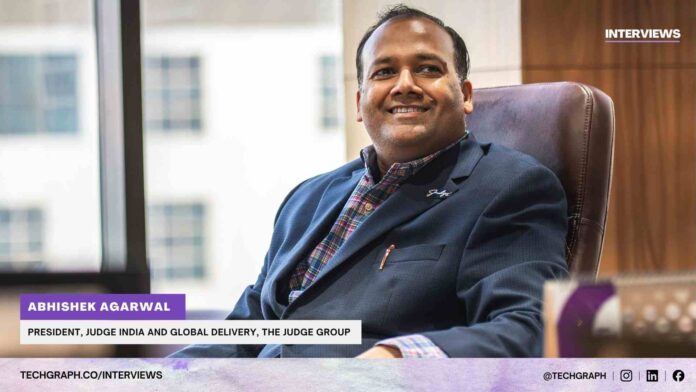

Speaking with TechGraph, Abhishek Agarwal, President of Judge India and Global Delivery at The Judge Group, discussed how India has become the strategic nerve center of the company’s global operations as clients look for co-creation and transformation guidance, and how Judge India’s role has expanded from service execution to driving digital roadmaps, product engineering, and AI-led delivery strategies for enterprises across industries.
Agarwal further highlighted how this evolution has reshaped the company’s engagement model, with India-based teams contributing to ideation, design, and deployment in partnership with customers to ensure measurable outcomes and stronger business resilience.
Read the interview in detail:
TechGraph: Over the years, Judge India Solutions has evolved from a staffing and talent organization into a full-fledged technology and solutions partner. What was the inflection point that convinced you this shift was essential, and how did you ensure it strengthened the company’s core delivery DNA rather than diluted it?
Abhishek Agarwal: Judge India Solutions has evolved over the years from being a provider of staffing and talent to a comprehensive IT services and solutions provider. The turning point for this transformation was when we realized that our clients were no longer seeking manpower—they were seeking long-term strategic technology partners who could assist them with innovation and service-based solutions in solving complex business issues.
Our clients were rapidly progressing towards digital transformation, automation, and integrated enterprise solutions. To remain relevant, we had to move in the same direction ourselves. This meant diversifying from staffing to core IT services, technology consulting, and delivery-focused solutions.
We ensured that this shift reinforced our core DNA—our in-depth knowledge of talent, delivery, and client requirements. We didn’t leave behind what worked for us; we leveraged it. By bringing together our staffing capabilities with our expanding portfolio of IT services and technology-driven solutions, we developed an exceptional value proposition that ensures quality service delivery along with end-to-end business outcomes.
TechGraph: India has become the operational backbone of your global delivery model. Beyond scale and cost advantages, what strategic functions are now being driven from here, and how has that changed your engagement with global clients?
Abhishek Agarwal: India has become the pulse of our global delivery business—not only for price and volume, but for strategic guidance. Now, Judge India Solutions is not only about execution or service support. Numerous key worldwide activities are being spearheaded from here, such as digital transformation, data analytics, AI and automation, product engineering, and customer experience solutions.
Our India business is heavily involved in co-creating solutions with clients around the world. It is not a back-office or delivery center anymore—it’s an innovation hub that is strategic. The pool of talent in India combines both technical capabilities and strategic thinking, enabling us to serve clients in a consultative approach. This transformation has altered the way we work with our clients.
We now collaborate with them in their innovative conversations, product planning, and digital roadmaps. Our clients engage us as partners who know their business issues intimately and provide holistic solutions instead of discrete services.
TechGraph: Many global delivery firms talk about moving up the value chain, but the transition from execution to co-creation often stalls at the middle-management level. What structural or cultural changes have you implemented within Judge India Solutions to make that shift genuinely visible in client engagements?
Abhishek Agarwal: Most of the global companies want to go up the value chain, but they struggle at the level of middle management. At Judge India Solutions, we address this by addressing both structure and culture.
Structurally, we realign our teams to facilitate cross-functional working. Rather than top-down hierarchies, we construct agile squads that combine people across disciplines—technology, analytics, and domain expertise—to work directly with clients on results.
We culturally empower our teams to own. We invest in leadership development and ongoing learning initiatives so that managers think strategically, not operationally. We foster open communication and innovation at all levels so that ideas can flow up.
This shift is evident in our client interactions. Our teams engage in ideation sessions, design thinking workshops, and collaborative innovation programs with clients. The outcome is a hybrid partnership model, wherein we co-create value instead of merely performing tasks.
TechGraph: With hardware design and engineering solutions now part of your portfolio, how are you aligning these capabilities with your IT and digital practices, especially when clients expect seamless integration across both physical and software environments?
Abhishek Agarwal: Including hardware design and engineering solutions in our offerings has been an organic extension of our abilities. With changing industries, customers increasingly demand technology partners to deliver end-to-end solutions encompassing both hardware and software.
We have coupled our hardware engineering services tightly with our IT and digital practices. For instance, in the automotive and manufacturing industries, our hardware groups collaborate with data scientists and software developers to create smart, connected systems. This allows us to integrate physical pieces and digital platforms seamlessly.
Our strategy is to shatter silos and build an integrated delivery model in which the hardware, software, and analytics teams work together from inception. This yields faster time-to-market, increased product reliability, and superior customer experiences.
TechGraph: The market is clearly shifting toward outcome-based models, where performance and business results outweigh traditional effort metrics. How is your delivery model evolving to meet that expectation, particularly when clients demand both accountability and agility?
Abhishek Agarwal: The market is evidently shifting from classic effort-based models to outcome-based engagements. Clients now gauge success on outcomes rather than hours. To address these demands, we have reconstructed our delivery strategy.
We begin by having our objectives directly tied to client business results, whether that be to enhance efficiency, boost revenue, or better serve customers. Our teams utilize data and analysis to measure progress in real-time and make changes when necessary.
We have also constructed flexible delivery structures that enable us to integrate accountability with adaptability. Through feedback loops, agile sprints, and open communication, we provide clients with full visibility into performance and outcomes. Such a model contributes to establishing trust and long-term relationships.
TechGraph: As AI, automation, and data-driven decision-making become central to enterprise operations, how are you embedding these technologies into your delivery approach to deliver faster execution and more intelligent, measurable outcomes for clients?
Abhishek Agarwal: AI, automation, and data-driven decision-making are now core to the way we work. We are integrating these technologies into our delivery framework to facilitate quicker execution, improved insights, and measurable results for our clients.
We apply AI-enabled tools to project management, predictive analytics, and quality assurance. Automation supports us in automating routine tasks, minimizing human error, and freeing our teams to concentrate on higher-value work. Data is at the core of every decision we make. From analyzing client performance to predicting risks, we use data to deliver intelligent, informed outcomes. This not only improves efficiency but also enhances the overall client experience by providing transparency and foresight.
TechGraph: The last few years have exposed how fragile global delivery networks can be in times of disruption. What steps are you taking to make Judge India Solutions’ delivery operations more resilient, and how do you balance agility with control and quality?
Abhishek Agarwal: The past years, particularly the pandemic years, proved how weak global networks can be. At Judge India Solutions, we have acted decisively to fortify our delivery model and make it more resilient and flexible. We have developed distributed delivery capabilities so that work would be possible across geographies with no disruption.
We also focus on risk management and scenario planning. Our teams are trained to respond quickly to challenges, maintaining both agility and control. We’ve strengthened our governance frameworks to ensure quality and security remain consistent, regardless of where the work is delivered from.
In short, we’ve created a model that is flexible enough to adapt to change but disciplined enough to maintain our high standards of delivery.
TechGraph: Looking ahead, what do you see as the next major inflection point for global delivery in the next five years, and how is Judge India Solutions preparing to stay on the leading edge of that change rather than respond to it later?
Abhishek Agarwal: In the future, we see the next big inflection point for global delivery being hyper-personalization through smart automation. The future is for those organizations that can leverage data, AI, and networked technologies to provide tailored, real-time solutions on a scale.
Judge India Solutions is already making the transition. We are investing in new technologies like generative AI, machine learning, and digital twins. We are also developing domain-specific knowledge to deliver niche solutions in industries such as healthcare, finance, and manufacturing.
Meanwhile, we are redesigning the employee experience. We think that innovation begins with people, so we are building a culture of ongoing learning, experimentation, and collaboration. We aim to be ahead of change by being proactive in anticipating client needs before they arise, so that we can continue to be a proactive partner in their transformation journeys.