

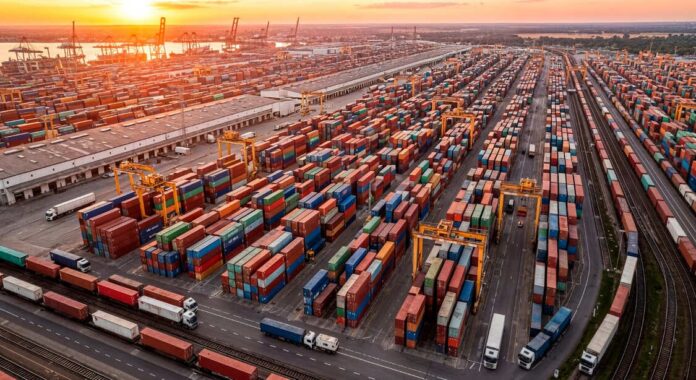
The Container Economy: What Market Share Trends Signal for Global Supply Chains

PUBLISHED:

See more TechGraph stories in your search results.
Google Add TechGraph on Google

In recent years, the dynamics of global supply chains have been heavily influenced by the shipping container market. As businesses navigate a complex economic landscape, understanding market share trends becomes crucial for strategic planning. This article delves into the evolving container economy, exploring its impact on global trade and businesses worldwide.

Growth in the Global Shipping Container Market

Shipping containers remain pivotal in the arena of international trade, significantly impacting logistics operations. According to Archive Market Research, by 2025, the market for global shipping containers was forecasted to reach a valuation of $5,551 million, highlighting the substantial increase in demand. As businesses continue to expand globally, the importance of efficient and scalable container logistics systems cannot be overstated.

- Advertisement -

The remarkable growth in the container market is a testament to the increased globalization of industries. As businesses strive to improve their operational efficiencies, the reliance on container systems is more evident than ever. This trend points to an ongoing evolution where containers are not just limited to shipping but are integral to supply chain strategies.

Moreover, the digital transformation of logistical processes has enabled businesses to track and optimize their container usage effectively. This technological advancement has made the market more adaptable to fluctuations in demand. As enterprises scale operations globally, enhanced container tracking capabilities have become indispensable in managing supply chain interruptions.

The Significant Revenue Share of Shipping Containers

In 2022, shipping containers made a significant mark in the market by accounting for a notable portion of revenue in the logistics sector. According to Grand View Research, shipping containers comprised a revenue share of 21.4%, reflecting their crucial role in trade. This revenue prominence indicates the indispensability of efficient container management in facilitating seamless business operations.

The substantial revenue share of containers reflects their strategic importance in maintaining competitive advantages in the logistics industry. Businesses that optimize container use are better positioned to reduce costs and improve service delivery. Consequently, the financial implications of well-managed container fleets underscore their contribution to robust business models.

Furthermore, the adaptability of containers to various commodities enhances their value in the supply chain. From perishables to electronics, the versatility of containers ensures businesses can transport a diverse range of goods effectively. This adaptability not only supports business growth but also fosters resilience in supply chain management.

The U.S. market for portable storage container rentals has shown notable growth, with projections indicating continuous expansion. According to Verified Market Research, in 2023, the market’s valuation was at $532.42 million and is expected to climb to $791.42 million by 2031, growing at a compound annual growth rate (CAGR) of 5.82% between 2024 and 2031. This growth trajectory underscores businesses’ increasing reliance on flexible storage solutions.

Portable storage solutions are becoming a strategic asset for businesses seeking adaptable logistics. The anticipated growth reflects shifts in consumer demand and the need for businesses to accommodate more agile inventory management strategies. By utilizing portable storage, companies are better equipped to handle seasonal demand fluctuations and infrastructural constraints.

The portable storage market’s growth also indicates broader shifts towards sustainable business practices. With containers increasingly being repurposed and reused, businesses are finding new ways to diminish their environmental impact. The evolving market points towards a future where innovation and sustainability coalesce within logistics frameworks.

The container economy presents both challenges and opportunities for businesses in the global supply chain sector. Understanding market share trends helps businesses align their strategies with market demands, optimize logistics, and remain competitive. As these trends continue to evolve, businesses must stay informed and adaptable, ensuring their supply chain practices meet the ever-changing landscape of international commerce.

Stay ahead of the curve, every day.

A daily briefing covering news, interviews, and the trends driving the world forward. Curated for readers who want news, not noise.

We don’t spam! Read our privacy policy for more info.

- Advertisement -
Krishna Mali
Krishna Mali
Founder & Group Editor of TechGraph.

Top Gainers · Global

View all
NamePriceChange
BRITANNIABritannia Industries ₹4,930.00 +6.36%
IRENIREN Limited $24.46 +5.08%
NESTLEINDNestlé India ₹1,248.40 +4.47%
TATACONSUMTata Consumer Products ₹1,073.00 +4.29%
DMARTAvenue Supermarts ₹3,359.00 +3.99%

Latest Stories

How Agentic AI Is Changing the Future of Cybersecurity

For ten years, AI in security was a smart...

The Mobile Banking AI Permission Matrix: What an Assistant Can Access, Recommend, and Execute

A customer asks a mobile banking assistant to explain...

Free Crypto Trading Signals: How to Judge a Prediction Before You Trust It

Learn how to assess free crypto trading signals, check the original claim, compare outcomes fairly, and spot gaps in a published record.

The Building Blocks of Academic Success: Learning, Play, and Physical Activity

Academic success is a multifaceted concept that goes far...

The Questions That Come After an Unexpected Workplace Injury

An ordinary workday can change in a matter of...

Related Articles

How Agentic AI Is Changing the Future of Cybersecurity

For ten years, AI in security was a smart filter. It ranked alerts. It flagged anomalies. It wrote summaries. A human still did everything...

The Mobile Banking AI Permission Matrix: What an Assistant Can Access, Recommend, and Execute

A customer asks a mobile banking assistant to explain recent spending, suggest a savings amount, and transfer $200 between accounts. The first request retrieves information. The second produces a recommendation. The third changes account balances and requires transaction authorization. Banks introducing AI assistants need rules...

Free Crypto Trading Signals: How to Judge a Prediction Before You Trust It

Learn how to assess free crypto trading signals, check the original claim, compare outcomes fairly, and spot gaps in a published record.

The Building Blocks of Academic Success: Learning, Play, and Physical Activity

Academic success is a multifaceted concept that goes far beyond the boundaries of traditional...

Is Your CRM a System of Record or a System of Meaning?

CRMs store fields, stages and amounts. But AI agents need more than raw data. Here's why meaning must become queryable, consistent and built into the system.

How AI Is Reshaping the Future of Global Trade

The global economy spent 2025 absorbing tariff shocks, rerouting supply chains and navigating a...

How Cybersecurity Is Becoming Central to Building Trust in India’s Fintech Sector

As digital payments become routine for millions, the industry's credibility rests less on speed and more on how well it protects the people using it.

The Hidden Economics of Fashion Ecommerce: Why Catalog Coverage Is a Business Decision, Not Just a Photography Cost

Fashion ecommerce teams often evaluate photography by looking at the cost of a shoot,...

How Inflation Can Affect Your Child Plans and Education Savings

Picture a parent in Pune who paid ₹40,000 for a Class 1 admission a...

The Rise of AI-Native Infrastructure and What It Means for India’s Future Cities

Our major cities are hitting a point where the current infrastructure just cannot keep...

The New Tech Patron: Why Founders like Alexey Gubarev Are Turning Private Obsessions Into Museums

When Microsoft co-founder Paul Allen wanted to house his fascination with rock music, he...

Why Pre-Marital Health Screening Is Gaining Traction in India

In 2021, the National Policy for Rare Diseases was finalised and placed in the...

The Questions That Come After an Unexpected Workplace Injury

An ordinary workday can change in a matter of seconds. A misplaced tool, an unstable surface, or an unexpected equipment problem can leave an...

The Rise of AI-Native Infrastructure and What It Means for India’s Future Cities

Our major cities are hitting a point where the current infrastructure just cannot keep...

The New Tech Patron: Why Founders like Alexey Gubarev Are Turning Private Obsessions Into Museums

When Microsoft co-founder Paul Allen wanted to house his fascination with rock music, he...

How Is AI Creating a New Workplace Divide?

Artificial intelligence is changing the workplace faster than any technology we have witnessed in...

How Is AI Creating a New Workplace Divide?

Artificial intelligence is changing the workplace faster than any technology we have witnessed in...

Create Cozy-Aesthetic Videos from Everyday Lifestyle Photos

There's a particular kind of content that never seems to go out of style...

How Gen Z Is Using AI to Make Matchmaking More Personal

Gen Z AI matchmaking reflects a broader shift in how young Indians approach marriage, with technology learning to understand what people are looking for rather than forcing them to fit their expectations into traditional search filters.

The Connected Exchange: NCDEX CTO Balkrishna Shankwalker on the Future of the Commodity Market

As commodity markets become more complex, NCDEX is rethinking its technology infrastructure around anticipating risks, widening digital access and improving price discovery through more connected market systems.