


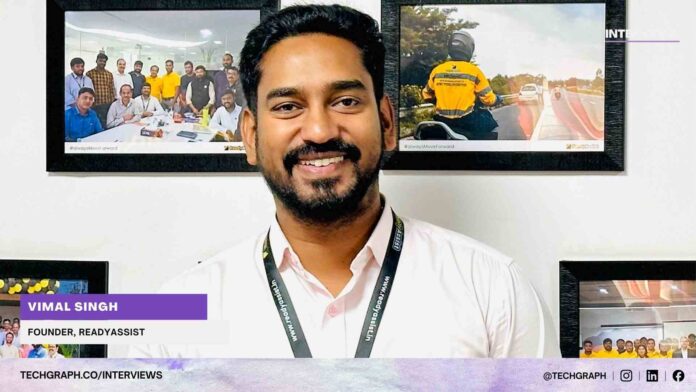

Speaking with TechGraph, Vimal Singh, Founder of ReadyAssist, discussed how traditional roadside assistance models built around call centres and manual coordination have struggled to keep pace with modern mobility needs, and how the company is helping accelerate this transition by building a technology-led operating backbone that brings consistency and reliability to a fragmented sector.
Singh also explained how ReadyAssist’s platform-driven model enables real-time request allocation and live technician tracking and continuously monitors service levels across locations, which helps reduce uncertainty for customers and allows on-ground partners to deliver consistent roadside support at scale through a unified system.
Read the interview in detail:
TechGraph: Roadside assistance in India was, for years, treated as a backup service rather than an organised industry. What pushed the market to finally take it seriously, and where do you see ReadyAssist’s role in accelerating that shift?
Vimal Singh: For years, roadside assistance was perceived as a fallback, something you needed only when things went wrong. What changed was the customer. As digital platforms began reshaping expectations around transparency, immediacy, and service reliability, the traditional, call-centre-based RSA model simply couldn’t keep up.
The industry needed to evolve from reactive to real-time, and that’s where ReadyAssist came in. By building a tech-first backbone and a fast, reliable network with 24/7 availability that brings structure, visibility, and predictability to an otherwise fragmented service, we’ve helped elevate RSA from a support function to a critical layer of mobility infrastructure.
Today, covering over 19,000 pin codes, we don’t just respond to breakdowns; we enable OEMs, insurers, and individual customers to view roadside assistance as an intelligent, always-on service ecosystem.
TechGraph: Technology is still underused in roadside services, yet you’ve placed deep-tech at the centre of your operations. How is it practically changing the customer journey, from the moment a distress call is made to the time the vehicle is fixed, and how do you measure that impact in real terms?
Vimal Singh: The entire ReadyAssist journey is orchestrated by technology, not as an add-on, but as the core of the experience. From the moment a customer raises a request, our AI-driven logic automatically identifies the nearest, best-qualified mechanic by factoring in location, issue complexity, skill specialisation, and live availability.
The technician’s ETA is predicted and shared with the customer in real time, and the system continuously analyses potential SLA breaches. If a delay is anticipated, the platform immediately assigns a backup to ensure assistance is delivered within the committed timeframe. The customer can track progress in real time, while our backend monitors SLAs, technician movement, and resolution times.
This has removed layers of manual inefficiency that plagued the traditional model. We measure success not just through reduced turnaround time, often within 30–45 minutes, but also through customer satisfaction, reliability, consistency across geographies, and the seamless integration of analytics that continually refines our service intelligence.
TechGraph: Most breakdowns happen in unpredictable places and odd hours, where arriving on time is as critical as solving the problem itself. How does your platform ensure reliability of response in such varied conditions, and what role do your mechanics and on-ground partners play alongside the technology?
Vimal Singh: In roadside assistance, reliability is the real differentiator. Our approach combines deep-tech orchestration with a human backbone that’s been rigorously trained and standardised. The ReadyAssist platform connects more than 11,000 mechanics and tow partners through a live dispatch system that optimises routing based on geography, time of day, and skill requirements. Operating 24/7 Pan India, every request is tracked in real time through our command centre, which can step in instantly if an SLA breach is detected.
On the ground, Mecademy-trained mechanics serve as brand custodians; they’re equipped not only with technical know-how but also the readiness to handle on-site decision-making. The synergy of tech precision and human adaptability is what allows us to operate consistently across terrains from dense metros to remote highways.
TechGraph: With electric mobility gaining ground, roadside assistance will increasingly mean handling battery failures, charging gaps, and software glitches. How prepared is ReadyAssist to respond to this transition, and where does deep-tech create the biggest edge?
Vimal Singh: Electric mobility is fundamentally rewriting what roadside assistance means. A flat battery, a software fault, or a charging gap needs a very different response framework than a puncture or mechanical breakdown. ReadyAssist has been investing ahead of the curve; over 3,000 of our mechanics are already EV-certified through Mecademy, and we’ve built diagnostic integrations that can interpret data from battery management systems and controller units in real time.
The real edge of deep-tech lies in how it turns data into foresight: enabling predictive diagnosis, dynamic dispatching, and remote assistance for EVs. As India’s EV ecosystem matures, our goal is to make RSA a silent enabler of that transition, dependable, data-aware, and ready before the driver even raises a call.
TechGraph: One of the promises of deep-tech is predictive ability, yet in India, vehicle servicing is still largely reactive. How close are you to using data and diagnostics to actually warn drivers about breakdown risks, and what hurdles do you face in turning that into an everyday feature?
Vimal Singh: Predictive servicing is the logical next step for mobility care, but it requires the right data infrastructure. We’re already working with OEMs and fleet operators to integrate telematics and fault-code APIs into our systems, which allows us to analyse live and historical data to forecast potential breakdown risks. The challenge is that India’s vehicle ecosystem is highly heterogeneous; every manufacturer follows its own diagnostic protocol, making standardisation a gradual process.
Despite that, our models are learning continuously from thousands of real-world incidents. Over time, this intelligence will allow us to move from being a reactive partner to one that can strategically deploy on-ground fleet based on data patterns, enabling the fastest possible response the moment a breakdown occurs, even before the customer reaches out.
TechGraph: Affordability remains a big factor in India, and scaling often forces companies to compromise on quality. What steps are you taking to balance cost with consistent, technology-enabled service, and how do you ensure customers across different cities receive the same level of support?
Vimal Singh: At ReadyAssist, we don’t see cost and quality as competing forces; they coexist through technology. Every RSA request is fully automated on our proprietary platform, which cuts out inefficiencies and reduces dependency on manual operations. By linking technician payouts to customer feedback and SLA adherence with instant payouts that reward performance in real time, we ensure that the drive for scale doesn’t dilute quality.
Our app-based SOPs, live command centre monitoring, and continuous upskilling through Mecademy ensure consistency across 19,000+ pin codes. Whether it’s a premium EV in Bengaluru or a commuter two-wheeler in Nashik, the customer experience remains the same: fast, transparent, and accountable. That’s the advantage of a data-driven model: it allows affordability without compromise.
TechGraph: Lastly, do you see deep-tech reshaping only roadside assistance, or could the same backbone eventually evolve into a broader vehicle lifecycle management ecosystem for Indian customers?
Vimal Singh: Deep-tech isn’t just transforming roadside assistance; it’s laying the foundation for the future of mobility care. The same infrastructure that powers real-time orchestration and diagnostics today can extend into rapid response mobility solutions, claims management, and connected vehicle analytics tomorrow.
Our “Claims Astro” platform, for instance, leverages the same core tech to simplify insurance claim workflows for OEMs and insurers. Over time, we see ReadyAssist evolving into a full vehicle lifecycle management platform where every touchpoint from breakdown to claim support to data-driven care is connected through intelligence and speed. That’s how we move from being an RSA provider to being a mobility enabler for a billion-mile India, assuring worry-free driving 24/7.


