


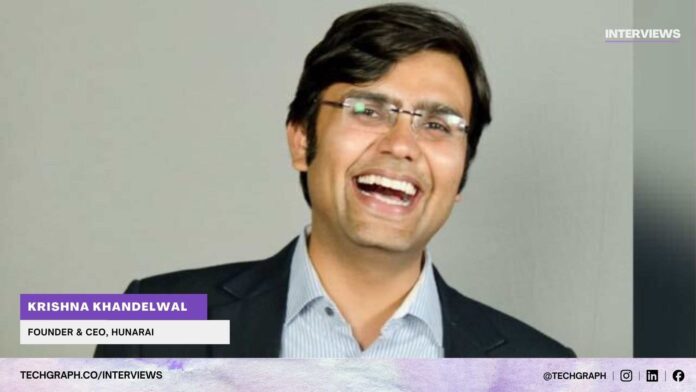

In an interaction with TechGraph, Krishna Khandelwal, Founder and CEO of Hunar.AI, outlined how traditional hiring tools have struggled to keep pace with India’s high-volume recruitment needs, and how conversational AI is filling this gap by enabling enterprises to engage candidates more effectively across languages, regions, and varying levels of digital access.
He further explained how HunarAI uses voice-based conversations to screen and engage candidates at scale, helping hiring teams understand intent and role fit early in the process and move candidates forward faster without relying on forms, repeated follow-ups, or manual filtering.
Read the interview in detail:
TechGraph: Over the past few years, we’ve seen artificial intelligence move from the sidelines to the center of recruitment. How is AI changing the fundamentals of hiring in India, especially in industries that depend on large-scale workforce deployment?
Krishna Khandelwal: In recent years, AI has not only made hiring easier but has also completely changed the way talent is screened and engaged with. The old ways of forms, follow-ups, and manual screening simply cannot keep up with the daily, high-volume hiring process across industries like manufacturing, logistics, BFSI, and retail.
The biggest change, in my opinion, is that hiring is now a conversation issue rather than a process issue. Conversation is key to engagement, which is key to recruitment and retention.
Companies have been using forms, portals, and chatbots to digitize hiring for years, but the adoption has been appalling because these tools only gather data and can’t comprehend conversations. Conversational AI has the ability to move beyond content to thoughts and intent. It has the power to understand the potential of a person, which goes beyond just the CV. Multilinguality in Voice AI reduces friction, increases trust, and improves candidate experience.
At Hunar.AI, this shift is tangible. Our voice AI agents now handle millions of monthly interactions from screening, assessing intent, verifying, and onboarding, while evaluating every single conversation.
TechGraph: India’s talent market is extremely diverse, with sharp variations in skills, geography, and access to technology. How do you ensure that your platform remains inclusive and effective across such different employment segments?
Krishna Khandelwal: That’s true, the talent ecosystem in India is extremely diverse, not only in terms of skills but also in terms of digital access, behavior, and language. The technological realities of a delivery partner in Patna and a recruiter in Bengaluru are entirely different. Meeting talent where they are, not where technology expects them to be, is the philosophy behind the product design at Hunar.AI.
The most unifying thing in India’s diverse workforce is conversation. Our multilingual contextual conversational AI ensures that a very diverse workforce segment is able to engage with our Voice AI agents.
Our AI interacts with candidates via the channels they already use, mainly voice and WhatsApp, in the language they are most familiar with. This makes it possible for someone to easily find and apply for opportunities even if they don’t have a resume or reliable internet. Every interaction feels intimate and natural because the system adjusts to linguistic, behavioral, and contextual subtleties, such as tone and response time.
TechGraph: There’s a growing debate on whether AI in recruitment enhances inclusivity or deepens existing biases. What measures does Hunar.AI take to ensure that algorithmic efficiency does not come at the expense of fairness and human judgment?
Krishna Khandelwal: That is a genuine concern. AI in hiring promises consistency and scale, but there is a risk of amplification: if your logic or data is biased, AI can scale that bias faster than a human process could. We at Hunar.AI have taken extreme care to design for fairness from the very beginning.
Our models are first trained on a variety of anonymized datasets that reflect the diversity of India’s workforce across industries, regions, and languages. We don’t predict suitability based on factors like location, gender, or name. Rather, we emphasize role alignment, conversational intent, and behavioral cues.
Secondly, our system’s AI decisions are all explicable. Not only can recruiters see that a candidate was shortlisted, but they can also see why. This transparency guarantees that judgment is still shared between recruiters and AI and also keeps recruiters informed.
Thirdly, we have ongoing feedback loops. The system does not simply automate; rather, it learns over time as each candidate interaction, recruiter override, and hiring outcome feeds back into model refinement.
We strongly believe that AI enhances human judgment rather than replaces it. AI merely makes sure that the recruiter’s definition of “good” is applied consistently, equitably, and at scale.
TechGraph: Many organisations invest in HR tech but struggle to measure its true impact. What should businesses focus on when assessing the return on investment in AI-based hiring systems beyond just reducing hiring time or costs?
Krishna Khandelwal: HR Tech adoption in India is generally poor, and ROIs are subjective. At the same time, reducing hiring time or costs is not a result; it is an output. The true benefit of AI adoption for businesses is found in how drastically it alters the caliber and consistency of their talent pool.
We at Hunar.AI encourage clients to assess impact in more profound ways other than speed and costs. The first is consistency and quality of hiring results: does the system produce talent of the same caliber for various recruiters, locations, and positions?
The second is candidate engagement metrics, which measure how well candidates engage with our Voice AI. AI makes it possible to measure previously undetectable signals like conversational depth, responsiveness, and conversion quality.
The third is the ability to reach a varied set of candidates across geographies and languages.
Hence, building a system that continuously learns, improves, and produces results that scale with the business is the true measure of ROI in AI hiring, not just efficiency.
TechGraph: The promise of faster and more reliable hiring sounds compelling, but large enterprises often struggle to integrate new technologies into existing workflows. How do you address adoption challenges within legacy HR systems and diverse organizational structures?
Krishna Khandelwal: Integration acts as an invisible barrier between impact and intent. At Hunar.AI, we saw early on that AI must be integrated into current recruiter behavior and enterprise infrastructure rather than requiring reinvention in order to truly drive adoption.
Our strategy has been to create AI that complements legacy systems rather than works against them. Hunar easily integrates with the CRMs, ATS platforms, and HRMS tools that are already in use by recruiters. Therefore, we enhance systems rather than replace them. The AI layer synchronizes data back into the enterprise stack in real time while automating sourcing, screening, and engagement.
From pilot and recruiter training to workflow personalization and success metrics, we collaborate closely with the HR and operations teams of our clients to create adoption frameworks. Adoption becomes natural when recruiters see AI enhancing their daily routine rather than upsetting it.
TechGraph: The talent landscape is evolving rapidly, with businesses now emphasizing agility and retention over sheer headcount. How does Hunar AI’s technology adapt to these shifting priorities, and where do you see the next phase of innovation emerging in this space?
Krishna Khandelwal: Talent-related conversations have drastically changed. Growth is now measured by agility, or how quickly teams can adjust and how quickly organizations can deploy and redeploy skills in a volatile market. From solving for volume and retention, Hunar.AI’s technology has advanced.
Our AI maps intent, adaptability, and potential fit in addition to matching candidates to positions. It transforms hiring from a transactional event into a predictive science by assisting employers in identifying candidates who are more likely to perform and stay by examining conversational patterns and behavioral cues. Enterprises are increasingly using our models not only for hiring but also for employer retention.
TechGraph: Looking ahead, what do you think will define the next stage of growth for AI-powered HR platforms in India, and how is Hunar AI preparing to stay ahead of those changes?
Krishna Khandelwal: Context will determine the next phase of development for AI-powered HR in India. Beyond automation, we’re heading toward intelligence that genuinely comprehends human and organizational context, not just what a candidate says, but why they say it, and not just where a company hires, but how its talent ecosystem changes over time.
Three factors will accelerate this evolution in India: outcome-linked intelligence, conversational interfaces, and multilingual access. AI will be crucial in bridging intent, opportunity, and inclusion as voice and vernacular will become the primary means of communication for millions.
We think that ecosystems that think, communicate, and change with the workforce they support will be the focus of HR technology in the future, rather than tools. India is the perfect starting point for that change because of its size and diversity.