


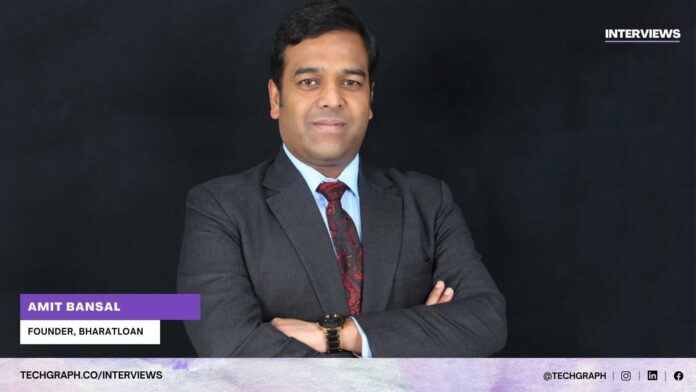

Speaking with TechGraph, Amit Bansal, Founder of BharatLoan, discussed how India’s personal loan market is expanding rapidly as salaried professionals increasingly rely on short-term credit to manage liquidity gaps, and how BharatLoan is addressing this shift through data-driven underwriting and responsible lending models that align access with repayment capacity to ensure sustainable financial inclusion.
He further outlined how the company’s lending framework combines speed with discipline, using real-time assessment tools, transparent terms, and early stress detection to help borrowers manage credit confidently while enabling lenders to maintain portfolio quality and trust.
Read the complete interview:
TechGraph: The personal loan segment in India has been expanding at a pace that often outstrips income growth, which raises questions about whether the trend reflects genuine financial inclusion or the early signs of over-leverage. How does BharatLoan read this growth cycle?
Amit Bansal: At BharatLoan, we see this growth as an important shift in India’s financial landscape, especially for salaried professionals who often face short term liquidity gaps despite having stable incomes. Traditionally, this segment was underserved because mainstream institutions did not move fast enough to meet their evolving needs.
The rise of personal loans shows that more people are now able to access credit in a timely manner. For us, the responsibility lies in making sure this access does not become overextension. Our technology-led assessments ensure we lend in line with repayment capacity, so inclusion is meaningful and sustainable.
TechGraph: While traditional banks continue to dominate lending through scale and established trust, digital-first players are challenging those incumbents on speed and convenience. What does it take for a relatively young platform like BharatLoan to genuinely shift the competitive dynamics in this space?
Amit Bansal: Traditional banks have deep roots and wide trust, especially among salaried customers. To shift dynamics, we focus on serving that segment with speed, clarity, and empathy. BharatLoan builds processes that remove friction in every step from application to repayment confirmation.
We listen closely to salaried professionals about what matters to them like clarity of documentation, certainty of approvals, and ease of access. We innovate in user journeys and customer experience. We believe that if salaried professionals see consistent service and fairness, we can win their trust and gradually change expectations in this space.
TechGraph: Regulators have historically tightened oversight whenever lending activity grows faster than safeguards, and the current digital lending guidelines reflect that approach. How is BharatLoan adapting its model so that compliance itself becomes a strength rather than a constraint?
Amit Bansal: We welcome regulatory oversight because it strengthens credibility and ensures customer protection. Salaried professionals in particular look for platforms they can trust with their financial data and obligations. From day one, we have treated compliance as a core design principle. We maintain full transparency on loan terms, offer grievance redressal mechanisms, and build processes that are easy to audit. For us, regulation is not a hurdle but a foundation that helps us stand apart as a responsible and reliable partner.
TechGraph: A significant portion of new borrowers in India lack formal credit histories, which has long been a challenge for lenders. Many have experimented with proxies and alternative data, often with mixed results. What gives BharatLoan confidence that its approach to underwriting can scale without repeating earlier industry missteps?
Amit Bansal: Most salaried professionals, even those with limited or no bureau history, have predictable financial footprints. We focus on factors such as employment stability, income flow, and repayment behavior in similar segments to evaluate creditworthiness.
Our underwriting is tested rigorously before we scale it, because we are cautious about avoiding the mistakes of earlier players. We are confident because our models are not only data-driven but also tailored to the realities of the salaried segment, where reliability and repayment discipline are stronger than often perceived.
TechGraph: Liquidity and funding cycles have undone many non-bank lenders in the past, particularly when market sentiment turned against them. How resilient is BharatLoan’s capital strategy in the face of those external pressures?
Amit Bansal: We understand that capital is the backbone of lending, and we have taken deliberate steps to make our strategy resilient. By working with a diversified pool of banks, NBFCs, and institutional partners, we ensure that we are not overexposed to any one channel.
Our growth is closely aligned with available capital, and we maintain buffers to navigate uncertainties. Because we primarily serve salaried professionals with stable income streams, our portfolio quality also supports resilience even during external shifts.
TechGraph: Recovery practices have been a recurring fault line in the lending sector, with aggressive methods eroding credibility and overly lenient ones weakening loan books. How does BharatLoan strike a balance between firmness and fairness in its collections framework?
Amit Bansal: For us, collections are about responsibility, not aggression. Salaried professionals often face genuine short term challenges, so we believe in engaging them early and offering structured solutions where possible.
At the same time, we are firm with cases of deliberate default. Our systems allow us to detect early stress and intervene with empathy before matters escalate. This approach helps us maintain strong customer relationships while protecting the integrity of our portfolio.
TechGraph: As the boundaries between personal loans, credit cards, buy-now-pay-later, and other consumer finance products blur, do you see BharatLoan remaining sharply focused on personal loans, or is the company preparing to evolve into a broader retail credit player?
Amit Bansal: Right now, our sharpest focus is personal loans for salaried professionals because we understand their needs deeply and because this segment remains underserved in terms of speed, simplicity, and fairness.
Over time, we expect to evolve into broader retail credit products when we can bring the same values to new offerings: clarity of product design, ease of access, and integrity in execution. We do not intend to diversify simply for growth. Any new product must align with what our customers expect from BharatLoan: trust, responsiveness, and fairness.