


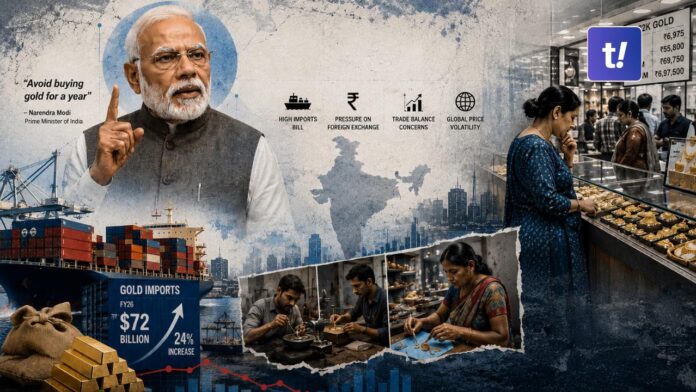

When Prime Minister Narendra Modi recently urged citizens to avoid purchasing gold for a year, the statement immediately unsettled large parts of India’s jewellery trade. Shares of listed jewellery companies reacted sharply, bullion traders began reassessing demand expectations, and retailers across major gold markets started evaluating what even a temporary slowdown in consumer buying could mean for one of the country’s largest employment-generating industries.
The reaction was unusually strong because gold in India functions as far more than a discretionary luxury purchase. Across large parts of the country, jewellery continues operating simultaneously as household savings, wedding expenditure, inherited wealth, emergency financial security, and informal collateral that families can liquidate during periods of medical stress, education expenses, or economic uncertainty. That dual role has historically made gold one of the most difficult commodities for policymakers to manage, particularly during periods when rising imports begin widening pressure on trade balances and foreign exchange outflows.
India remains one of the world’s largest gold-consuming nations while producing very little domestically, forcing the country to depend heavily on imports to meet demand. During periods of geopolitical instability, that dependence quickly becomes economically sensitive because rising bullion prices and rupee weakness directly inflate import costs. The pressure is already visible in trade data. Despite gold demand during FY26 reportedly declining only around 4.76 percent, India’s gold import bill still surged nearly 24 percent to approximately $72 billion because of elevated international prices and currency weakness.
Siddharth Purohit, Fund Manager-Equity at InvestValue Capital Pvt Ltd, said countries heavily dependent on oil and gold imports remain especially exposed during periods of geopolitical disruption because commodity volatility rapidly translates into pressure on import bills and external balances.
“The ongoing Middle East conflict has a cascading effect on economies around the world, but countries with high dependency on oil and gold are seeing a material impact on their import bills,” Purohit said.

For policymakers, however, reducing gold demand is not simply a matter of controlling imports. India’s gems and jewellery sector contributes nearly 7 percent to GDP and supports more than 5 million jobs across refining, manufacturing, logistics, exports, retail, stone cutting, polishing, and artisanal craftsmanship. The country also remains one of the world’s largest jewellery exporters, with annual gems and jewellery exports contributing roughly $30 billion to the broader trade ecosystem.
What makes the industry particularly complex is the scale of its informal and MSME-driven supply chain. Large sections of India’s jewellery trade continue operating through interconnected networks of family-run stores, local wholesalers, karigar workshops, polishers, transporters, packaging vendors, and regional suppliers that depend heavily on wedding and festival demand cycles. In markets such as Surat, Rajkot, Jaipur, Kolkata, Thrissur, and Mumbai, seasonal jewellery demand often sustains local manufacturing activity, workshop wages, and inventory rotation simultaneously.
A slowdown in fresh gold purchases therefore, does not simply affect showroom sales. It slows inventory movement for wholesalers, reduces manufacturing orders for workshops, delays payments across artisan networks, and weakens seasonal liquidity cycles that many smaller jewellery markets depend on during wedding periods. Small and mid-sized jewellers remain particularly exposed because many businesses operate on narrow working-capital cycles where even temporary demand weakness can affect cash flow, manufacturing payments, and labour retention.
That pressure is already becoming visible across several retail markets where rising bullion prices had begun weakening customer sentiment well before the Prime Minister’s remarks entered the broader conversation. According to Parth Soni of Yashoda Jewels, many customers had already started postponing larger purchases as affordability pressures increased earlier this year.
“Footfall has thinned, and customers are postponing big purchases because gold prices had already shot up earlier this year, so sentiment was fragile even before the appeal,” Soni said, adding that any further increase in import duties or landed costs would place additional pressure on margins across the jewellery ecosystem.
The impact is unlikely to be distributed evenly across the industry. Larger organised chains with stronger balance sheets, diversified product portfolios, and greater pricing flexibility may still be able to absorb temporary disruptions more comfortably. Smaller retailers and workshop operators, however, remain far more vulnerable if softer demand persists over a prolonged period because many local businesses lack the inventory depth and financial flexibility available to national chains.
Even so, the current environment is not necessarily translating into a complete collapse in jewellery demand. Instead, buying behaviour itself is beginning to change. Across several urban and semi-urban markets, consumers are gradually shifting toward lighter collections, delayed purchases, exchange-driven buying, and redesign services instead of heavy bullion-led purchases.
That transition had already started emerging across parts of the market over the past two years as elevated bullion prices steadily weakened affordability for middle-income households. Rather than purchasing entirely new sets, many families are increasingly repurposing inherited jewellery, redesigning older collections, or exchanging existing pieces to reduce fresh gold outflows.
For jewellers, that redesign economy is now becoming an increasingly important revenue stream during periods of weaker fresh demand. Tanya Anand, Co-Founder of Paisley Pop Shop, said many households are bringing older family jewellery back into circulation through redesign and customization instead of treating heirloom pieces as dormant locker assets.
“We are seeing a significant trend where families are turning toward the jewellery they already own, repurposing pieces from mothers and grandmothers,” Anand said.
That behavioural shift is also gradually pushing parts of the industry away from a pure bullion-selling model toward more design-led and craftsmanship-oriented offerings where customization, repair work, and artisanal upgrades are becoming increasingly important revenue streams.
“The industry’s sustainability during a slowdown lies in its ability to pivot from selling gold to selling craft and emotion,” Anand added.
Smaller independent jewellers are simultaneously being forced to rethink inventory and retail strategies as customers become more price-conscious and deliberate with spending decisions. Dishi Somani, Founder of Dishis Designer Jewellery, said several retailers are becoming increasingly cautious around fresh inventory exposure while expanding categories capable of sustaining demand at lower price points.
According to Somani, many businesses are now focusing more aggressively on lightweight jewellery, silver collections, anti-tarnish fashion products, exchange programs, remodelling services, and customization work instead of depending entirely on traditional heavy gold purchases. Several retailers are also increasing digital outreach and personalized customer engagement as buying cycles become slower and more selective.
The slowdown is also beginning to affect businesses connected to jewellery supply chains more broadly, including manufacturers, suppliers, packaging vendors, artisans, and regional traders dependent on seasonal demand cycles. Avanish Agarwal, CEO and Managing Partner at Sri Jagdamba Pearls, said many businesses are now responding through tighter inventory planning, more value-driven product positioning, and stronger focus on customer retention as buying behaviour becomes increasingly cautious.
According to Agarwal, several regional and heritage jewellers are also attempting to balance affordability with design-led offerings while investing more aggressively in personalized retail experiences and versatile collections capable of appealing to younger consumers without disconnecting completely from traditional purchasing behaviour.
At the same time, the changing demand environment is accelerating interest in categories increasingly viewed as less dependent on heavy bullion consumption. Silver jewellery, gold-plated collections, pearls, coloured gemstones, moissanite products, and lab-grown diamonds are gradually being positioned as categories capable of sustaining festive and wedding demand without carrying the same import intensity as traditional heavy gold purchases.
Aarav Bafna, Director at Akoirah by Augmont, said the current environment is accelerating shifts that had already started emerging across parts of the jewellery market, particularly among younger consumers increasingly gravitating toward lighter, design-led collections and products positioned around accessibility, sustainability, and everyday wear rather than purely bullion-linked value.
According to Bafna, recycled gold jewellery, lab-grown diamonds, and lower-karat lightweight collections are increasingly attracting urban consumers looking for affordability, versatility, and contemporary aesthetics alongside traditional jewellery ownership.
The broader policy discussion is also beginning to move beyond consumption alone toward questions around how India could gradually reduce import dependency without disrupting the larger economic ecosystem built around jewellery demand. Saransh Kothari, CEO of Prismara and a fifth-generation representative of the KGK Group, believes policymakers should focus less on suppressing jewellery demand entirely and more on redirecting consumption toward lower-import categories.
Kothari argued that incentivising lower-purity formats such as 9Kt jewellery could significantly reduce import intensity while still preserving purchasing behaviour around weddings and gifting. He also pointed toward lab-grown diamonds as a category India could strategically expand because of the country’s growing domestic manufacturing base, particularly in Surat, which has already emerged as one of the world’s largest centres for lab-grown diamond production.
For several industry participants, the larger economic concern also lies in the distinction between productive jewellery consumption and passive bullion accumulation. Dr. C. Vinod Hayagriv, Managing Director at C. Krishniah Chetty Group, argued that large quantities of imported bullion ultimately remain locked away as idle investment instead of circulating through productive economic channels.
“India imports nearly 800 tons of gold annually, and industry estimates suggest that close to 200 tons is being locked away every year in the form of raw bullion purchased by individuals as passive investments,” Hayagriv said.
According to Hayagriv, such accumulation places sustained pressure on foreign exchange reserves without generating equivalent value through manufacturing, exports, or organised economic activity.
Industry bodies are now attempting to balance those macroeconomic concerns with the realities of employment and business continuity across the sector. Kirit Bhansali, Chairman of Gem & Jewellery Export Promotion Council, said the industry understands the broader economic reasoning behind the Prime Minister’s appeal while continuing consultations with stakeholders across the ecosystem.
“The gem and jewellery industry fully understands the reason and respects the appeal made by Hon’ble Prime Minister Shri Narendra Modi in view of the current global situation and the larger national interest,” Bhansali said.
Outside industry circles, the broader conversation is also beginning to influence household spending behaviour more generally. Mitali Ahuja, a working professional based in Bengaluru, believes the current environment may push families toward more cautious and financially disciplined spending decisions during a period of prolonged global uncertainty.
“In uncertain global situations, the first instinct is often fear-driven spending or panic investing, but this is actually the time to become more measured and practical with money decisions,” Ahuja said.
Whether Indian consumers meaningfully reduce gold purchases over a prolonged period, however, remains uncertain. Historical demand patterns suggest that while buying behaviour may temporarily shift toward lighter products, redesign services, or alternative categories, India’s long-standing relationship with gold has repeatedly survived periods of elevated prices, policy restrictions, and economic disruption alike.
That is what makes the current debate particularly complicated for policymakers. Reducing dependence on imported bullion may help ease external economic pressure during volatile periods, but it could simultaneously slow activity across a labour-intensive ecosystem supporting millions of workers, artisans, retailers, exporters, and small businesses whose livelihoods remain closely tied to jewellery consumption.


