


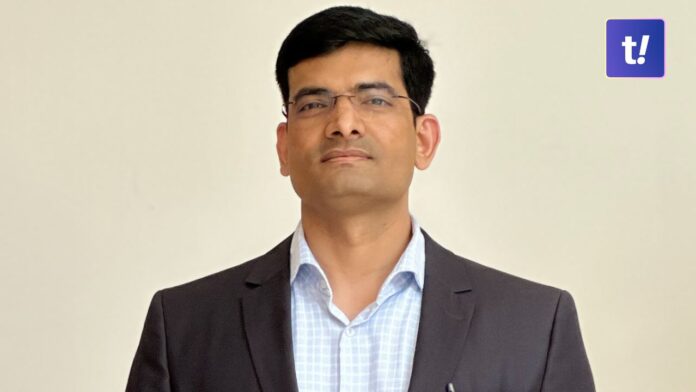

Speaking with TechGraph, Shiv Kumar Borade, Founder & CMD of Borade.AI, discussed how many growing businesses continue to struggle with disconnected software tools that add operational complexity instead of simplifying day-to-day growth, and explained how Borade.AI was built as a centralized platform that brings analytics, lead generation, social media management, and execution workflows into a single dashboard.
Borade also spoke about how the platform combines AI-driven market analysis, competitor tracking, and business intelligence with built-in execution capabilities that turn recommendations into ready-to-publish actions, while following a “co-pilot” approach where AI handles research, automation, and drafting, and business owners remain in control of strategy, brand identity, and final decision-making.
Read the interview in detail:
TechGraph: Many businesses today already use a mix of analytics tools, marketing platforms, and automation software, yet decision-making often remains fragmented. What gap did you identify that led to the creation of Borade.AI as a unified system rather than another layer of tools?
Shiv Kumar Borade: If we talk to small business owners, the first thing they’ll say isn’t that they lack ideas, it’s that they are exhausted by the noise of their technology. They log into five different dashboards to launch one campaign. They use separate email tools, social managers, lead trackers, and endless spreadsheets to connect them. Technology was promised as a growth catalyst, but it has become a massive tax on their time. They aren’t just business owners anymore; they’re playing ‘systems integrator,’ stitching together disconnected tools.
That was the gap we identified. The market is saturated with vendors selling parts, a widget here, a scheduler there, but nobody was offering the whole house. Business owners shouldn’t need a technical team just to manage their digital presence.
We built Borade.AI differently. We didn’t want to be just another login to manage; we built the Operating System for the business. By unifying lead generation, social media, and analytics into a single dashboard, we enable owners to stop managing software and start managing their growth. We aren’t here to add to their to-do list; we are here to give them their time back and simplify their path to scale.
TechGraph: The idea of generating a full growth strategy from just a website URL sounds compelling, but it also raises questions around depth and accuracy. How does Borade.AI ensure that what it produces goes beyond generic output and becomes something a business can genuinely act on?
Shiv Kumar Borade: Generic advice is useless for a growing business, so when you provide your URL, we don’t just read the text. Our engine analyzes your digital footprint to gain a deep understanding of your brand reach. We examine your products, services, and current offerings to identify exactly who your ideal customers are and what your focus should be.
Beyond that, the engine looks outward, scanning current industry trends to map out competitor activity. This identifies the growth gaps and opportunities you might be missing right now.
We aren’t just summarizing what you already know; we are collecting precise data to find the right space for your brand. By understanding your business context deeply, we can suggest paths that are specific to your goals. Our goal is to help you stand out from your competitors in a way that feels clear, natural, and entirely aligned with your business identity.
TechGraph: Analysing competitors, customer behaviour, and market trends is not new, but translating that into clear execution is where most tools fall short. How does Borade.AI move from insights to an actionable strategy that businesses can realistically implement?
Shiv Kumar Borade: Most business tools act like a textbook; they provide information, but they leave you to figure out how to use it. At Borade.AI, we are engineered to bridge the gap between ‘knowing’ and ‘doing.’ We don’t stop at insights; we turn them into finished work.
When our engine identifies a market opportunity, it doesn’t just present a report; it instantly converts that data into a concrete task. And because we want to remove every bottleneck, we’ve integrated social media management directly into the platform. You don’t just get a strategy,you get the keys to execute it.
You can review the AI-generated content and schedule it across all your social platforms without ever leaving our dashboard. We remove the ‘thinking phase’ that usually causes delays. You aren’t left wondering what to do with the information; you’re handed a finished plan that’s ready to publish.
TechGraph: AI-generated content and automated decision support are becoming widely accessible, yet concerns around quality and reliability remain. How are you ensuring that what Borade.AI produces is dependable enough for real business use?
Shiv Kumar Borade: Reliability is the foundation of our platform. AI can generate vast amounts of content, but in a real business context, utility matters more than volume. Our focus was never just blind automation; it is about ensuring that every output makes sense for the specific business it serves.
Borade.AI does not work in a vacuum. It relies on real inputs, including your business context, market trends, and your own historical data, ensuring that recommendations are relevant rather than generic.
Over time, the platform gets even better because it learns from your feedback, becoming more accurate with every cycle. We treat the AI as a sophisticated support tool; it handles the heavy lifting of research and drafting, but your strategic oversight remains the foundation of everything we do.
TechGraph: Many small and mid-sized businesses are still not deeply data-driven, either due to limited expertise or bandwidth. How are you designing Borade.AI to simplify complexity without oversimplifying the decisions that businesses need to make?
Shiv Kumar Borade: Small business owners are often overwhelmed by data because they lack the bandwidth to interpret it. The risk of oversimplification is that you hide vital information, but we solve this by reducing the effort, not the thinking.
In most businesses, the struggle isn’t making the decision; it’s the time and effort spent parsing reports to feel confident. We handle that heavy lifting in the background. We filter what actually matters and present it in a way that is clear and understandable, without dumbing down the strategy.
At the same time, we do not take control away from you. You can always see what is being suggested and why, and you can change it if needed. Think of it like using a GPS; it helps you find the best route and saves you time, but you are still the one making the final call. That balance between ease and agency is vital to us.
TechGraph: As businesses begin relying more on AI-led systems for growth and revenue planning, questions around dependency and control naturally emerge. How do you see the balance between automation and human decision-making evolving on your platform?
Shiv Kumar Borade: We don’t see AI as a replacement for human judgment, but as a smart partner. The most successful businesses are those where human gut feeling, the ‘heart’ of the brand, is boosted by clear data.
In our system, the AI handles the pattern spotting, checks the trends, and does the hard research, but it never makes the final call.
We’ve built a ‘co-pilot’ model. The AI makes the plan and writes the drafts, but you keep your hands on the steering wheel. This isn’t just about safety, it’s about keeping your brand’s true spirit. A computer can chase clicks, but only you know your brand’s voice and long-term goals. We are building a partnership where the AI brings the speed, and the human brings the wisdom.
TechGraph: The space is getting increasingly crowded, with new AI tools launching almost every week. Where do you see BoradeAI positioning itself as businesses move from experimentation to expecting consistent, measurable outcomes from AI?
Shiv Kumar Borade: Most AI tools are built just to generate ideas; they’re helpful for brainstorming, but they don’t drive real business growth.
We are positioning Borade.AI as a dedicated ‘Growth Engine.’ We aren’t here to offer another chat interface or a brainstorming tool.
We are here to offer a structured, repeatable system for results. Where others offer suggestions, we offer action. Where others provide reports, we provide tasks. Our focus is entirely on measurable outcomes, moving the needle on customer acquisition, retention, and scaling.
In a market full of tools that help you ‘think’ about your business, we are the one that helps you ‘build’ it. We are the system for founders who are ready to stop experimenting and start executing.