


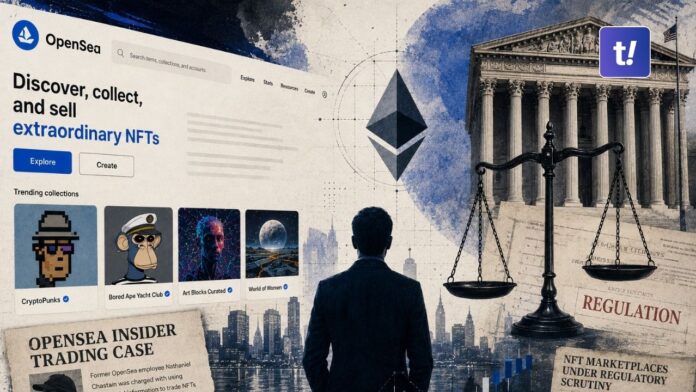

When federal prosecutors charged former OpenSea employee Nathaniel Chastain in June 2022, the case was widely described as the first major insider trading prosecution involving NFTs. The allegations emerged during the peak of the Ethereum NFT boom, when digital collectibles had rapidly evolved from niche blockchain experiments into one of the most commercially active and speculative segments of the crypto market.
The U.S. Department of Justice alleged that Chastain, then a product manager at OpenSea, used confidential information about which NFT collections would be featured on the marketplace’s homepage, purchased those assets in advance through anonymous wallets, and later sold them after the featured placements increased visibility and trading activity.
During that period, homepage positioning on OpenSea carried enormous market influence. Collections highlighted on the platform often experienced immediate increases in floor prices, trading volume, and investor attention as speculative capital poured into Ethereum-based NFTs.
What initially appeared to be a narrowly focused case involving one employee and one marketplace soon evolved into a much broader legal and regulatory discussion. Regulators viewed the prosecution as an opportunity to test how traditional fraud and market abuse laws could be applied to blockchain-based marketplaces, while much of the crypto industry saw it as an early indication of how aggressively authorities might attempt to extend legacy insider trading interpretations into digital asset markets.
In May 2023, a federal jury in New York convicted Chastain on wire fraud and money laundering charges. He was later sentenced to three months in prison, fined $50,000, and ordered to forfeit the Ethereum linked to the trades. At the time, the conviction reinforced concerns across parts of the crypto industry that enforcement agencies were prepared to pursue cases even in areas where the legal treatment of NFTs and blockchain assets remained unsettled.
However, the legal foundation of the prosecution began to weaken in 2025 when the U.S. Court of Appeals for the Second Circuit vacated Chastain’s conviction in a 2-1 split ruling. The appeals court concluded that the jury instructions used during the original trial were flawed and questioned whether the information involved in the case could even qualify as “property” under federal wire fraud statutes. Prosecutors had argued that OpenSea’s homepage selection data constituted confidential business property, but the court indicated that the information did not clearly possess the kind of independent commercial value traditionally associated with property under existing fraud law.
The ruling did not bar future enforcement involving crypto marketplaces or insiders but set an important limitation on old fraud statutes’ application in blockchain. This highlighted the ongoing need for clearer legal definitions or regulatory guidance, making the closure of the case a pivotal moment in NFT-related legal precedent.
While the OpenSea matter centered around NFTs, the questions it raised have expanded far beyond digital collectibles alone. Over the past several years, regulators globally have intensified scrutiny around token listing disclosures, employee trading activity, treasury movements, market manipulation allegations, and governance practices across the broader crypto industry. Authorities in the United States, Europe, Asia, and the Middle East have increasingly examined how exchanges, trading platforms, and digital asset firms handle non-public information capable of influencing investor behaviour and market prices.
Some of the most prominent investigations have involved advanced knowledge of token listings on centralized exchanges, employee trading activity tied to market-moving announcements, and allegations of front-running across crypto markets. Former Coinbase product manager Ishan Wahi pleaded guilty in 2023 to charges linked to using confidential token listing information before public announcements were made, while several exchanges globally have faced scrutiny around disclosure standards, listing transparency, and operational controls during periods of heightened volatility.
At the same time, governments have accelerated efforts to establish more formal oversight systems for crypto businesses. The European Union introduced the Markets in Crypto-Assets framework, while jurisdictions such as Singapore, Hong Kong, and the UAE have developed licensing structures and compliance standards for exchanges and digital asset service providers. In the United States, disagreements between regulators over whether certain crypto assets should be treated as securities, commodities, or alternative financial instruments have continued, creating uncertainty for companies operating in the sector.
Against that backdrop, the OpenSea matter has increasingly been viewed as one of the earliest major legal tests for how market conduct rules may apply inside blockchain-based ecosystems. The case highlighted the difficulty regulators and courts face when attempting to interpret trading behaviour, platform activity, and non-public information within markets that do not always fit neatly inside traditional financial definitions.
Ashish Singhal, Co-founder of CoinSwitch, said the significance of the ruling extends beyond NFTs because it reflects a much wider challenge regulators and courts are now confronting across the crypto industry. According to Singhal, the case highlights the difficulties involved in applying legacy financial statutes to digital asset markets where ownership structures, token classifications, and platform dynamics continue evolving faster than legal systems themselves.
“Regulators and courts across jurisdictions are navigating a foundational question right now, and the OpenSea case is very much part of that conversation,” Singhal said. “Specifically, how existing legal frameworks extend to digital asset ecosystems like NFTs and Web3.”
Singhal noted that while the appeals court ruling focused on technical interpretations surrounding wire fraud law, broader questions around how digital assets should ultimately be governed remain unresolved globally. Different jurisdictions continue adopting different approaches toward cryptocurrencies, tokenised assets, and blockchain-based financial products, leaving platforms and investors operating within fragmented oversight environments.
“The ruling does bring some clarity, specifically around the boundaries of how existing laws can be applied in digital asset cases,” he said. “The larger questions, particularly around how NFTs and similar assets should be classified, are still being worked through.”
Those debates are becoming more important as crypto markets move beyond speculative trading into areas involving stablecoins, tokenised financial products, institutional participation, and cross-border settlement infrastructure. While blockchain technology continues to advance rapidly, policymakers globally are still attempting to determine how these products fit within existing financial and legal systems.
For India, those discussions carry additional significance because the country remains one of the world’s largest crypto markets despite lacking a comprehensive policy structure governing cryptocurrencies, stablecoins, tokenised assets, and blockchain-based investment products.
Industry executives argue that while policy discussions continue, Indian crypto platforms have already moved beyond purely speculative trading models and are increasingly building products tied to long-term investing behaviour, diversified digital asset exposure, cross-border settlement infrastructure, and tokenisation.
Edul Patel, Founder and CEO of Mudrex, said Indian crypto companies are operating in an environment where platforms face substantial compliance obligations despite the absence of a comprehensive policy structure governing cryptocurrencies, stablecoins, and tokenised financial products.
According to Patel, one of the biggest shifts inside India’s crypto market has been the emergence of disciplined SIP-style investing behaviour, where users increasingly approach digital assets as portfolio diversification tools rather than purely speculative bets. He noted that many investors are now gravitating toward products resembling index-based investment structures, including diversified crypto baskets, passive exposure models, and periodic portfolio rebalancing mechanisms.
“India remains one of the few significant economies without a comprehensive crypto and stablecoin policy framework despite leading the world in crypto adoption for the third consecutive year with nearly 120 million crypto users in 2025,” Patel said. “The most underappreciated development in Indian crypto is the emergence of the disciplined SIP investor. India’s SIP culture, built over decades through equity markets, has found a new expression in digital assets.”
Patel added that Indian platforms are already operating under extensive compliance obligations involving KYC systems, AML and CFT transaction monitoring, FIU-IND registration requirements, and tax reporting mandates, even as several categories of blockchain-based financial products continue functioning without clearly defined legal treatment. He argued that many companies are effectively carrying the operational burden of regulation without receiving the legal certainty typically associated with regulated industries.
“What is often missed in this conversation is that Indian crypto platforms are making significant investments in compliance,” Patel said. “Indian platforms are paying the full cost of operating in a regulated environment without receiving the benefits of one.”
The discussion has also expanded beyond trading activity alone. Stablecoin infrastructure, cross-border remittance systems, and real-world asset tokenisation are increasingly becoming central to conversations around how blockchain technology may eventually integrate into broader financial infrastructure. India’s remittance economy, which exceeds $135 billion annually, is frequently cited by industry participants exploring blockchain-based settlement systems designed to reduce delays, intermediary costs, and foreign exchange inefficiencies associated with traditional international payment networks.
Patel said companies building stablecoin-based payment infrastructure and tokenised investment products in India are effectively operating ahead of legal definitions that still remain unresolved. He also pointed to the growing development of tokenised real-world assets involving real estate, commodities, infrastructure-linked products, and fractional ownership systems that could potentially widen retail participation in asset classes historically dominated by institutional or high-net-worth investors.
“Platforms building cross-border payment infrastructure for India are doing so without knowing whether the instruments they are building on will be classified as payment instruments, securities, or something else entirely,” Patel said. “Indian crypto platforms are building such tokenised products today that will collide with regulatory definitions that have not been written yet.”
The broader conversation around governance standards inside crypto companies has also evolved considerably since the speculative excesses that defined the 2021 and 2022 market cycle. Exchanges, NFT marketplaces, and digital asset firms increasingly face pressure from investors, institutions, and regulators to implement internal controls resembling those expected in traditional financial markets.
Singhal said the OpenSea matter demonstrates why governance and operational transparency can no longer be treated as secondary concerns for platforms operating in digital asset markets.
“Conflict of interest policies, internal reporting mechanisms, monitoring systems, and compliance frameworks go beyond meeting regulatory requirements,” Singhal said. “They are central to building the kind of user trust that platforms in this space will need for long-term credibility.”
The OpenSea case also highlighted how blockchain transparency differs from traditional financial systems, where trading activity is often fragmented across institutions and private networks. Because blockchain transactions remain publicly traceable on-chain, analysts and researchers are often able to identify suspicious wallet activity and trading patterns in real time.
For many across the industry, the OpenSea case is now viewed less as a narrow NFT insider trading dispute and more as one of the earliest legal stress tests for how market conduct rules may ultimately evolve across crypto markets more broadly. As crypto increasingly moves toward areas involving payments infrastructure, tokenisation, digital ownership, and institutional finance, regulators globally are facing growing pressure to define oversight models that can keep pace with technologies evolving far faster than existing legal frameworks.