


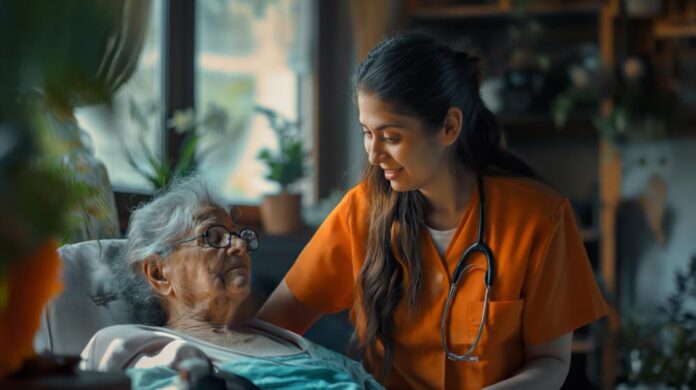

The Indian health care industry has seen considerable transformation in recent times, primarily due to changes in patient demand and an increasing need for convenient and cost-effective health care. India is a country where high-quality health care facilities were available only in urban areas, and people had to endure hardships such as traveling great distances to access health care facilities. The concept of health care at home has revolutionized the health care industry in India.
Home-based healthcare operates under its main principle that the patient should receive all care before hospitals. Patients can now receive professional medical treatment at their homes, which eliminates their need to navigate complex healthcare systems.
This approach provides exceptional benefits to elderly and postoperative patients and individuals with chronic medical conditions who require ongoing treatment. Staying in a familiar environment creates mental relief that accelerates your recovery process and improves your overall health. The model provides its main advantage through its ability to reach out to disadvantaged population groups. In tier-2 and tier-3 cities, the availability of specialized healthcare services is very limited.
However, through home-based care, people can avail themselves of such services as doctor consultations, nursing care, physiotherapy, and tests without having to make the journey to a specific destination. This decentralization of healthcare services has made them more accessible to patients regardless of their location.
Also, due to the increasing number of non-communicable diseases like diabetes and high blood pressure, among others, home health care has become common because such conditions need continuous treatment. Through home health care, one is able to monitor the patient all the way, administer the proper drugs, and help them to adopt healthy lifestyle practices. The rising elderly population in India serves as a major element that drives this particular development. Many families currently require high-quality, compassionate elder care services.
With home healthcare, patients get professional attention from doctors in the convenience of their homes. Thus, they enjoy the benefits of living independently and still receive quality care and safety from any risks of accidents.
The use of digital technologies can be regarded as one of the most significant features of home healthcare development. A patient is able to make an appointment, examine his or her records, consult a physician remotely, and use any other equipment for solving problems associated with health issues. In this way, a high level of efficiency, access, and quality of services are achieved.
Additionally, home healthcare appears to be cheaper than the one provided by a hospital. The treatment in hospitals is rather expensive since patients should pay for each day spent there. In turn, home healthcare services can offer affordable quality care services.
Moving forward, it is clear that home healthcare will become an indispensable part of the healthcare system of India. Combining all three elements of convenience, compassion, and technology, home healthcare is able to fill in the gaps in access to quality care.