


EV Sector Call for 5% GST, ITC Reforms, and Enhanced PLI in Budget 2025

Date:

Trending

- Advertisement -

As the date for the Union Budget 2025 draws near, the electric vehicle (EV) industry has outlined specific expectations that aim to accelerate growth and bolster domestic manufacturing. Industry leaders are particularly advocating for a uniform 5% GST across EVs, their components, and the associated charging infrastructure to simplify the tax system and drive down costs.

Another priority is the overhaul of the input tax credit (ITC) refund process, which could provide critical liquidity for startups. In addition, increased government support for public-private partnerships and adjustments to the Production-Linked Incentive (PLI) scheme are seen as crucial steps to enhance the sector’s competitiveness and innovation.

Read the union budget 2025 expectations in detail from Electric Vehicles & E-bike industry leaders:

Dinkar Agrawal, Founder, CTO & COO, Oben Electric

The Union Budget 2025 is a critical opportunity to address key challenges in India’s EV transition. To achieve the ambitious target of 30% EV penetration by 2030, it’s crucial to tackle both manufacturing and consumer-centric challenges.

Simplifying the GST structure with a uniform 5% tax across EVs, components, and charging infrastructure is essential to reducing costs and fostering growth. Additionally, resolving the inverted GST structure on raw materials will ease working capital pressures and encourage sustainable manufacturing.

Performance-linked incentives for battery innovation and indigenous component manufacturing can further strengthen India’s Make-in-India push, positioning the country as a global leader in EV technology. On the consumer front, initiatives like reduced interest rates on EV loans and targeted subsidies can make electric vehicles more accessible, bridging the affordability gap.

- Advertisement -

Nilesh Bajaj, Co-Founder & CEO, Vayve Mobility
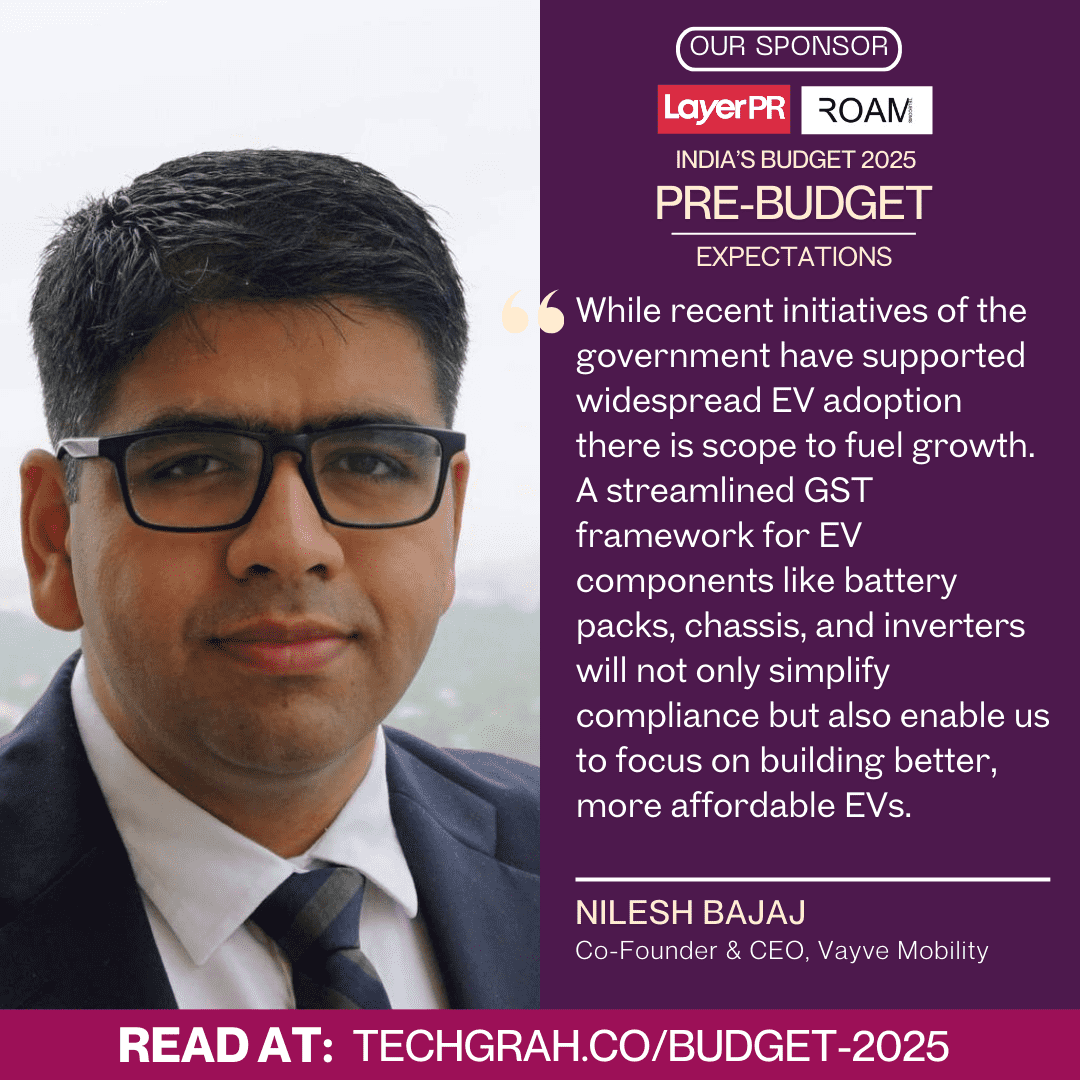
The Union Budget 2025 presents a significant opportunity to accelerate India’s transition to sustainable urban mobility. While recent initiatives of the government have supported widespread EV adoption there is scope to fuel growth. A streamlined GST framework for EV components like battery packs, chassis, and inverters will not only simplify compliance but also enable us to focus on building better, more affordable EVs.

The inverted duty structure, where key inputs like lithium-ion batteries attract higher GST than the EV itself, impacts cash flow and increases production costs. Simplifying the refund process for input tax credits (ITC), including capital goods, would provide much-needed working capital support for early-stage startups. Increased budget allocation for public-private partnerships in the EV space would foster consumer confidence in adopting EVs.

Enhanced PLI Schemes by leasing domestic value addition (DVA) requirements and ensuring faster disbursements can boost local EV manufacturing and scale innovative solutions. A clear roadmap outlining the future of these incentives would help consumers plan their purchases confidently and allow OEMs to align their production strategies with policy timelines.

At Vayve Mobility, we’re passionate about redefining personal mobility for Indian cities. With the right support from the Union Budget, we believe we can lead the way in making electric mobility more efficient, accessible, and sustainable for all.

- Advertisement -

Kunal Arya, Co-Founder & Managing Director, ZELIO E Mobility Ltd.

As India’s electric mobility sector gears up for an era of unprecedented growth, the Union Budget 2025-26 will play a critical role in shaping its trajectory. To ensure a sustainable future, we at ZELIO E Mobility believe that the government must introduce long-term subsidies akin to the FAME scheme, which will not only support the industry’s expansion but also encourage widespread consumer adoption of electric vehicles.

Consistent policy backing will give manufacturers the confidence to invest in innovative solutions and scale production. We also urge the government to provide subsidies for the establishment of EV manufacturing plants. Facilitating this capital-intensive infrastructure will enable India to emerge as a global leader in EV production, stimulating local economies and fostering technological advancements.

Simplifying access to financial services from banking institutions is another vital need of the industry. More accessible lending schemes and flexible credit options will allow EV manufacturers to expand their operations and bring high-quality products to market at a faster pace. Notably, we request a reduction in GST on spare parts from the current 28% to a more realistic range of 5-12%. This adjustment will substantially reduce production costs, allowing manufacturers to pass on the benefits to consumers, thereby further accelerating the adoption of electric vehicles.

Karam S Dhillon, Founder, Perpetuity Capital

As we approach the upcoming budget, it’s crucial to recognize the pivotal role that subsidies on electric vehicles (EVs) have played in accelerating the transition to a sustainable future.

Reducing these subsidies now could undermine the momentum the EV sector has built and disrupt the progress we’ve made toward cleaner transportation. Continued financial support for at least another year is essential to ensure that consumers remain incentivized to make the switch to EVs.

Without these incentives, many will likely revert to cheaper, traditional petrol or diesel vehicles, hindering our collective efforts to reduce carbon emissions and achieve long-term sustainability goals.

THE SNAPSHOTS

Sign up to get quick snaps of everyday happening, directly in your inbox.

We don’t spam! Read our privacy policy for more info.

- Advertisement -
Krishna Mali
Krishna Mali
Founder & Group Editor of TechGraph.

More Latest Stories

More Articles

How Air Can Become Urban India’s New Water Source

India's cities are running dry. Chennai nearly ran out of groundwater in 2019. Bengaluru's lakes are shrinking. Delhi's borewells are drawing from depths unimaginable...

The Human Algorithm: Why the Future of Digital Marketing Belongs to Empathetic Strategists

The modern marketing department is quieter than it used to be. The frantic tapping of copywriters racing against deadlines and the loud debates of creative directors have largely been replaced by the hum of servers processing natural language. Today, an enterprise can generate ten...

How AI is Rewriting the Economics of India’s $300 Bn IT Services Sector

When Microsoft CEO Satya Nadella recently disclosed that artificial intelligence now generates nearly 30...

Bounce House Rental vs Inflatable Slides: Which Option Delivers More Excitement?

Planning a family gathering or a children's party often involves finding the perfect entertainment...

How Hiring a Qualified Plumber Solves Major Household Issues

For many homeowners, maintaining a functional and safe home is a top priority. Plumbing...

Why India Must Own Its Education Intelligence Stack

India has rapidly digitised large parts of its education ecosystem over the last decade....

Why Micro Learning at 3 Minutes Works Better Than Lectures at 3 Hours

In the fast-moving world of digital education, there is one myth that continues to...

More Than Just a Scratch: The Importance of Windshield Care

Maintaining your vehicle’s windshield often appears as a seemingly minor task that can easily...

How Choosing A Licensed Plumber Ensures Quality Repairs

When it comes to maintaining a safe and comfortable home, the quality of plumbing repairs can significantly impact your daily life. From leaky faucets...

The world’s largest crypto market is building in the dark

India remains one of the few significant economies without a comprehensive crypto and stablecoin...

How Location Data Storage Technology is Making City Travel Smoother

India’s mobility ecosystem is undergoing a quiet but powerful transformation, driven not just by...

India Is Building Cities Without Building the Systems That Make Them Work

India is in the middle of the largest urban expansion in its history. By 2050,...

Why Cyber Resilience Is Replacing Cybersecurity as a Boardroom Priority

Traditionally, cybersecurity was hard-wired to be a technology concern that was only taken care...

Infrastructure 4.0: How AI & Predictive Analytics Are Transforming Real Estate

The new era of technology and innovation has changed operations in many industries. The integration of artificial intelligence in different industries is making processes...

The Rise of Integrated Solar Tech Ecosystems in India

India’s clean energy is all about building an ecosystem that is interconnected with various elements and goes beyond just installing solar panels at scale. Renewable energy generation, storage, digital intelligence, manufacturing, financing, and grid infrastructure work together within the said ecosystem in a coordinated...

Beyond Nvidia: The Hidden Winners of the AI Stock Rally

Nvidia stock (NASDAQ:NVDA) has returned roughly 1,200% since ChatGPT launched in late 2022. Most...

What PM Modi’s Appeal to Avoid Gold Buying Could Mean for India’s Jewellery Economy

When Prime Minister Narendra Modi recently urged citizens to avoid purchasing gold for a...

How Agentic AI Is Personalising the End to End Salon Experience

Walk into a salon today, and more often than not, the experience still depends...

From Black Box to Trusted AI: Why Defence Needs Constitutional AI Models

For decades, the defence and intelligence agencies have followed one non-negotiable rule: trust nothing...

Apple Reports $111.18 Billion Revenue in Q2 FY26, Net Profit Rises to $29.6 Bn

Apple Inc. (NASDAQ:APPL) has reported its financial results for the quarter ended March 28,...

Hermès vs MetaBirkin: The NFT Case That Redefined Ownership on Ethereum

The NFT boom of 2021 and early 2022 pushed digital assets into the mainstream,...

Bihar Police, Vehant Technologies Partners to Deploy Screening Systems Across 40 Courts

In a bid to enhance safety and security across court premises for judges, lawyers,...

Rethinking Hospital Security: TrioTree Technologies CEO Surjeet Thakur on Securing Fragmented Hospital IT Environments

In an interaction with TechGraph, Surjeet Thakur, Founder and CEO of TrioTree Technologies, outlined...

What the Next Phase of Growth Looks Like for Indian and Global E-commerce Players

For close to a decade, metrics for evaluating the growth of e-commerce included customer...

India Is Building Cities Without Building the Systems That Make Them Work

India is in the middle of the largest urban expansion in its history. By 2050,...

“Budget should focus on reducing taxes on capital gains,” Says Abhishek Gupta of Hex N Bit

Speaking in the upcoming Union Budget 2021, Abhishek Gupta, Founder, and CEO, Hex N...

“China is a Global thief” Rep. Tom Rice on Uyghur Forced Labor Prevention Act

Speaking at the House on Uyghur Forced Labor Prevention Act, Rep. Tom Rice (R-SC)...

Borade AI Founder Shiv Kumar Borade on Building an AI Growth Engine for Small Businesses

Speaking with TechGraph, Shiv Kumar Borade, Founder & CMD of Borade.AI, discussed how many...

When AI-Generated Documentation Hurts More Than Helps

AI-generated documentation has quickly become a selling point for modern SaaS and developer platforms,...

Why Cyber Resilience Is Replacing Cybersecurity as a Boardroom Priority

Traditionally, cybersecurity was hard-wired to be a technology concern that was only taken care...

Alphabet Discloses $2.14 Billion in Public Equity Holdings as of June 30

Alphabet Inc. disclosed $2.14 billion in equity securities held across 39 positions as of...

Gaming for Good: Boosting the Indian Gaming Community through Technology

The Indian gaming industry is transforming remarkably, driven by technological advancement and a growing...

India to generate $100 bn from telephonic investments

India expects to attract $100 billion in investments in the telecom sector, a union...