

India must Adopt Zero-emissions Technology to Mitigate Methane Emanating from Transport Sector

Date:

Before Article Content · 728×90
Advertise Here

Trending

- Advertisement -

Even as CNG is gaining popularity and becoming the most preferred automobile fuels in India, primarily because of its low cost, and high calorific value, it is a concern due to its contribution to global warming and atmospheric pollution. Experts, therefore, have suggested faster adoption of zero-emissions technology to mitigate transport methane emissions.

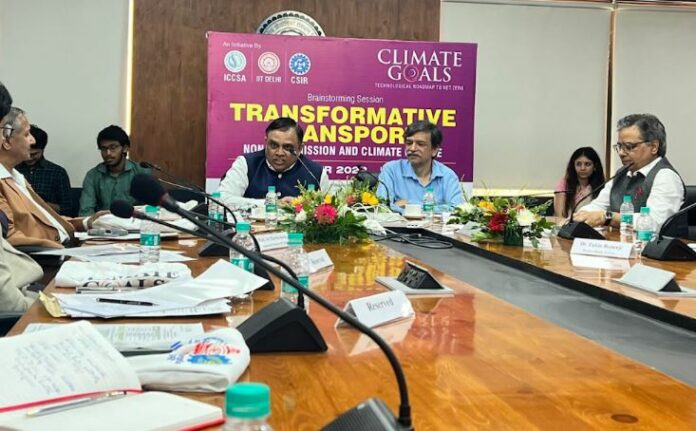
Dr J S Sharma Head ICCSA, Prof. T.G Sitharam Chairman, AICTE, Prof. Rangan Banerjee, Director IIT Delhi, Dr Rakesh Kumar Officer on Special Duty CSIR

Currently, Indias CNG penetration in the transport sector is about 10 percent to 12 percent. It should start shifting more towards 20-25 percent by 2030, CNG passenger vehicle sales in the just-ended FY2023 increased by 40.71% compared to FY2022, accounting for 8.80% of the overall retail sales of 36,20,039 PVs.

“While CNG usage surge is expected to continue to grow in the transport sector, there are some challenges to be overcome, including leakage of methane. It contains 80 to 90 percent methane. Methane emissions from CNG-operated vehicles have become a growing concern due to their contribution to atmospheric pollution. CNG vehicles emit a significant amount of CH4 as a slip and CO and HCHO gases due to partial oxidation,” Dr J S Sharma Head of International Center for Climate and Sustainability Action Foundation (ICCSA) said.

Prof. T.G Sitharam Chairman of AICTE, said, “Developing Indias transportation sector is the backbone of its economic development, contributing significantly to GDP growth but emissions from the Transport sector are unavoidable and pose a significant challenge to Indias sustainability goals at the workshop Transformative Transport Non-CO Emissions and Climate Change,” jointly organised by ICCSA, IIT Delhi and Council for Scientific and Industrial Research.

- Advertisement -

Prof. Sitharam said that AICTE will look to inculcate greater training amongst the students on various environmental issues and said that greater emphasis should be given to hands-on learning and internships in this domain.

Dr Rakesh Kumar Officer on Special Duty at Council for Scientific and Industrial Research (CSIR) said, “Research and development for sustainable transportation alternatives, such as multi-modal transport and hydrogen-powered vehicles, can reduce methane emissions from the global transportation sector.”

The surge in CNG vehicle sales in India reflects a growing preference for cleaner and more sustainable transportation options despite higher methane emissions. This trend reflects a shift towards reducing carbon footprints and promoting environmental conservation in the automotive industry.

Prof. B. Sengupta, former member secretary, CPCB said, “Fugitive methane emissions from CNG vehicles and stations are a major environmental concern due to methanes impact, and strict technological measures can reduce it.”

- Advertisement -

Prof. Sengupta emphasized the need for regular audits of CNG stations to identify and address fugitive emissions. He also said that conventional kitchen burners previously used for LPG when used for PNG led to 25% CH4 leakage into atmosphere. Governments should educate the public regarding the need to change of these old burners.

Dr RR Sonde, Professor of the Department of Chemical Engineering IITD said that Zero Leakage design and monitoring system are necessary to control transport emissions and ensure environmental sustainability. These systems play a crucial role in reducing the release of harmful pollutants into the atmosphere. Implementing zero leakage design and monitoring systems can also contribute to meeting regulatory standards and improving overall air quality.

Reduction of Methane emissions is the most cost-effective method to fight global warming by switching the global transport sector to zero emissions technologies. This has the potential to reduce the impact of climate change. Developing these technologies can also help to reduce air pollution in cities. Moreover, they could create many job opportunities in the renewable energy sector.

Avinash Kumar Agarwal, Professor, Dept of Mechanical Engineering, IIT Kanpur said that well maintained CNG cars were much better from an environmental footprint point as compared to EVs and tailpipe emissions from the properly maintained cars were overall much cleaner than the ambient air. But this statement was with riders as the poorly maintained CNG cars were an entirely different story and can be much more detrimental to the environment due to leakages.

Prof. Rangan Banerjee, Director of IIT Delhi, Shri Rajesh Gupta, Director at NITI Aayog, Mr. Alok Kumar, GM (T) of NHAI, representatives of various pollution control boards and other experts from the scientific institutes such as NEERI, CRRI, NPL, NITs were part of the brainstorming session on transformative transport non-CO2 emissions and climate change at IIT Delhi.

To mitigate methane emissions, the automobile industry must develop advanced zero-leakage designs and monitoring systems, which are critical to fuel efficiency, vehicle safety, and environmental protection, said Dr J S Sharma.

It’s crucial to ensure that CNG vehicles meet strict emission standards, Moreover, it is important to ensure that CNG stations are properly regulated and maintained to reduce fugitive emissions. This becomes more important when we realize that more than 5500 CNG filling stations are there in the country with more than 500 existing in NCR alone.

A pledge was made during a brainstorming session on transport emissions to formulate policy and a roadmap for methane mitigation using available technologies and also developing new technologies to capture fugitive methane. India is already in the process of transitioning to renewable energy sources, investing heavily in renewable energy to reduce its carbon intensity.

Stay ahead of the curve, every day.

A daily briefing covering news, interviews, and the trends driving the world forward. Curated for readers who want news, not noise.

We don’t spam! Read our privacy policy for more info.

- Advertisement -

More Latest Stories

More Articles

The AI Studio Economy: SimplifyGenAI’s Gurleen Khurana on Redefining Creative Production

Speaking with TechGraph, Gurleen Khurana explains how generative AI is transforming brand storytelling, creative production, and the rise of integrated AI studios.

StationPC PA100 Pro: The Next-Gen Portable NAS Storage Solution for On-the-Go Professionals

The next-generation PocketCloud (model: PA100 Pro) portable NAS from StationPC has officially been unveiled, following its launch on June 30, 2026. Positioned as a major upgrade in the portable storage category, it brings a new level of flexibility and performance to mobile users. For photographers...

The Borderless Startup: FinStackk CGO Nithin Reddy on Simplifying Financial Operations for Global Founders

Speaking with TechGraph, Nithin Reddy, Co-founder & Chief Growth Officer at FinStackk, discussed how...

The New Collateral in Lending Isn’t an Asset; It’s a Citizen’s Consent

Old habits die hard, and few habits in Indian finance have died harder than...

How Mixed-Use Ecosystems Will Shape the Next Decade of Urban India

India's urban growth story is entering a decisive phase. By 2036, nearly 600 million...

The Responsiveness Economy: DashLoc’s Sumit Singh on Redefining Customer Conversations with AI

Speaking with TechGraph, Sumit Singh, Co-Founder & CEO of DashLoc, discussed how businesses are...

How AI Is Quietly Turning Interior Design into a Predictive Science

Predictive science uses historical data, behavioral trends, simulations, and machine learning models to predict...

AI That Serves: Impact AI Foundry’s Arjun Balaji on Making Artificial Intelligence Accessible for Nonprofits

Speaking with TechGraph, Arjun Balaji, Co-Founder and Programme Director of Impact AI Foundry, discussed...

Why Do Most Enterprise AI Projects Never Make It Past the Pilot Stage?

Conceiving, developing, and implementing AI projects an optimum mix of creativity, dedication, and perseverance.

How AI Is Building India’s Next-Generation Emergency Mobility Infrastructure

Imagine this. A customer is stranded on the roadside due to a vehicle breakdown...

Human-in-the-Loop: Why AI in Education Still Needs the Professor

Generative AI is rapidly entering classrooms, boardrooms, and training programs. Yet a critical question...

Redrob AI Launches Professional AI Platform for India’s Workforce

In a bid to help students and professionals navigate an increasingly fragmented digital work...

How changing lifestyles are driving demand in home improvement products

The parking lot outside a home interiors store in Bengaluru's Marathahalli is full by...

Why Indian Business Still Runs on Spreadsheets and WhatsApp for Treasury

India is home to one of the world's fastest-growing fintech ecosystems, projected to reach $421 billion by 2029. As the third-largest fintech hub globally,...

The New Age of Digital Assets: How Blockchain Is Redefining Financial Inclusion

Innovation is changing the nature of economic participation and making it more inclusive, especially with the development of blockchain technology. Blockchain technology introduces a secure, permissionless digital infrastructure that operates without barriers. This evolution of digital assets offers a powerful mechanism to address one...

The Efficiency Gap That Will Reshape Finance by 2030

Here is the number that should be keeping every CFO awake right now: 97%...

The rise of tier-2 GCCs: How digital infrastructure is redefining India’s technology talent map

For the better part of two decades, India's Global Capability Centre (GCC) story was...

Why Startups Are Turning to Virtual CFOs for Smarter Growth

​For a long time, finance leadership in startups followed a predictable path. Founders managed...

Nexchain Rebuild Story Puts AI Layer 1 Development Back on the Crypto Presale Radar

Nexchain AI has brought its rebuild story back into focus as its AI Layer...

From IP to Global Leadership: Aum Ventures’ Chetan Mehta on India’s Next Deeptech Breakout Companies

Speaking with TechGraph, Chetan Mehta, Founding Partner at Aum Ventures, outlined why deeptech remains...

How Machine Learning Is Redefining Short-Term Borrowing for Tech-Savvy Consumers

Short-term lending has long relied on limited snapshots of a borrower’s history. That approach...

The HiPCO Advantage: NoPo Nanotechnologies’ Gadhadar Reddy on Scaling SWCNT Manufacturing for Emerging Industries

Speaking with TechGraph, Gadhadar Reddy, Co-Founder and CEO of NoPo Nanotechnologies, discussed how manufacturing...

India’s Air Crisis Needs a Deeptech Answer, Not a Consumer Gadget

Twenty years ago, an air conditioner in an Indian home was a luxury. Today...

Top No-KYC Crypto Casino Sites in 2026

Most online casinos demand a lot of personal information from you before you can...

Redrob AI Launches Professional AI Platform for India’s Workforce

In a bid to help students and professionals navigate an increasingly fragmented digital work...

“Budget should focus on reducing taxes on capital gains,” Says Abhishek Gupta of Hex N Bit

Speaking in the upcoming Union Budget 2021, Abhishek Gupta, Founder, and CEO, Hex N...

“China is a Global thief” Rep. Tom Rice on Uyghur Forced Labor Prevention Act

Speaking at the House on Uyghur Forced Labor Prevention Act, Rep. Tom Rice (R-SC)...

The Reliability Equation: Trev Mobility CEO Naveen Gupta on Building Trust in Premium Electric Ride-Hailing

During an interview with TechGraph, Naveen Gupta, Founder & CEO of Trev Mobility, highlighted...

Nexchain Publishes New Roadmap as $0.06 Token Stage Continues

Nexchain has unveiled its updated development roadmap, providing the community with a clearer view...

How changing lifestyles are driving demand in home improvement products

The parking lot outside a home interiors store in Bengaluru's Marathahalli is full by...

Key differences between a burner phone & prepaid phone

You may have heard both terms mentioned when it comes to protecting your identity....

Alphabet Discloses $2.14 Billion in Public Equity Holdings as of June 30

Alphabet Inc. disclosed $2.14 billion in equity securities held across 39 positions as of...

India to generate $100 bn from telephonic investments

India expects to attract $100 billion in investments in the telecom sector, a union...