


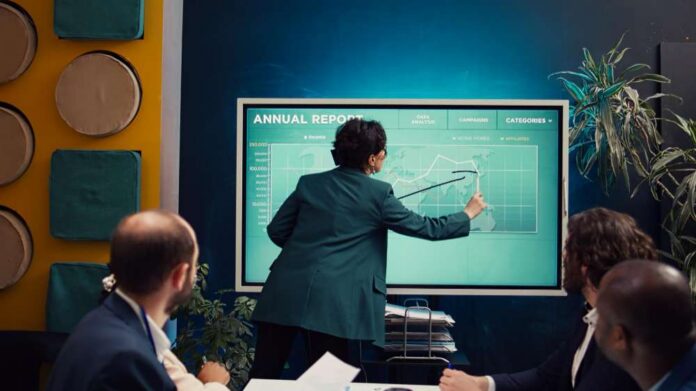

Picture the last hybrid meeting you attended. A few colleagues sat around a table, others joined from home, and someone else dialled in from another city. When it works, ideas flow, and everyone builds on each other’s thoughts. When it doesn’t, remote participants shrink into small faces on a screen, waiting for a pause long enough to speak. Interactive displays, supported by well-integrated audio-visual technology, are changing that experience for the better.
Hybrid Work Has Found Its Footing
Hybrid work is no longer a temporary adjustment. Industry analysts now describe it as the permanent operating model for enterprise organisations. Companies are putting their budgets where their meetings happen. In Cisco’s research, 50% of organisations are prioritising meeting rooms capable of hybrid sessions, and 55% are investing in digital whiteboards and interactive displays.
The need is real. Gensler’s 2026 Global Workplace Survey, which covered 16,459 full-time office workers across 16 countries, found that limited meeting rooms lead more than 60% of workers to take calls in hallways or at their desks, or to cancel meetings altogether. Better-equipped rooms are therefore a practical route to more productive days, not a luxury.
One Shared Canvas for Everyone
An interactive display is more than a large screen on the wall. It works as a shared canvas where a presenter can open a document, circle a figure, sketch a quick idea, or rearrange a slide, and everyone can see it happen live. Teams can collaborate as if they were in the same space, without anyone having to point a camera at a whiteboard during a video call.
Ideas stay in motion. A product manager in the room can drag a feature up a roadmap while a designer at home adds a note to the same page. Because the display is touch-enabled, brainstorming feels natural and spontaneous. The notes, diagrams and decisions from the session can be saved and shared afterwards, so the meeting leaves something useful behind.
Where Integrated AV Closes the Communication Gap
A display on its own can only do so much. The real magic appears when it works with video conferencing, wireless screen sharing, quality microphones and smart cameras. Together, these tools enable seamless communication between in-office and remote participants, reduce communication barriers and support hybrid work models.
Simplicity matters as much as capability. Cables, adapters and fixed ports create friction, which is why wireless-first meeting rooms are becoming the default. A colleague can walk in, share their screen in seconds, and start the discussion, instead of spending the first five minutes searching for the right HDMI cable. As one 2026 industry guide puts it, the best meeting rooms will not be those with the most technology, but those that feel easy to use.
Clear audio and sharp visuals matter too. High-resolution displays help ensure both in-room and remote participants can clearly see shared materials, while interactive displays add flexibility for collaboration. When people can hear and see properly, they spend less energy decoding the meeting and more on contributing to it.
Making Every Voice Count
The real test of a hybrid meeting is whether a person’s location shapes how much they contribute. Without the right tools, it often does. People in the room naturally dominate the conversation, while those on screen hover at the edges.
Interactive displays help level the field. When a remote colleague can annotate on the same screen, add a comment to a shared whiteboard, or take over the pen during a discussion, they are participating as a full contributor and not just observing. Smart framing cameras that follow the speaker and microphones that pick up soft voices across the room make the conversation feel more even. Real-time captions and shared notes help colleagues who speak different first languages, work in noisy environments, or simply process information better in writing.
Consistency also supports inclusion. Employees should not have to learn a different process in every room. When the same platform and the same touch gestures work across small huddle spaces, mid-sized conference rooms, and large boardrooms, people feel confident walking into any meeting. That confidence encourages more participation from everyone.
Technology That Brings People Closer
There is a comforting idea in Gensler’s findings. Janet Pogue McLaurin, the firm’s global director of workplace research, observed that people often assume more technology means less connection, but the data tells a different story. The survey found that 30% of employees now qualify as AI Power Users, who regularly use AI tools in both their professional and personal lives. These workers tend to spend less time working alone, devote more time to learning, and report stronger connections with their teams.
That is encouraging for meeting rooms. When technology is designed around people, it can deepen collaboration rather than replace it.
What Comes Next
The road ahead looks promising. Interactive displays are moving toward smarter, more intuitive experiences, with AI that helps summarise discussions, capture action items, translate conversations in real time, and frame speakers automatically. Room scheduling, wireless sharing and cloud whiteboarding are set to blend into a single smooth workflow. In 2026, meeting rooms that don’t properly support hybrid meetings will start to feel outdated quickly.
For organisations, the opportunity is to treat interactive displays and integrated AV as core infrastructure for how teams think, decide and create together, and not as an afterthought. The goal is simple: every participant, whether sitting in the boardroom or logging in from a spare room hundreds of kilometres away, should feel equally present, heard and valued. With the right technology in place, hybrid meetings can feel less like a compromise and more like the best of both worlds.