


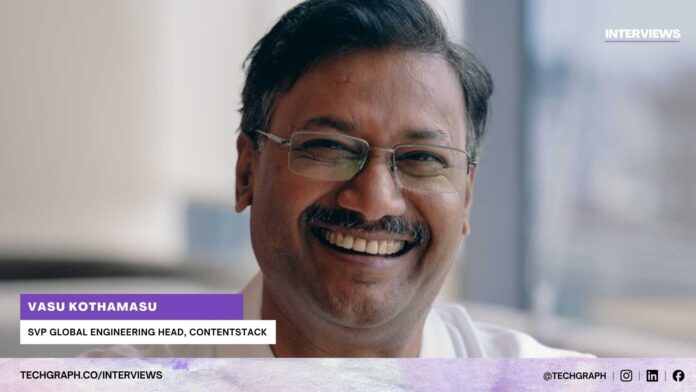

Speaking with TechGraph, Vasu Kothamasu, Senior Vice President and Global Engineering Head at Contentstack, explained how enterprises are shifting from traditional CMS models to composable digital ecosystems that require adaptability, intelligence, and speed, and how the company’s API-first platform establishes itself as the core of these digital experiences to help brands achieve consistent engagement across global audiences.
He also outlined how the company’s engineering strategy integrates AI-led innovations, such as Brand Kit, Automation Hub, and Agent OS, with the integration of the real-time customer data platform Lytics, to build a connected framework that enables enterprises to innovate confidently while maintaining operational stability and long-term resilience.
Read the complete interview:
TechGraph: Contentstack goes beyond a traditional headless DXP, positioning itself as the backbone of modern digital experiences. From your perspective, what’s the real differentiator that keeps enterprise clients loyal when competitors are pushing similar narratives?
Vasu Kothamasu: At Contentstack, our mission has always been to help enterprises break free from rigid, outdated systems and embrace a truly future-ready approach to digital. What began as a headless CMS foundation has evolved into a platform that provides brands with the speed, flexibility, and adaptability they need to deliver seamless experiences across every channel, even as the landscape continues to evolve.
More than a headless CMS, we’re the backbone of composable digital experiences. A key milestone in that journey was acquiring Lytics, a real-time customer data platform. That move wasn’t about expansion for its own sake; it was about giving enterprises the ability to really understand their audiences and deliver personalised experiences at scale, instantly, for every user.
What sets us apart is our relentless focus on being AI-native, composable, enterprise-ready, and customer-obsessed. To ensure customer success, we don’t just troubleshoot—we build real relationships with people whose outcomes we care about deeply, and we’re always ready to respond with help. We call this “Care without Compromise.” We don’t see ourselves as just another vendor; we’re a long-term partner. From our AI Accelerator, which helps teams start harnessing AI in 30 days, to MACH-certified partners who ensure seamless implementation, we guide customers at every step—because success for them is success for us.
Flexibility is also core to our DNA. Multi-cloud support across AWS, Azure, and Google Cloud means customers are never locked in. Our modular architecture, best-of-breed integrations, and innovation-first approach give teams the freedom to build, experiment, and scale on their own terms. And brands that aspire to differentiate in the market always look for such innovative partners. Contentstack is one of those SaaS platforms embracing the latest market trends and continuously innovating. The multiple products we’ve released in the past few years reflect our product and engineering teams’ ability to innovate at pace.
That’s why leaders like MongoDB, Mattel, and Alaska Airlines trust Contentstack to future-proof their digital strategies.
TechGraph: Enterprise customers often grapple with balancing agility and governance. How are you engineering the platform to ensure speed of content delivery without compromising the level of security and compliance enterprises demand?
Vasu Kothamasu: At Contentstack, we’ve engineered the platform to give enterprises the best of both worlds—unmatched agility and uncompromising governance. Our modular, API-first, microservices-based architecture enables rapid content delivery across channels, while enterprise-grade features such as role-based access controls, granular workflows, audit trails, and automated compliance checks ensure teams operate within a secure, governed framework.
We also support multi-cloud deployments and adhere to global security standards like ISO, SOC 2, and GDPR, giving enterprises the confidence that their data and operations remain fully protected. By combining speed with robust security and governance, we empower enterprises to innovate quickly without ever sacrificing trust or compliance.
Our platform is built on a mature CI/CD pipeline with security “shift-left” practices. Beyond regular unit, functional, and end-to-end testing, we also embed performance, stability, and security tests into our core development cycle. This ensures every release is resilient, reliable, and secure.
Thanks to our microservices-based architecture, we can innovate and deploy product features across all cloud regions within hours—without impacting customers. On average, we release about 1,800 updates per year, nearly five per working day, all with zero downtime. This pace of innovation ensures our customers are always ahead of the curve.
TechGraph: Scalability in a headless architecture can be both an opportunity and a challenge. What are some of the toughest scalability problems your engineering teams are solving today that customers might not even see on the surface?
Vasu Kothamasu: One of the hardest scalability problems we solve is delivering low-latency performance globally while content is distributed across websites, apps, IoT devices, and regional markets. To make this possible, our teams optimise caching, routing, and edge delivery, while orchestrating load balancing and elastic scaling so traffic spikes don’t disrupt performance.
Cloud makes it possible to scale with demand, but one of the toughest challenges is ensuring API availability and fast response times without overprovisioning infrastructure. Our Site Reliability Engineering (SRE) team has built robust practices that continuously monitor infrastructure and automatically scale capacity as customer load increases—delivering efficiency without compromising performance.
Another challenge is ensuring reliability in a composable ecosystem where hundreds of microservices and APIs interact. At scale, even rare errors can surface frequently, so we design for resilience with circuit breakers, retries, observability, and carefully managed API contracts.
Security and governance add yet another layer of complexity. As enterprises grow, managing roles, permissions, workflows, and compliance across regions becomes harder. We address this with advanced access controls, automated compliance, and auditability—without slowing teams down.
And finally, scaling engineering practices themselves is critical. We invest in optimised CI/CD pipelines and modular architectures to reduce technical debt, so innovation can continue at pace without compromising stability.
TechGraph: A recurring criticism of headless platforms is the steep learning curve for business users. How are you addressing this challenge to ensure adoption scales smoothly inside enterprises?
Vasu Kothamasu: The steepest curve in any tech adoption isn’t technical; it’s change management and human. Success depends on helping teams adapt their ways of working and feel confident from the start.
That’s why we’ve built learning right into Contentstack. From an in-app Help Centre with searchable docs, AI guidance, and instant support, to quick-start guides and sandbox environments where teams can safely experiment, we make it easy to bridge the gap. For deeper learning, Contentstack Academy offers role-based paths, whether you’re a developer, content manager, or marketer, complete with hands-on modules and certifications. And we don’t stop there; our customer success teams and community programs give enterprises real partners in adoption.
As a result, business users don’t just “get through” the learning curve; they move faster, collaborate better, and actually enjoy the process. This way, adoption stops being a barrier and becomes the very reason transformation succeeds.
TechGraph: With AI becoming central to digital experiences, how do you see it influencing the way content is structured and served in your platform, and how much of that innovation is happening in-house versus through ecosystem partnerships?
Vasu Kothamasu: We’ve moved from a content economy—where scale mattered—to a context economy, where relevance decides winners. Every AI investment we’ve made at Contentstack reflects that shift.
We built Brand Kit to stop AI from drifting off-brand, Personalise to help marketers adapt in real time, and Automation Hub to remove manual, low-value tasks. Each exists to solve a clear enterprise tension: speed without losing control.
Where innovation moves too fast to own—like foundation models or media optimisation—we partner. Integrations with AWS Bedrock, OpenAI, and Cloudinary let customers access best-in-class tech while we stay focused on orchestration.
Acquiring Lytics was decisive because content without real-time customer data is guesswork. That move closed the loop between content and audiences, making personalisation measurable and deterministic.
And we launched Agent OS because the final gap was operational: giving brands agents that act with full content, brand, and data context. It turns AI from a tool into an operator, driving adaptive, one-to-one experiences at scale.
TechGraph: Finally, with both established tech giants and fast-moving startups expanding into the digital experience space, how do you see Contentstack continuing to shape the direction of the market and set benchmarks for others?
Vasu Kothamasu: Contentstack has always shaped this market by looking ahead to what enterprises will need tomorrow, not just what they’re asking for today. The industry is shifting fast, but our north star is clear: brands need a platform that can adapt as quickly as their customers do. That’s why we pioneered composable architecture, brought in Lytics to unify content with real-time customer data, and are now leading the move into adaptive digital experiences with Agent OS.
AI and automation aren’t new, but they’ve mostly been siloed experiments. With Agent OS, we’ve rethought the model. It combines three capabilities in one: operational agents that streamline workflows, an embedded co-pilot (Polaris) that makes teams more effective, and a digital concierge that meets customers in their channel of choice. Others might offer pieces of this puzzle; we’ve integrated them end-to-end so enterprises can finally trust AI to deliver consistent, on-brand experiences at scale.