


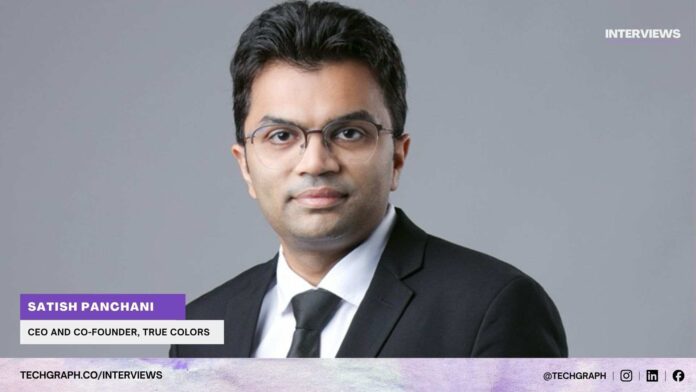

Speaking with TechGraph, Satish Panchani, CEO and Co-founder of True Colors, discussed how the company’s planned ₹128 crore IPO is aimed at meeting growing demand for digital textile production by strengthening working capital and operational readiness, ensuring the company can scale capacity while maintaining delivery timelines and margin discipline.
He also spoke about how the capital will support smoother order execution, greater cost efficiency, and a stronger presence across both export and domestic markets as True Colors widens its product reach in a sector steadily shifting toward faster, more sustainable printing solutions.
Read the full interview in detail:
TechGraph: True Colors has operated in a steady, capital-intensive part of the textile value chain for years. What changed inside the company or in the market that made you feel this was the right moment to invite public investors into the company’s story?
Satish Panchani: Several key developments – both within the company and the broader market – have made this time the opportune time to invite public investors. Internally, we were converted into a public limited company in early 2025. We also achieved strong financial growth, reporting over ₹233 crore in revenue and profitability. This growth was powered by our vertical integration strategy that improved margins and operational efficiency.
Moreover, we adopted eco-friendly digital printing technologies that align with the greener textile theme. Externally, digital textile printing is expanding rapidly. Brands and exporters are shifting toward sustainable, on-demand production. The positive demand outlook also helped us to finally make up our minds on IPO and make public investors part of our growth story.
TechGraph: You plan to raise ₹128 crore through this issue. Beyond the usual talk of expansion and modernisation, what is the real transformation you want this capital to deliver, whether in technology, efficiency, or market positioning?
Satish Panchani: True Colors plans to use the ₹128 crore issue to create a deeper transformation. The goal is not to grow bigger but to work smarter. The majority of funds will be used to strengthen working capital to allow the firm to manage orders more efficiently. Another share will go towards lowering costs and improving profitability. We will also deploy funds to intensify innovation and elevate overall quality.
The company will also use funds to boost reliability and scale its operations. Expansion efforts will also get a boost as we aim to position ourselves as a preferred partner for global brands. Summarily, True Colors aims to strengthen its market position, cut costs, and elevate its global presence with the raised funds.
TechGraph: Investor sentiment toward new listings has been cautious this year, especially in the manufacturing space. How did that shape your approach to pricing and communication, and what kind of feedback have you been getting from investors during the run-up to the IPO?
Satish Panchani: True Colors shaped its IPO strategy, keeping in mind the reality of the market. The company focused on building trust through consistent transparency and communication. Pricing was kept fair and grounded in the fundamentals of the firm. Management emphasised the company’s integrated business model, helping investors see stability in a volatile market.
We also convinced potential investors of operational efficiency and the growing demand for digital printing solutions. The feedback we received was largely positive, with investors recognising the company’s ability to balance growth and prudence. Many viewed it as a credible, long-term play rather than a short-term listing opportunity. In sum, True Colors was able to build confidence even in a cautious market, resulting in strong interest across investors.
TechGraph: Textile processing has always been vulnerable to cost swings, export cycles, and compliance pressure. What steps are you taking internally to build consistency and predictability into your earnings once you move into the public market?
Satish Panchani: True Colors recognizes constant challenges – rising costs, shifting demand, and tighter compliance – that the textile industry faces. We are building greater predictability through an ecosystem approach. This helps us to reduce dependence on external suppliers and stabilises margins. We are also investing in automation to improve efficiency and lower waste.
This will help us to sustain profitability even when raw material prices fluctuate. We are expanding beyond exporters to domestic brands and institutional clients. Sustainability is another key focus for us at True Colors.
The use of water-efficient methods ensures compliance with environmental standards. Together, these measures will give investors more predictable performance and steady long-term value.
TechGraph: Many of your listed peers have used their IPOs to reposition themselves, entering new product categories or moving up the value chain. How is True Colors thinking about its next phase of growth once the listing is complete, and where do you see the most potential to scale responsibly?
Satish Panchani: We see the public listing as the start of a new growth phase. The company plans to deepen its presence across the digital textile printing ecosystem. We will be expanding into higher-value, technology-driven segments. We plan to introduce advanced printing solutions tailored for the fashion and home decor segments. The firm will expand its footprint across new segments while keeping sustainability at the centre of expansion efforts. With disciplined financial management, True Colors aims to scale steadily and deliver long-term value to shareholders.
TechGraph: Sustainability is central to your brand identity, but in public markets, it has to be backed by data and disclosure. What are you putting in place to measure and report environmental and social performance in a way that investors can trust?
Satish Panchani: Sustainability is at the heart of our operational philosophy. We have established a structured Environmental, Social, and Governance (ESG) framework in our firm. This helps us to track sustainability indicators and work towards improving them. Independent audits and third-party verifications will also be used to ensure credibility among investors. True Colors will also form a sustainability committee that will ensure sustainability goals are embedded into business decisions.
TechGraph: Lastly, how do you see this IPO shaping the company’s next five years, and what role do you hope True Colors will play in defining the future of sustainable textile processing from India?
Satish Panchani: The IPO marks a defining moment for True Colors, setting the stage for the company’s next five years of growth, innovation, and leadership. The capital raised will allow the company to scale operations, invest in digital technologies, and strengthen integrated manufacturing.
Over the next five years, True Colors aims to become a trusted partner for global brands. The company also sees an opportunity for sustainable textile processing, demonstrating that profitability and environmental responsibility can go hand in hand. In essence, the IPO has offered us a platform to accelerate growth and strengthen our leadership in the industry.