


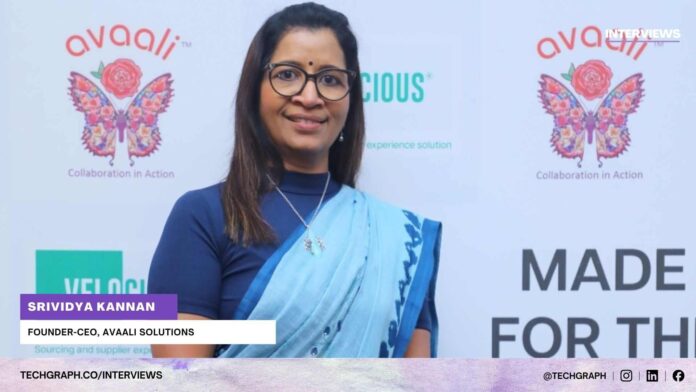

Speaking with TechGraph, Srividya Kannan, Founder and CEO of Avaali Solutions, discussed how cost optimization is evolving beyond short-term efficiency to become a foundation for strategic competitiveness and how the company’s Connected Enterprise framework is helping organizations achieve measurable operational mastery across procurement, finance, and compliance functions.
She also talked about Avaali’s Velocious supplier experience platform and its consulting-first engagement model that helps enterprises move from incremental process improvements to large-scale business transformation while ensuring measurable outcomes and sustained margin growth across global operations.
Read the interview in detail:
TechGraph: Avaali has built its reputation around cost optimization and margin improvement. How do you translate that positioning into a clear competitive edge in an industry where every provider promises efficiency?
Srividya Kannan: Our competitive edge lies in what we call measurable operational mastery. While others promise efficiency, we deliver documented cycle time reductions of 40-70% with quantifiable cost savings of 20-40%. The difference is in our approach-we don’t just automate existing processes; we fundamentally redesign them for sustained performance.
What sets us apart is our focus on enterprise-wide transformation rather than point solutions. We create ecosystem transformations that deliver competitive advantage, not just operational improvements. This means integrating supplier networks, financial processes, and compliance frameworks into cohesive, intelligent systems.
Our unique value proposition centres on three pillars: First, we focus on measurable outcomes through our structured engagement model. Every project begins with baseline measurement together with specific business cases focused on targeted outcomes. Second, our deep expertise in regulated industries like oil & gas, manufacturing, and infrastructure means we understand compliance complexities that generic providers miss. Third, we stay invested in long-term client relationships, not short-term revenue extraction.
The real differentiator is our Connected Enterprise approach. Instead of siloed improvements, we create integrated ecosystems where procurement, finance, and operations work seamlessly together. Our Velocious platform exemplifies this; it’s not just a sourcing tool but a comprehensive supplier experience platform that transforms entire procurement ecosystems.
Most providers focus on technology deployment. We focus on business transformation that happens to leverages technology. The outcomes we deliver aren’t just system implementations; they represent fundamental process reimagination that creates sustainable competitive advantage.
TechGraph: Large enterprises already have multiple technology providers. What is Avaali’s strategy to integrate into that ecosystem without becoming redundant or overlapping with what others are doing?
Srividya Kannan: Our strategy is intelligent integration, not displacement. Rather than competing with existing providers, we orchestrate them into cohesive, high-performing ecosystems. Avaali serves as the integration architect who makes disparate systems work together seamlessly.
We’ve learned that large enterprises don’t need another vendor; they need a strategic partner who can optimize their existing technology investments. Our approach focuses on the unstructured content lifecycle in businesses, where 80% of business processes still happen through email, Excel, and manual workflows. This is where we create transformational value without disrupting existing IT infrastructure.
Our partnership strategy is built around three key differentiators: First, we’re technology-agnostic. With deep OpenText and SAP BTP expertise, we work with whatever systems clients already have. Second, we focus on process intelligence rather than system replacement. We enhance existing environments rather than replacing them.
The key is our consulting-first approach. Before any technology deployment, we conduct comprehensive process mapping to identify optimization opportunities within existing ecosystems. This ensures every solution adds incremental value without creating redundancy.
Our success with over 300 transformation projects across Asia, MEA, and Europe demonstrates this approach. We consistently deliver enhanced agility and visibility without disrupting proven workflows, positioning ourselves as the “orchestration layer” that maximizes ROI from existing technology investments while filling critical gaps in process automation.
TechGraph: Many providers stop at implementation, but Avaali emphasizes sustained impact. Can you walk us through how your engagement model ensures efficiency gains are not just short-term wins?
Srividya Kannan: Our engagement model is built around continuous value realization, not project completion. We’ve structured our approach to ensure that initial improvements compound over time rather than decay through change resistance or process drift.
The foundation is our three-phase methodology: Foundation, Transformation, and Evolution. During Foundation, we establish governance frameworks and change management protocols that outlast any single implementation. The Transformation phase focuses on measurable improvements with built-in monitoring systems. Evolution ensures continuous optimization through regular performance reviews and enhancement cycles.
What makes this sustainable is our emphasis on knowledge transfer and internal capability building. Rather than creating vendor dependency, we train client teams to own and optimize processes independently. Our approach builds internal competency to maintain and accelerate momentum over time.
Our Enterprise Resilience Hub concept exemplifies this approach. We create autonomous shared services that evolve with changing business requirements. This includes proactive monitoring, predictive maintenance, and continuous improvement protocols that ensure performance gains accelerate over time.
The commercial model supports this philosophy. We tie our success to client outcomes through performance-based contracts that extend well beyond initial implementation. Ongoing optimization and capability enhancement are built into every engagement model.
Most critically, we establish Centers of Excellence within client organizations. These internal teams become champions for continuous improvement, ensuring that optimization becomes part of organizational DNA rather than a temporary project outcome. This approach enables sustained relationships where ongoing capability enhancement drives continuous value creation.
TechGraph: You operate in industries where margins are under constant pressure from manufacturing to utilities. How has Avaali tailored its offerings to address the unique cost challenges of these sectors?
Srividya Kannan: Each sector presents distinct cost pressures that require specialized approaches. In manufacturing, margin pressure comes from raw material volatility and supply chain complexity. For utilities, it’s regulatory compliance costs and infrastructure maintenance. Our solutions are tailored accordingly.
In manufacturing, we focus on supply chain optimization and procurement intelligence. Our work with automotive and industrial clients centers on supplier collaboration platforms that reduce procurement costs while improving quality control. The key is real-time visibility into supplier performance, which enables proactive cost management rather than reactive problem-solving.
For utilities and infrastructure, regulatory compliance represents a massive cost burden. Our solutions automate compliance reporting while creating audit trails that reduce regulatory risk. When we worked with Oil India Limited, the focus was on creating transparent supplier communication channels that enhanced compliance while reducing administrative overhead.
In banking and financial services, cost pressure comes from regulatory changes and digital transformation requirements. Our approach combines process automation with risk management, ensuring that cost reductions don’t compromise compliance or customer experience.
The pharmaceutical and healthcare sectors require specialized handling of regulated processes. Our solutions ensure that cost optimization doesn’t compromise quality or compliance standards. We’ve built specific accelerators for validation workflows and documentation management that address sector-specific requirements.
Our sector expertise is reflected in our technology partnerships. With specialized OpenText capabilities, we can address complex document processing and content management requirements that are critical for regulated industries. These partnerships ensure we can deliver sector-appropriate solutions rather than generic automation.
The common thread across all sectors is our focus on operational intelligence—providing real-time visibility into cost drivers while automating corrective actions. This enables proactive cost management rather than reactive cost-cutting.
TechGraph: Clients today are skeptical of buzzwords like AI and automation. How does Avaali cut through that noise and prove that your solutions deliver real financial and operational outcomes?
Srividya Kannan: We lead with results, not rhetoric. Every engagement begins with baseline measurement and clear success metrics. Our approach focuses on documented outcomes with measurable cycle time reductions and quantifiable improvements delivered within defined timeframes.
Our approach is “Show, Don’t Tell.” We start with proof-of-concept implementations that demonstrate value before full-scale deployment. This allows us to prove ROI through tangible improvements (such as reducing daily reconciliation processes from multiple hours to a single hour) before scaling solutions across other areas.
The key differentiator is our focus on business outcomes rather than technical features. When clients ask about AI, we discuss how intelligent document processing reduces manual data entry by significant percentages. When they inquire about automation, we explain how it enables touchless processing capabilities that deliver measurable time savings.
We’ve standardized outcome measurement across all engagements. Every project includes baseline performance metrics, target improvement goals, and regular progress reporting. This creates accountability for both Avaali and our clients while building confidence through transparent progress tracking.
Our case studies provide concrete validation with documented time savings and cost reductions. These real-world examples carry more weight than theoretical capabilities or technology demonstrations.
Most importantly, we start by acknowledging limitations upfront. Recent industry analysis shows that only 8.8% of enterprises achieve 90%+ OCR accuracy in accounts payable automation. By being honest about challenges, we build credibility when discussing achievable outcomes. We review the current state to define our innovations that will allow customers to move to the desired state with newer solutions. This alignment ensures that our success depends on delivering documented value rather than just implementing technology.
TechGraph: As enterprises expand into diverse markets, cost structures become complex and fragmented. How does Avaali position itself as a partner that can deliver consistent optimization across such varied geographies?
Srividya Kannan: As enterprises expand into diverse markets, cost structures often become complex and fragmented. Avaali positions itself as a trusted partner by leveraging a deep understanding of functional business processes and local regulatory guidelines, which are often dynamic and closely tied to core operations. Our proprietary solution, Velocious, embodies our approach of ‘Think Global, Optimize Local.’
We bring proven methodologies and established partnerships to new markets while tailoring implementation strategies to align with local business environments. By combining global consistency with local adaptability, we ensure that technologies not only automate but also enhance business processes, delivering predictable and optimized outcomes across even the most geographically complex operations.
TechGraph: Looking ahead, where do you see the biggest growth opportunity for Avaali — scaling deeper within existing industries or extending your model into new verticals that are yet to embrace digital cost transformation?
Srividya Kannan: Avaali’s growth is driven by relentless innovation, with a strong focus on building cutting-edge solutions in AI and agentic AI to address real-world business challenges. Our recent advancements showcase this commitment to delivering transformative value to enterprises.
One of our recent innovations is QuantumClean, our Master Data Cleansing solution. This solution tackles the critical challenge of maintaining clean, accurate, and reliable master data. By automating data cleansing and validation, QuantumClean enables better decision-making, reduces inefficiencies, and ensures compliance with regulatory standards.
Another standout is our Correspondence Management Solution, built on OpenText. This solution automates the entire lifecycle of enterprise correspondence—both internal and external—ensuring seamless communication, enhanced traceability, and improved compliance. It empowers organizations to handle high volumes of correspondence with precision, reducing manual effort and turnaround times.
Under our Velocious suite, we’ve also launched a template-less AI-based OCR and Accounts Payable solution. This innovation eliminates the need for rigid templates, enabling enterprises to process invoices and other documents with unparalleled flexibility and accuracy. By leveraging AI, this solution automates the extraction, validation, and processing of data, significantly improving efficiency and reducing errors in accounts payable workflows.
Looking ahead, the future for Avaali will be a healthy combination of products, innovations, and consulting. Our focus will remain on scaling our AI and agentic AI capabilities, building solutions that address complex business needs, and delivering value through a blend of technology and strategic advisory. By continuously innovating and expanding our portfolio, we aim to empower enterprises to achieve sustainable digital transformation and unlock new levels of efficiency and growth.