


Solar, Renewable Sector Expects Tax Breaks, Subsidies for BESS & Solar Financing Reform From Budget 2025

PUBLISHED:

See more TechGraph stories in your search results.
Google Add TechGraph on Google

As Union Budget 2025 approaches, renewable energy leaders are urging Finance Minister Nirmala Sitharaman to introduce tax incentives and subsidies for Battery Energy Storage Systems (BESS) to foster clean energy innovation. Industry experts also requested the government to improve access to affordable financing through low-interest loans and risk-mitigation mechanisms to boost rooftop solar installations.

Read the Union budget 2025 expectations in detail:

Piyush Goyal, Co-Founder & CEO, Volks Energie
India has embarked upon an ambitious journey of achieving net zero emissions by 2070, and a part of that future is achieving 500 GW of energy from non-fossil fuel forces by 2030. To the same end, we at Volks Energie believe that this year’s budget announcement could be a watershed moment for India’s renewable energy sector, especially solar and green energy.

- Advertisement -

We expect the budget to introduce incentives for tech breakthroughs and innovations in clean energy. There should also be provisions supporting large-scale investments in solar and wind energy projects, spread across the wide lands and coastlines of India.

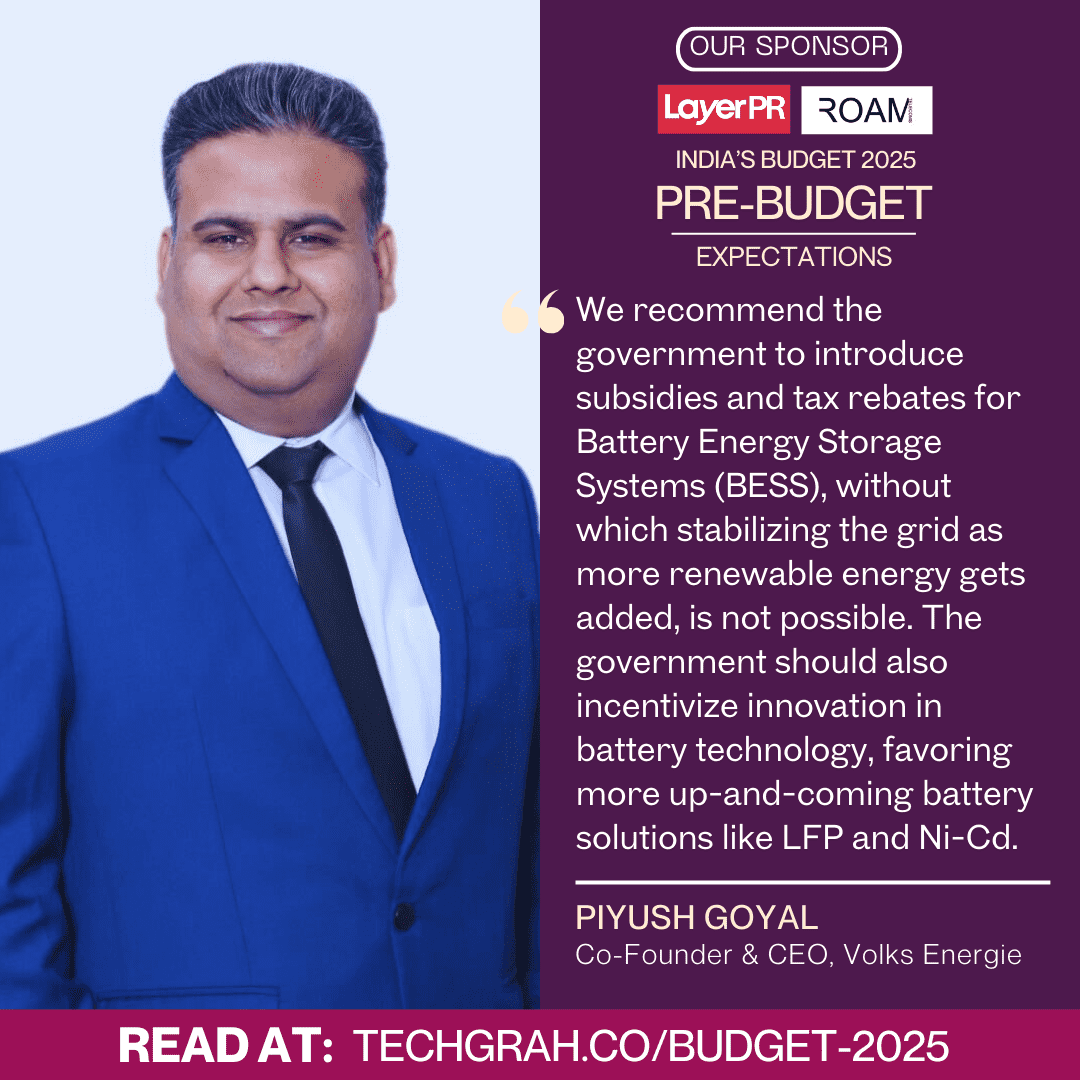
At the same time, we recommend that the government introduce subsidies and tax rebates for Battery Energy Storage Systems (BESS), without which stabilizing the grid as more renewable energy gets added, is not possible. The government should also incentivize innovation in battery technology, favoring more up-and-coming battery solutions like LFP and Ni-Cd.

The current ecosystem for renewable energy needs to be strengthened and companies supporting cutting-edge sustainable practices must be empowered with favorable policies and investments to drive long-term sustainable growth. We certainly need a forward-looking budget that prioritizes green and clean energy in 2025.

Pratik Mandvia, Solar Business Head, Mufin Green Finance

As the Union Budget 2025 approaches, the solar financing sector is anticipating critical policy measures that will support the growth of rooftop solar installations. With the government’s goal to achieve 50,000 MW of rooftop solar capacity by 2030, there is a need for financing solutions that cater to the residential, commercial, and industrial segments. The budget could play a pivotal role in creating a framework that simplifies access to capital for solar projects and encourages financial institutions to increase their participation in solar financing.

Incentives for banks and financial institutions to provide low-interest loans, as well as risk-mitigation mechanisms, would be crucial to scaling up rooftop solar adoption. Further, tax exemptions, subsidies, and rebates on solar installations will help reduce upfront costs for consumers and businesses, driving demand in both urban and semi-urban areas.

The anticipated focus on enhancing the solar financing ecosystem will support India’s renewable energy goals, particularly the target of 500 GW of non-fossil fuel-based energy by 2030. By creating an enabling environment for solar financing, the government can foster greater adoption of solar energy, contributing to India’s energy security and environmental sustainability.

Stay ahead of the curve, every day.

A daily briefing covering news, interviews, and the trends driving the world forward. Curated for readers who want news, not noise.

We don’t spam! Read our privacy policy for more info.

- Advertisement -
Krishna Mali
Krishna Mali
Founder & Group Editor of TechGraph.

Latest Stories

The Cost of Knowing: Why Intelligence Is Becoming the Most Expensive Function in the Enterprise

AI is making enterprise intelligence more expensive, increasing the importance of data quality, governance and infrastructure in turning AI into measurable business value.

How Continuous Evaluation Can Transform Student Learning from Performance to Progress

Education needs to move beyond one-time exams, with continuous assessment and AI-enabled tools helping teachers identify learning gaps earlier and use assessment data to improve instruction.

The Growing Gap Between Education and Employability in Young India

India's demographic dividend has long been regarded as one...

White Label Crypto Exchange vs Building From Scratch: Guide for Fintech Companies

Compare white label crypto exchanges with custom development across cost, control, compliance, maintenance, and long-term product ownership for fintech.

InspeCity Space Laboratories Appoints Rajeev Gambhir as Executive Vice President

Rajeev Gambhir will lead strategic partnerships and institutional engagement as InspeCity scales its space technology business.

Vingo Snaps $1.2 Mn in Seed Round Led by IndiaQuotient

The fresh capital will support product development, trust infrastructure, and user acquisition as the startup expands its marketplace.

Hero Enterprise, Cap Alpha Ventures Lead ₹65 Crore Series A in Vaaree

The investment will support Vaaree’s plans to improve deliveries and build new AI-powered home styling tools for its online marketplace.

Related Articles

The Cost of Knowing: Why Intelligence Is Becoming the Most Expensive Function in the Enterprise

AI is making enterprise intelligence more expensive, increasing the importance of data quality, governance and infrastructure in turning AI into measurable business value.

How Continuous Evaluation Can Transform Student Learning from Performance to Progress

Education needs to move beyond one-time exams, with continuous assessment and AI-enabled tools helping teachers identify learning gaps earlier and use assessment data to improve instruction.

The Growing Gap Between Education and Employability in Young India

India's demographic dividend has long been regarded as one of our biggest strengths. With...

White Label Crypto Exchange vs Building From Scratch: Guide for Fintech Companies

Compare white label crypto exchanges with custom development across cost, control, compliance, maintenance, and long-term product ownership for fintech.

Vingo Snaps $1.2 Mn in Seed Round Led by IndiaQuotient

The fresh capital will support product development, trust infrastructure, and user acquisition as the startup expands its marketplace.

Hero Enterprise, Cap Alpha Ventures Lead ₹65 Crore Series A in Vaaree

The investment will support Vaaree’s plans to improve deliveries and build new AI-powered home styling tools for its online marketplace.

Nebius Appoints Former Square Executive Lindsey Irvine as CMO

Former Square executive Lindsey Irvine has been named Chief Marketing Officer at Nebius, where she will oversee the AI cloud company’s global marketing efforts.

QubeHealth-Pay, Petos Partners to Expand Pet Healthcare Payments

The integration brings QubeHealth-Pay’s healthcare payment infrastructure to the pet insurance platform, with the companies targeting over ₹50 crore in pet healthcare payments within 18 months.

Gaurs Group to Launch Luxury Residential Project Gaur Alaris on Yamuna Expressway

Gaurs Group expects its latest luxury housing project near the Noida International Airport to generate nearly ₹1,900 crore in sales.

QubeHealth-Pay, Petos Partners to Expand Pet Healthcare Payments

The integration brings QubeHealth-Pay’s healthcare payment infrastructure to the pet insurance platform, with the companies targeting over ₹50 crore in pet healthcare payments within 18 months.

Gaurs Group to Launch Luxury Residential Project Gaur Alaris on Yamuna Expressway

Gaurs Group expects its latest luxury housing project near the Noida International Airport to generate nearly ₹1,900 crore in sales.

ProMobi Rolls Out New Scalefusion Update for Enterprise IT Teams

The latest Scalefusion update reflects how enterprise IT priorities are shifting from managing devices to securing users, identities and endpoints through a single platform.

InvestValue Launches ₹20 Crore ESOP for More Than 75% of Employees

The Fintech company is broadening employee ownership beyond leadership with a ₹20 crore ESOP programme covering more than three-quarters of its workforce.

Remsons Industries Appoints Rahul Prabhakar Desai as CEO

Rahul Prabhakar Desai has been appointed CEO of Remsons Industries, succeeding Amit Srivastava as the automotive components manufacturer advances its planned leadership transition.

InspeCity Space Laboratories Appoints Rajeev Gambhir as Executive Vice President

Rajeev Gambhir will lead strategic partnerships and institutional engagement as InspeCity scales its space technology business.

ProMobi Rolls Out New Scalefusion Update for Enterprise IT Teams

The latest Scalefusion update reflects how enterprise IT priorities are shifting from managing devices to securing users, identities and endpoints through a single platform.

InvestValue Launches ₹20 Crore ESOP for More Than 75% of Employees

The Fintech company is broadening employee ownership beyond leadership with a ₹20 crore ESOP programme covering more than three-quarters of its workforce.

How AI Is Quietly Turning Interior Design into a Predictive Science

Predictive science uses historical data, behavioral trends, simulations, and machine learning models to predict...

How AI Is Quietly Turning Interior Design into a Predictive Science

Predictive science uses historical data, behavioral trends, simulations, and machine learning models to predict...

PayMe CEO Mahesh Shukla on Where Loans Against Mutual Funds Fit in India’s Credit Market

Mahesh Shukla, Founder & CEO of PayMe, outlines how India’s expanding mutual fund investor base is creating new opportunities for asset-backed lending without disrupting long-term wealth creation.

The Privacy Imperative: Judge India’s Abhishek Agarwal on Modernising Enterprise Infrastructure

The Judge Group’s Abhishek Agarwal discusses why data privacy is becoming a strategic business priority and how it is shaping enterprise technology and digital transformation strategies.

Beyond the Profile Picture: FRND CPO Harshvardhan Chhangani on Building Social Discovery for Bharat

FRND Co-founder and CPO Harshvardhan Chhangani discusses why voice-first interactions and AI-powered identity are redefining social discovery for users beyond India’s metro markets.