



India’s Finance Minister, Nirmala Sitharaman, presented the Interim Budget 2024 on February 1, drawing varied responses from industry experts across sectors.
Here’s a snapshot of their reactions:
Ashish Singhal, CFO & Company Secretary, CORE Diagnostics Pvt Ltd
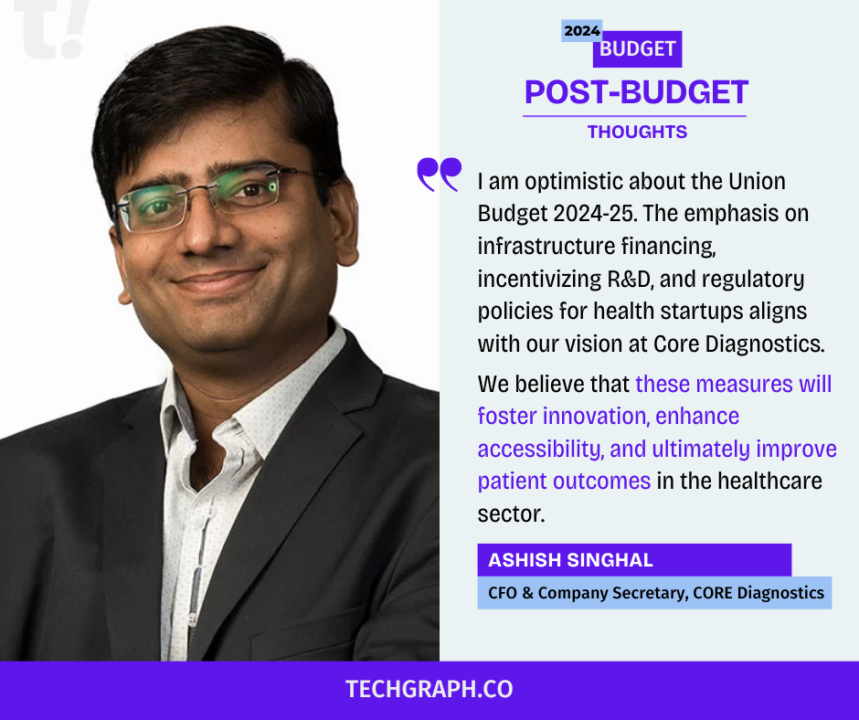
I am optimistic about the Union Budget 2024-25. The emphasis on infrastructure financing, incentivizing R&D, and regulatory policies for health startups aligns with our vision at Core Diagnostics. We believe that these measures will foster innovation, enhance accessibility, and ultimately improve patient outcomes in the healthcare sector. We look forward to seeing the positive impact of these policies on the diagnostics industry and the healthcare sector as a whole. This Interim Budget was neutral for the Diagnostics industry, and we hope for a favorable budget in the Final budget.
Anjan Pathak, CTO & Co-founder, Vantage Fit
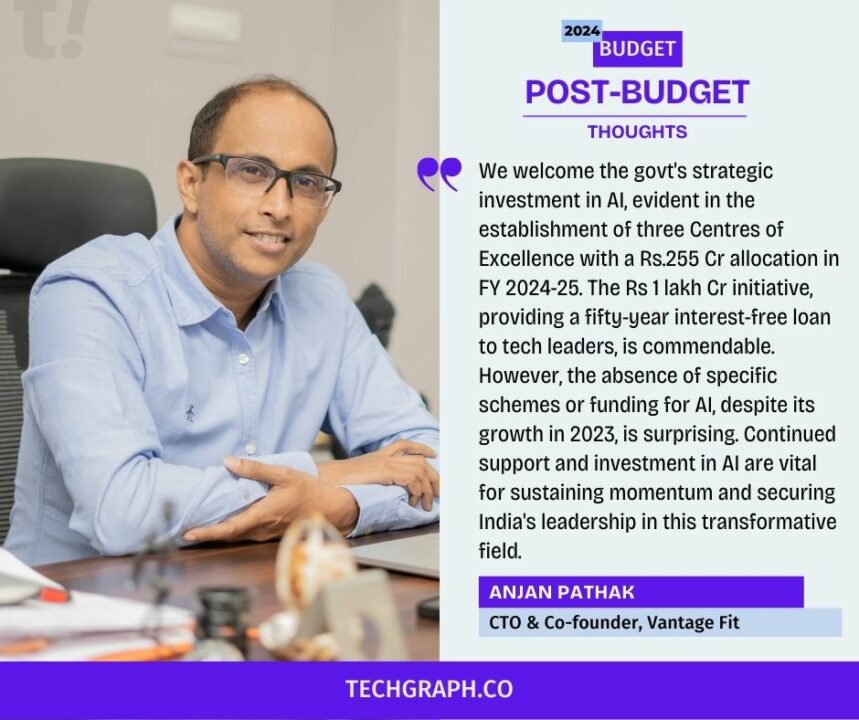
We welcome the government’s strategic investment in Artificial Intelligence, evident in the establishment of three Centres of Excellence with a Rs.255 Cr allocation in FY 2024-25. The Rs 1 lakh crore initiative, providing a fifty-year interest-free loan to tech leaders, is commendable. However, the absence of specific schemes or funding for AI, despite its growth in 2023, is surprising. Continued support and investment in AI are vital for sustaining momentum and securing India’s leadership in this transformative field.
Henna Misri, CEO, Space Creattors Heights
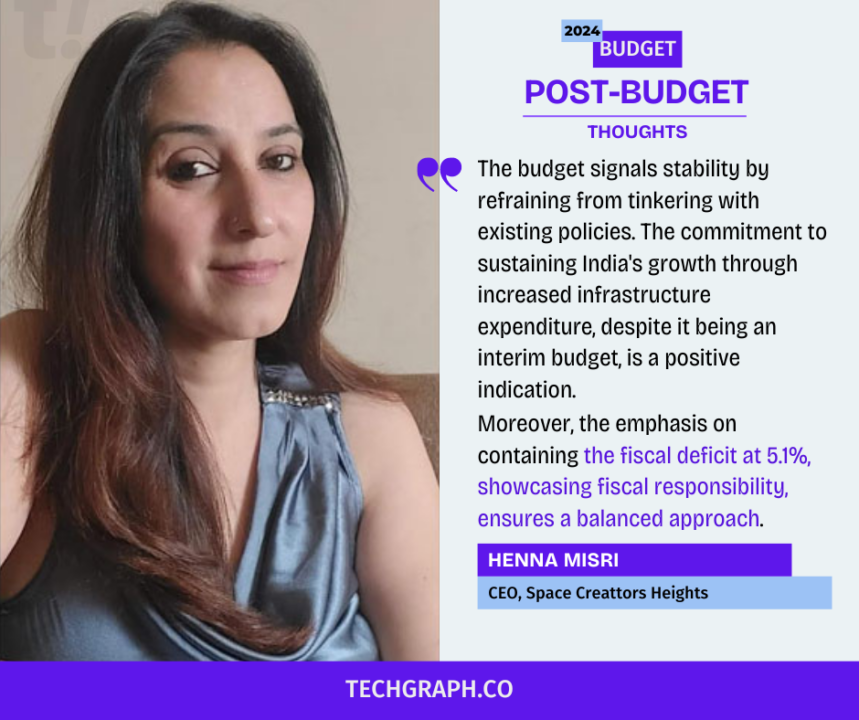
The budget signals stability by refraining from tinkering with existing policies. The commitment to sustaining India’s growth through increased infrastructure expenditure, despite it being an interim budget, is a positive indication.
Moreover, the emphasis on containing the fiscal deficit at 5.1%, showcasing fiscal responsibility, ensures a balanced approach. The pledge for inclusiveness, particularly for women and the downtrodden, reflects a commitment to leaving no one behind.
Overall, the government has adeptly navigated a challenging landscape, promising to maintain the positive trajectory of the last five years, even amid adversities like COVID, supply chain disruptions, and geopolitical tensions.
Vipin Suree, Founder & Managing Director, Space Creattors Heights
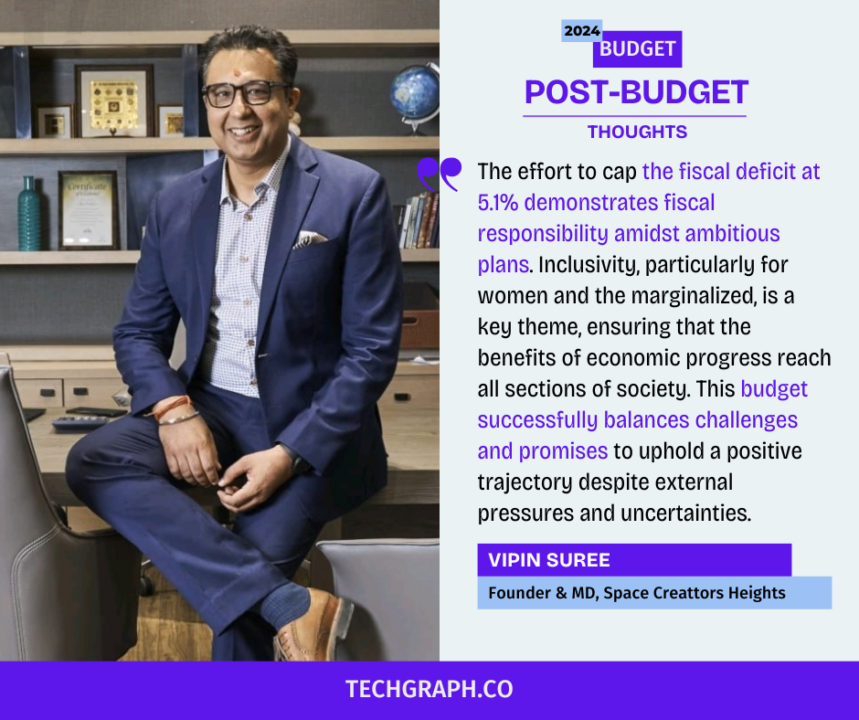
A commendable aspect of this budget is its stability – a commitment to maintaining the current course without unnecessary alterations. The promise to continue India’s growth journey through sustained infrastructure investment, despite the interim nature of the budget, is a reassuring signal.
The effort to cap the fiscal deficit at 5.1% demonstrates fiscal responsibility amidst ambitious plans. Inclusivity, particularly for women and the marginalized, is a key theme, ensuring that the benefits of economic progress reach all sections of society. This budget successfully balances challenges and promises to uphold a positive trajectory despite external pressures and uncertainties.
Naresh Ahuja, Founder, SMS Scientific Products Pvt Ltd

I commend the government’s visionary approach to the budget, foreseeing five years of unprecedented development. The emphasis on comprehensive ‘governance, development, performance’ reflects a commitment to progress.
The budget’s focus on establishing more medical colleges is promising, anticipating a new generation of doctors who embody inclusivity and prioritize effective patient-doctor communication. This progressive budget sets the stage for transformative growth and a healthier, more connected future for our nation.
Saurav Agarwal, Founder and CEO, PromotEdge
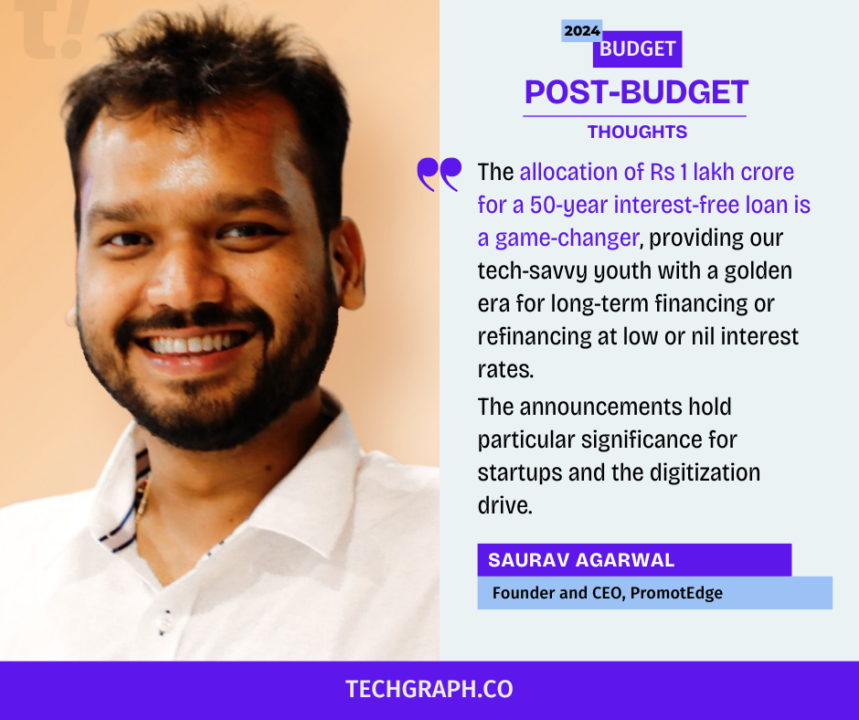
We are pleased to acknowledge the visionary steps taken by Finance Minister Nirmala Sitharaman in the Union Budget, paving the way for a digitally advanced, globally sustainable, and healthy India.
This budget reflects a progressive approach, focusing on inclusive growth, leveraging the potential of cutting-edge technologies, and implementing crucial business reforms.
Over the past decade, the Indian economy has undergone a remarkable positive transformation, and this budget is a testament to our commitment to sustaining this upward trajectory. The consumer tech startup sector will surely be stimulated by the proposed tax advantages, which would encourage entrepreneurship and innovation.
The allocation of Rs 1 lakh crore for a 50-year interest-free loan is a game-changer, providing our tech-savvy youth with a golden era for long-term financing or refinancing at low or nil interest rates. The announcements hold particular significance for startups and the digitization drive. Since this was an interim budget, there was not much regarding the digital sector, we expect much more in the upcoming budget in July.
Avneet Singh Marwah, CEO of SPPL
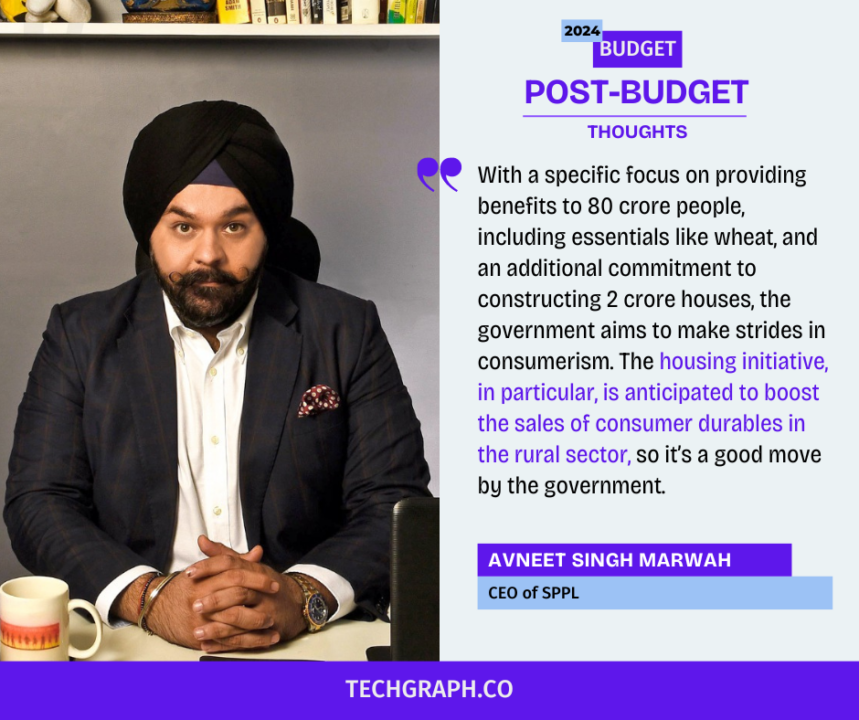
The government’s budget announcement, slated for June or July, reflects a strong sense of confidence but primarily revisits past policies over the last five years.
With a specific focus on providing benefits to 80 crore people, including essentials like wheat, and an additional commitment to constructing 2 crore houses, the government aims to make strides in consumerism. The housing initiative, in particular, is anticipated to boost the sales of consumer durables in the rural sector, so it’s a good move by the government. Other than that, there has been nothing in this budget. We are now waiting to see what will happen after the election and how the administration presents new policies.
It seems to be part of a broader continuity strategy, with a clear eye on the upcoming election. The government seems inclined to defer major policy decisions until post-election, possibly to avoid making U-turns later. This approach leaves industries, especially those expecting relief for the middle class and changes in tax structures, eagerly awaiting July for potential policy unveilings.
Anand Nagarajan, Co-Founder & CEO, Shaka Harry
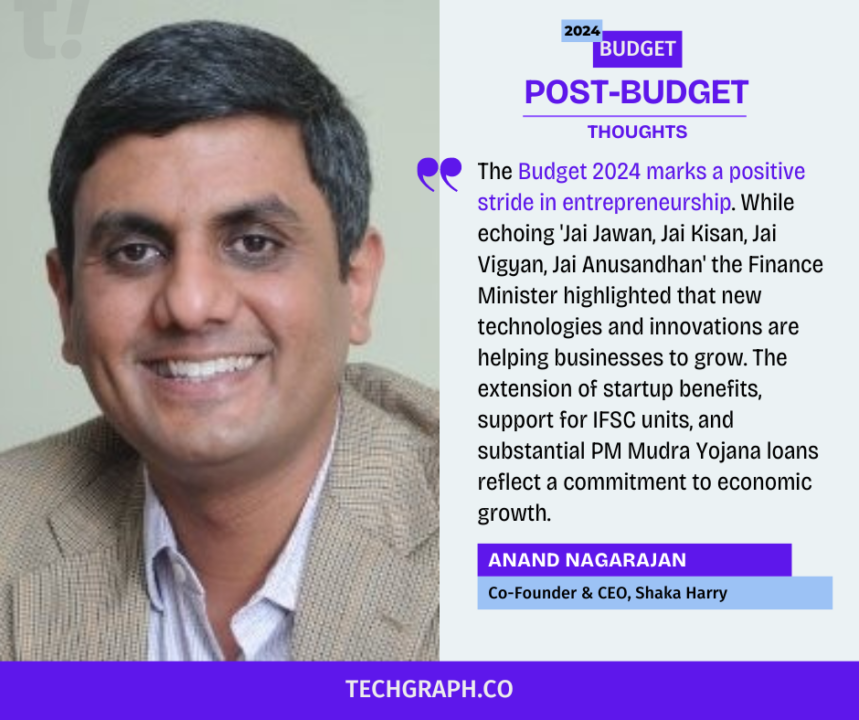
The Budget 2024 marks a positive stride in entrepreneurship. While echoing ‘Jai Jawan, Jai Kisan, Jai Vigyan, Jai Anusandhan’ the Finance Minister highlighted that new technologies and innovations are helping businesses to grow. The extension of startup benefits, support for IFSC units, and substantial PM Mudra Yojana loans reflect a commitment to economic growth.
Government resilience since 2014, coupled with reforms and pro-people initiatives, lays the foundation for widespread development. The emphasis on women’s entrepreneurship signifies a commendable shift towards inclusivity and empowerment, aligning with the government’s dedication to fostering an empowered and inclusive society.
Sanjeev Chabbra, Managing Director & CEO at Beetel Teletech Ltd.
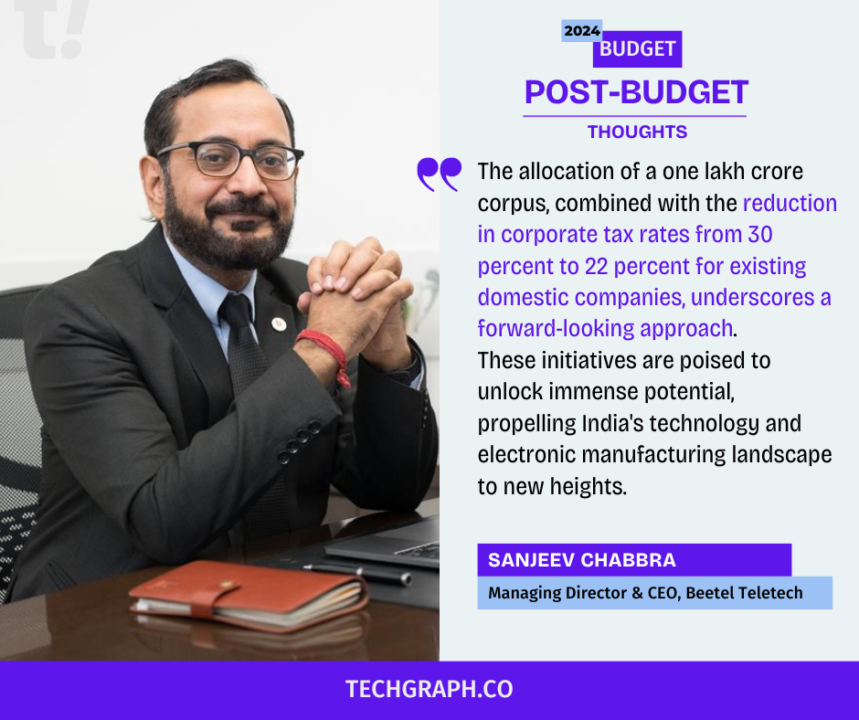
The budgetary focus on the three identified economic railway corridor programs through PM Gati Shakti is a significant stride toward enhancing multi-modal connectivity, laying a strong foundation for positioning India as a global electronics manufacturing hub.
The allocation of a one lakh crore corpus, combined with the reduction in corporate tax rates from 30 percent to 22 percent for existing domestic companies, underscores a forward-looking approach. These initiatives are poised to unlock immense potential, propelling India’s technology and electronic manufacturing landscape to new heights. The budget reflects a commitment to fostering innovation, competitiveness, and a brighter future for our nation in the realm of technology.
Amit Prasad, Founder and CEO, of SatNav

The prediction of unprecedented growth in the next five years is very encouraging and will ensure the vision of becoming one of the top 3 economies of the world becomes a reality. This will help existing companies and new industries tap the humongous opportunities that arise as a result of this growth.
The figures on a continued uptrend in the collection of taxes as well as the subtle reference to the formalization of the economy should not be read casually, it indicates how the grey economy that still exists in large numbers is slowly and surely being targeted by the Government to make it mainstream. We are very confident that all these positive signals will benefit Businesses and help them scale their Enterprises faster in the coming years.
Pooja Sodhi, Co-Founder and CEO, Combonation

The budget 2024 redefines the dedication to the empowerment and welfare of the ‘Mahilayen’ (Women), and ‘Yuva’ (Youth), and stands resolute, as articulated by our Prime Minister.
Financial budget underscore their needs and aspirations, acknowledging that the country’s progress is intricately related to the development in these areas. To bolster this, the budget champions Nari Shakti, spotting the momentum received in women’s empowerment over the last decade.
Importantly, the budget introduces strategic tax benefits for startup ventures, aligning with the government’s dedication to fostering entrepreneurial spirit. As part of the broader initiative, the Mudra Yojana has dispensed 30 crore loans to women entrepreneurs, reflecting a tangible commitment to assisting female-led organizations.
The expanded enrollment of women in higher education, mainly in STEM courses, highlights the advantageous trajectory toward gender inclusivity. Budget 2024, with its multi-faceted method, now not only addresses the various desires of our society but also propels the nation closer to inclusive increase and monetary prosperity.
Siddharth Tandon, Partner, Indirect Tax, BDO India
Expansion of existing airports and the development of new airports along with the extension of the UDAAN scheme for regional connectivity would remain an area of key focus aiding tourism and development.
Raghwa Gopal, CEO of MSM Global
The Interim Budget 2024 sets the stage for ‘Viksit Bharat’ by 2047, laying focus on research & innovation as the bedrock for India’s sustainable growth. The allocation of INR 1 Lakh Crore interest-free loan for tech research underscores a commitment to pushing the Indian technology landscape forward.
The budget focuses on enhancing healthcare education and fostering international collaborations, primarily through the Middle East – India corridor, aligning with the ‘First Develop India (FDI)’ principle. The budget not only addresses immediate educational and technological needs but also gears India towards becoming a knowledge-driven economy.
Mayuresh Raut, Co-founder & Managing Partner, Seafund
The scheme for deeptech in defense will not only help the government start addressing the Make in Bharat initiative through indigenous technologies in defense but also unlock these technologies for other civilian uses. Deeptech-focused funds like ours will benefit from enabling initiatives like this.
The solar rooftop schemes will be a big boost to not only meet our goals for clean energy but will also set up India to start addressing the EV charging infrastructure that is currently holding back wider adoption of EVs. It will also create enormous jobs for the installation, manufacturing, and maintenance of solar infrastructure and a secondary effect will be opportunities available for startups to build on this.
The extension of tax benefits for sovereign wealth funds expiring on 31st March 23 to 31st March 25 is a good signal from the government to indicate that there will be a continuation of beneficial policies and friendly institutional investor policies.
Sandeep Shah, Co-Founder & MD, Optimized Electrotech
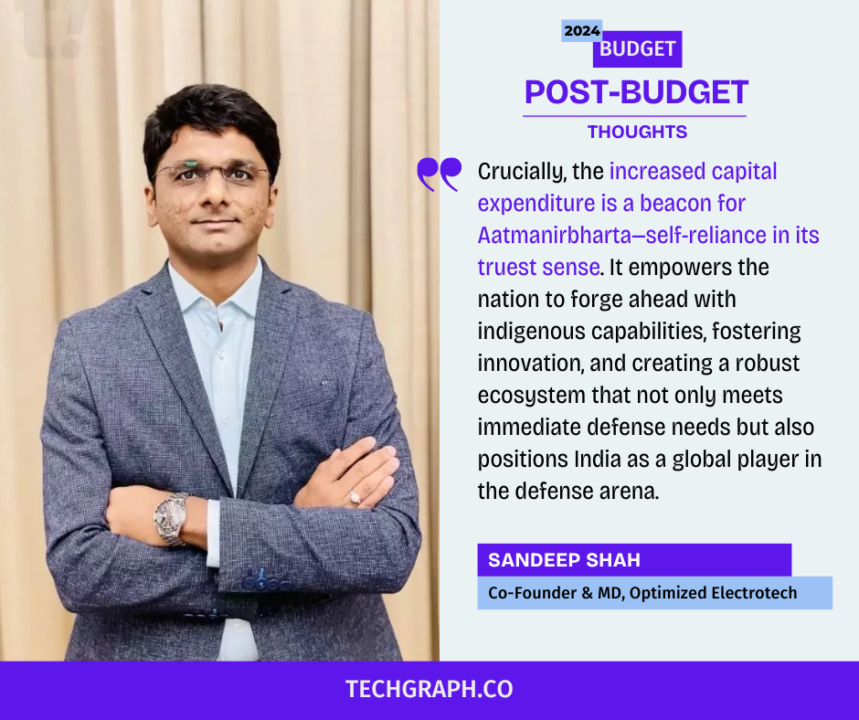
A strategic roadmap that not only balances fiscal prudence but also seeds the ground for sustainable growth, innovation, and resilience. Investing in a future that champions progress, inclusivity, and economic vitality.
Beyond numbers, it signifies a transformative shift in the defense industry, where innovation now takes center stage alongside capital. This strategic move reshapes the landscape, redefining the playbook for the next decade. The winners will be those who innovate, adapt, and champion progress.
This budget is not merely a financial plan; it’s a small step towards a comprehensive modification of the defense sector, heralding an era where the game-changers are the innovators.
Crucially, the increased capital expenditure is a beacon for Aatmanirbharta—self-reliance in its truest sense. It empowers the nation to forge ahead with indigenous capabilities, fostering innovation, and creating a robust ecosystem that not only meets immediate defense needs but also positions India as a global player in the defense arena.
Sudeep Kulkarni, Founder, Game Theory

In my view, Budget 2024 is all about supporting our young innovators. Setting up a Rs. 1 lakh crore fund with a 50-year interest-free loan is a positive step. It means long-term support for tech-savvy ideas. With this help for startups, our future looks brighter than ever.
Embracing the ‘First Develop India’ ethos, the government aims to forge bilateral treaties with foreign partners, prioritizing India’s growth. With a development policy centered on social and geographical inclusion, we’re charting a path toward a more equitable and prosperous future for all.
Sumit Kumar, Chief Strategy Officer, TeamLease Degree Apprenticeship
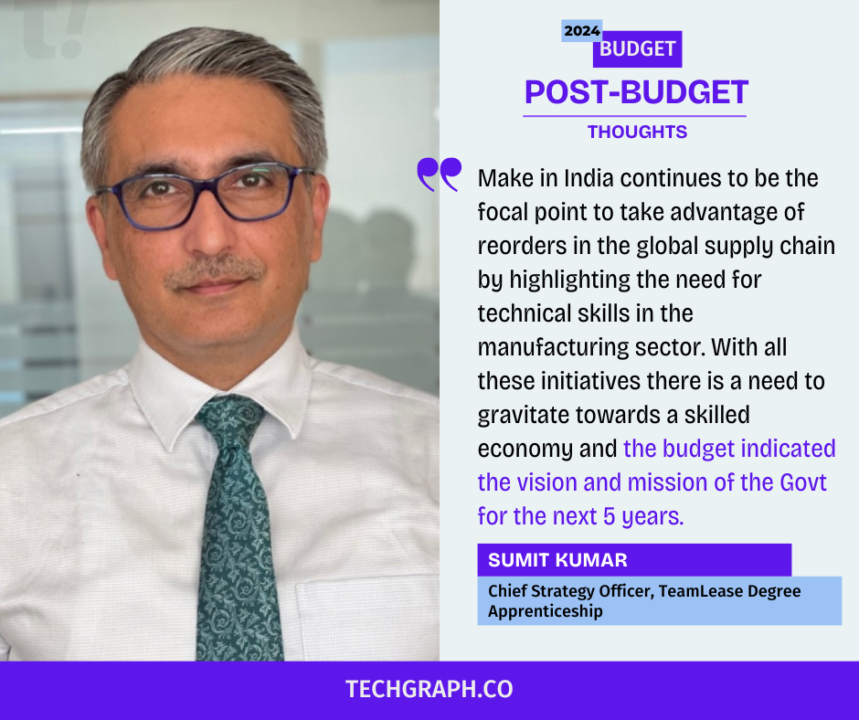
The budget paves the way for setting the stage for Viksit Bharat with Sabka Sath, Sabka Vikas, in 2024. It is inclusive, holistic, progressive, and sustainable, aiming for a $5 trillion economy by 2027 and preparing for a $30 trillion turn by 2047.
With the special focus on the poor, women, and youth – it is an indication of leveraging demographic dividends to raise economic productivity. Investments in infrastructure development related to travel, housing, and tourism are expected to raise much-needed employment opportunities which will percolate to the skilled talent required to fulfill those jobs.
To achieve the target of net zero carbon emissions by 2070, there has been an emphasis on a green economy with a focus on the expansion of solar energy, biofuels, and charging infrastructure which will raise the need for green skills.
Make in India continues to be the focal point to take advantage of reorders in the global supply chain by highlighting the need for technical skills in the manufacturing sector. With all these initiatives there is a need to gravitate towards a skilled economy and the budget indicated the vision and mission of the Government for the next 5 years that it is expected to be in power.
Kaushal Sampat, Founder of Rubix Data Sciences
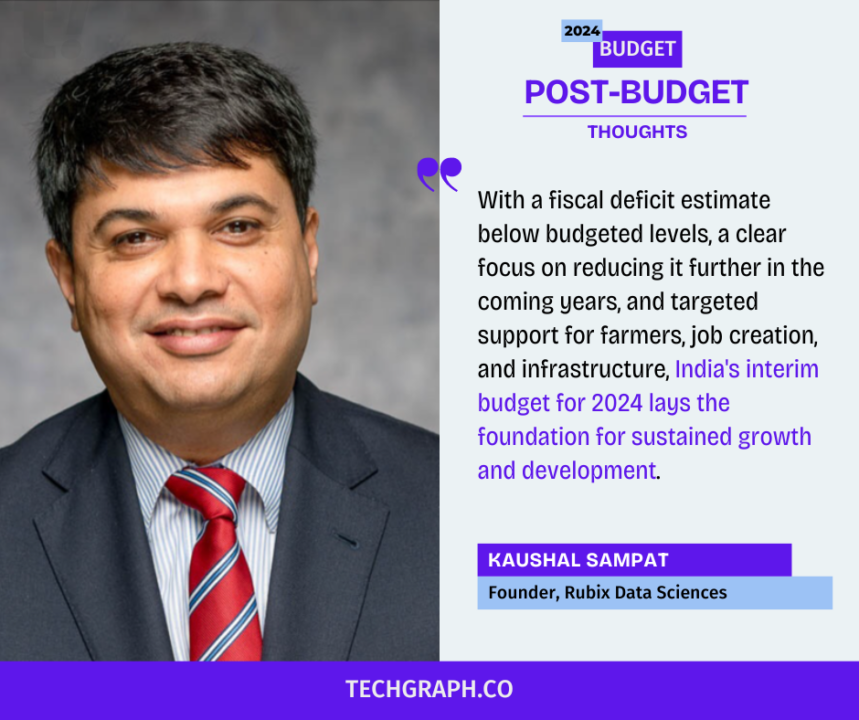
In the midst of an election year, India’s interim budget for 2024 has defied fears of fiscal recklessness, maintaining a commendable level of prudence. Despite the political climate, the government has opted for a lower borrowing number for the next year, signaling a commitment to fiscal responsibility. This budget stands out for its focus on infrastructure, capital expenditure, and fostering entrepreneurship—a clear continuation of a decade-long trajectory of GDP, to borrow the Finance Minister’s acronym for “Governance, Development, and Performance.
If India is to reach the ambitious target of $7 trillion GDP by 2030, it is important to focus on infrastructure development, energy security, skill development, and emphasis on innovation and entrepreneurship. The budget touches on all these aspects. Capex outlay has increased by 11.1%, there have been announcements on solar energy and electric vehicle infrastructure, and skill development is also being given importance.
The allocation of a significant 1 lakh crore for a 50-year loan dedicated to innovation, research, and development underlines the government’s recognition of the pivotal role these elements play in India’s journey to becoming a developed economy.
The budget speech not only highlighted government achievements but also provided a roadmap for the future, emphasizing macroeconomic stability, robust investments, and a thriving economy. With a fiscal deficit estimate below budgeted levels, a clear focus on reducing it further in the coming years, and targeted support for farmers, job creation, and infrastructure, India’s interim budget for 2024 lays the foundation for sustained growth and development.
Sankey Prasad, Chairman & MD, India and CMD Middle East Project Leaders, Colliers
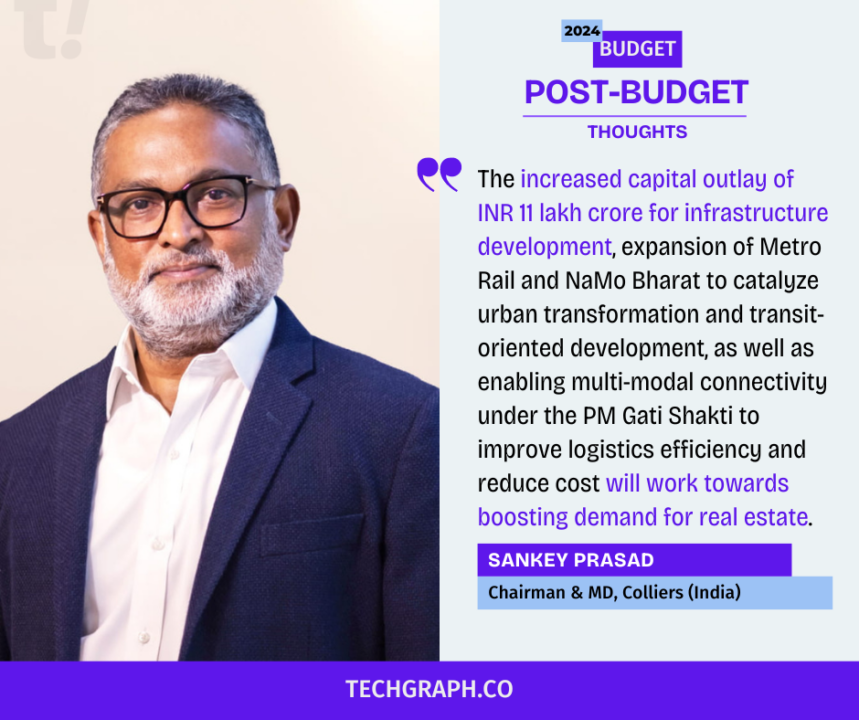
Looking at the announcements made by the Hon’ble Finance Minister today, we can clearly see the three pillars that real estate players should note: a) addressing social needs, b) closing market-specific gaps, and c) connecting the dots to fuel overall growth.
The ‘build or buy’ support for the urban middle-class is a near-to-medium-term opportunity with an immediate impact on the people while the announcement on creating and enhancing tourism hubs and a ranking framework based on supporting infrastructure is likely to make hospitality a sought-after subsector. It will bring hospitality-related development into sharp focus by creating the need for holiday homes, second homes, and commercial and social infrastructure in emerging tourist hubs.
Promoting rooftop solar systems at the household level and creating charging infrastructure for electric vehicles is a big boost towards the greening efforts we have been making and will help us widen the ambit of our impact.
Besides, the increased capital outlay of INR 11 lakh crore for infrastructure development, expansion of Metro Rail and NaMo Bharat to catalyze urban transformation and transit-oriented development, as well as enabling multi-modal connectivity under the PM Gati Shakti to improve logistics efficiency and reduce cost will work towards boosting demand for real estate.
Angad Bedi, Managing Director, BCD Group
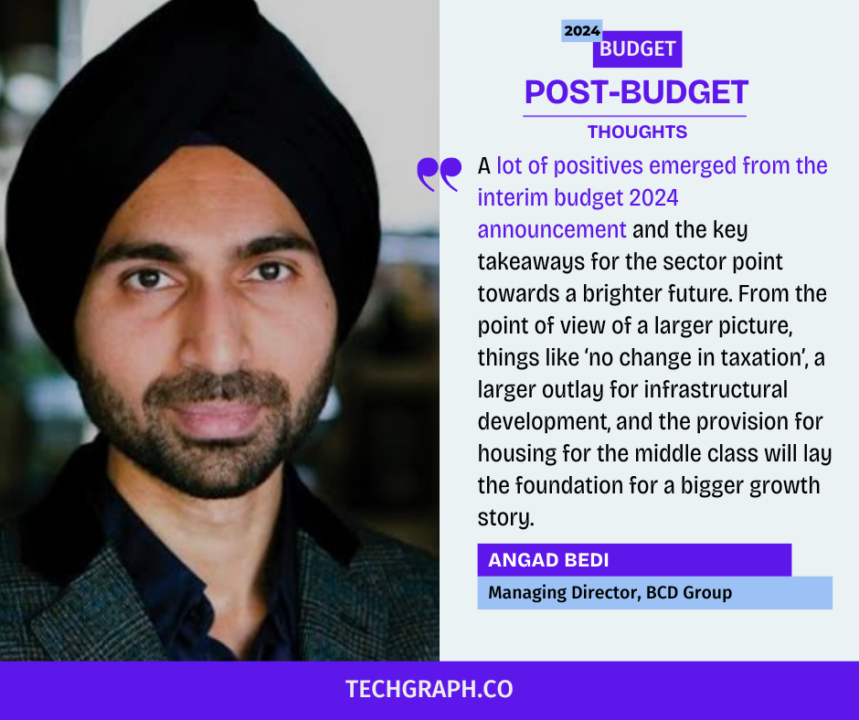
A lot of positives emerged from the interim budget 2024 announcement and the key takeaways for the sector point towards a brighter future. From the point of view of a larger picture, things like ‘no change in taxation’, a larger outlay for infrastructural development, and the provision for housing for the middle class will lay the foundation for a bigger growth story.
While looking at the cumulative result of what has been presented, I am optimistic that the actual budget will uncover fresh perspectives for the real estate sector, and in the process, the affordable sector will get immense opportunities to recover from the setback that it experienced in the last one or two years. At the end of the day, it is the consumer who will benefit, and we are eagerly waiting for more policy incentives and proactive steps for the sector.” scientific ecosystem in the country.
Saurabh Rai, CEO, ARAHAS Technologies
The Indian Government’s forward-looking Interim Budget for FY 2024-25 marks a transformative moment, aligning perfectly with its mission and values. The introduction of ‘Kartavya Kaal’—a call to duty for the private sector to significantly boost research and innovation—resonates deeply with our ethos.
We’re poised to lead in pioneering sustainable solutions across sunrise sectors, leveraging this budget as a springboard towards a greener, more innovative India.
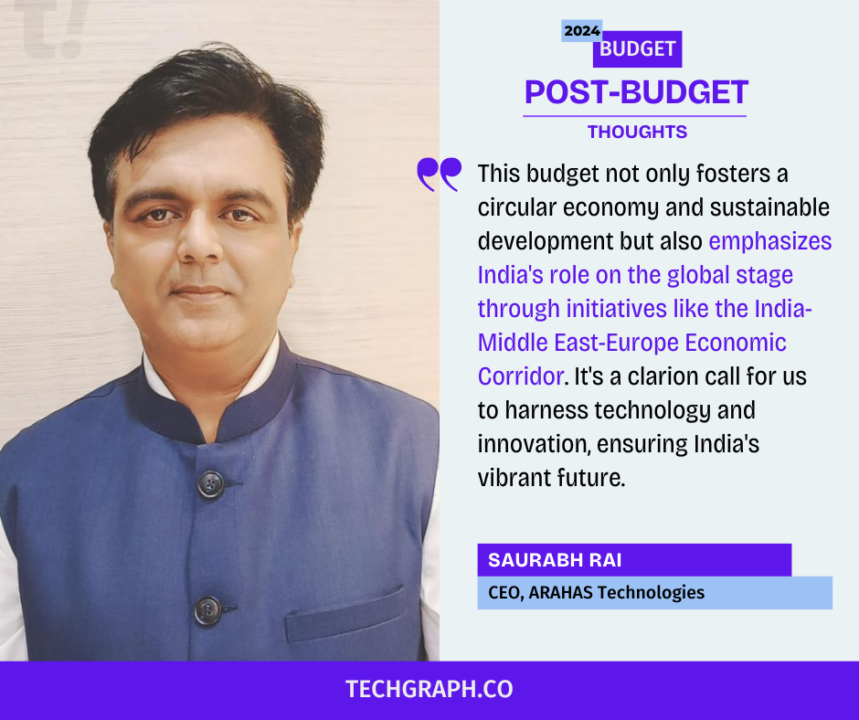
This budget not only fosters a circular economy and sustainable development but also emphasizes India’s role on the global stage through initiatives like the India-Middle East-Europe Economic Corridor. It’s a clarion call for us to harness technology and innovation, ensuring India’s vibrant future. We’re committed to contributing to ‘Innovation India,’ driving transformative changes that will benefit our society and economy.
Anshuman Das, CEO & Founder, LONGHOUSE Consulting
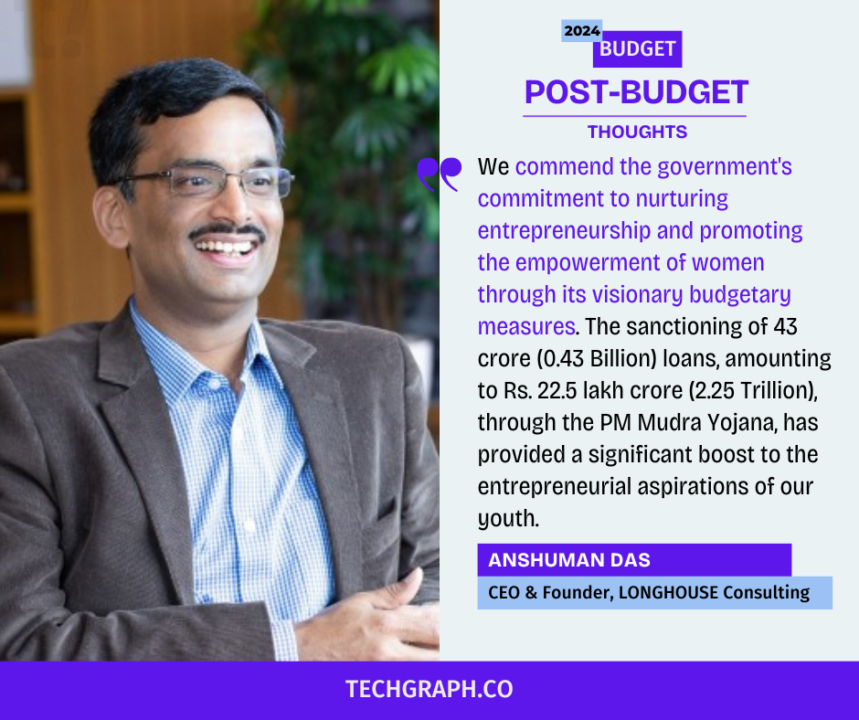
We commend the government’s commitment to nurturing entrepreneurship and promoting the empowerment of women through its visionary budgetary measures. The sanctioning of 43 crore (0.43 Billion) loans, amounting to Rs. 22.5 lakh crore (2.25 Trillion), through the PM Mudra Yojana, has provided a significant boost to the entrepreneurial aspirations of our youth.
In addition, the Fund of Funds, Startup India, and Startup Credit Guarantee Schemes have played a crucial role in supporting our budding entrepreneurs. The remarkable increase in women’s participation in the workforce is a testament to the government’s dedication to fostering women’s empowerment and ensuring a dignified standard of living. We applaud these endeavors and eagerly anticipate contributing to this transformative journey of progress.”
Ajay Trehan, Founder and CEO, AuthBridge
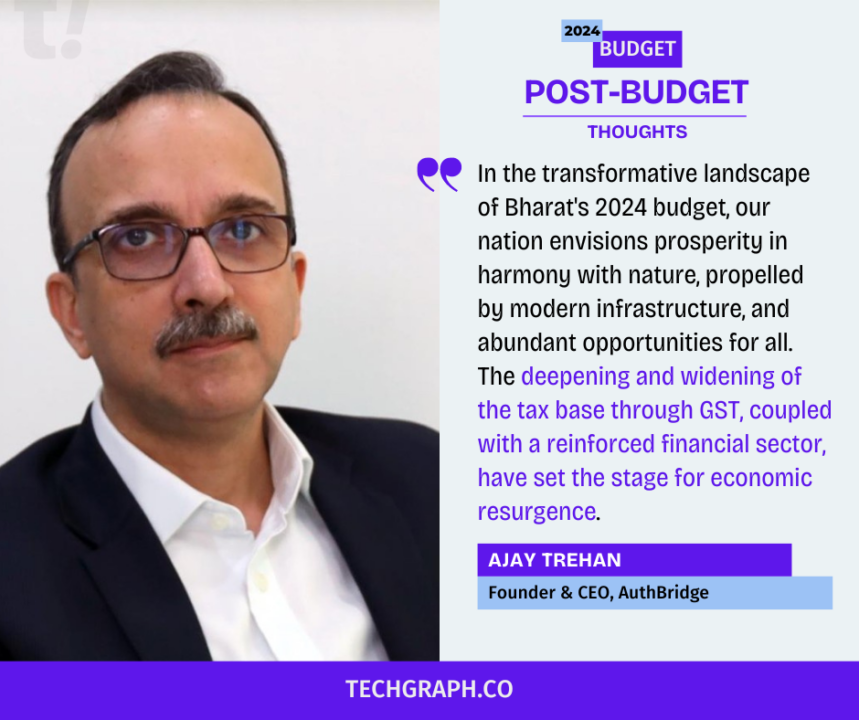
In the transformative landscape of Bharat’s 2024 budget, our nation envisions prosperity in harmony with nature, propelled by modern infrastructure, and abundant opportunities for all. The deepening and widening of the tax base through GST, coupled with a reinforced financial sector, have set the stage for economic resurgence.
As we witness the implementation of major railway corridor programs under PM Gati Shakti, the expansion of airports, and comprehensive urban development schemes, we seamlessly align with these initiatives. With 43 crore loans sanctioned under PM Mudra Yojana, AuthBridge is a key partner in enabling efficient verification processes, fostering employment growth, and contributing to the nation’s journey of progress and inclusivity.
Alok Kashyap, Founder & CEO, Yatiken Software Solutions
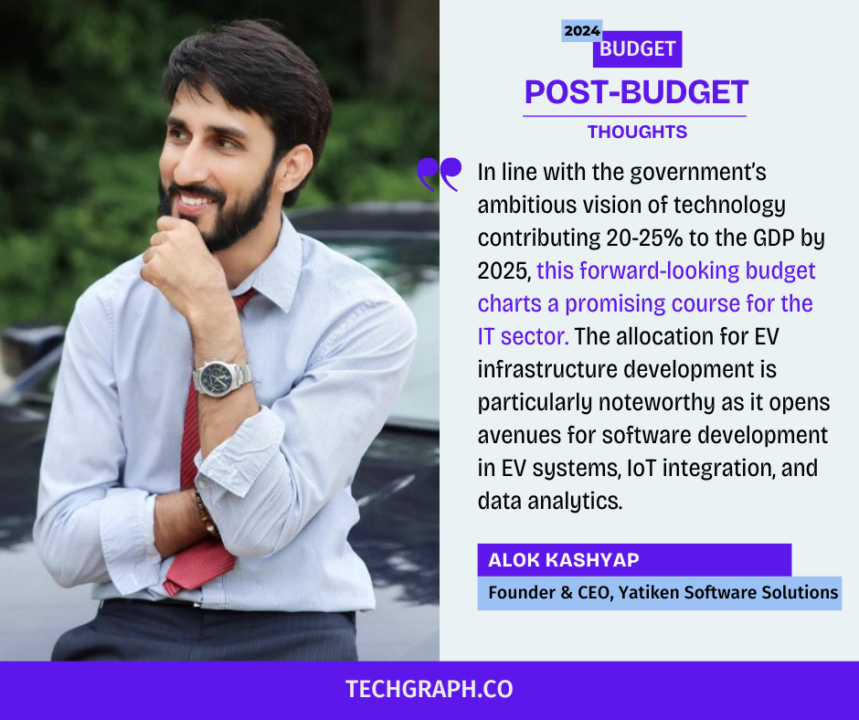
In line with the government’s ambitious vision of technology contributing 20-25% to the GDP by 2025, this forward-looking budget charts a promising course for the IT sector. The allocation for EV infrastructure development is particularly noteworthy as it opens avenues for software development in EV systems, IoT integration, and data analytics.
The 1-lakh crore corpus for long-term financing is another indispensable boon for the IT industry, fostering innovation and research. Moreover, the Skill India Mission’s initiatives and tax benefits for startups provide a robust foundation for skill development and entrepreneurial growth.