

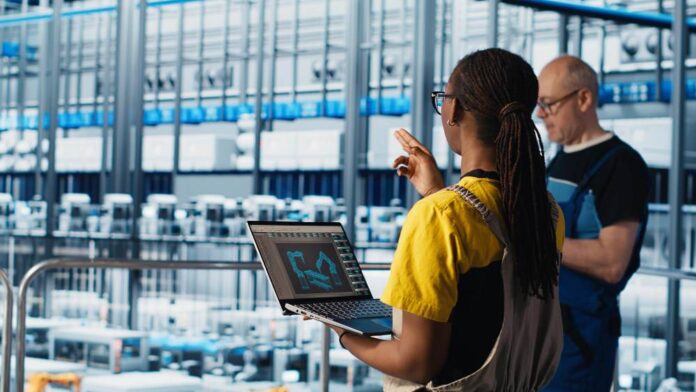
What Technologies Have Allowed the Manufacturing Industry to Exponentially Increase Output?

Date:

Trending

- Advertisement -

The manufacturing industry has consistently evolved with the advancement of technology. Innovations have simplified processes, boosted productivity, and significantly increased output. As we delve into the specific technologies that have revolutionized manufacturing, it’s evident that these transformations are steering the sector towards unprecedented productivity levels.

Laser Technology: Precision and Efficiency

According to JPS International, laser technology continues to dominate in 2025, with manufacturers leveraging its precision and efficiency to improve production processes. Laser tech, known for its ability to perform complex tasks with sharp accuracy, has replaced traditional methods that were labor-intensive and prone to errors. This technological leap allows manufacturers to maintain a high-quality standard while significantly cutting down the time and cost involved in production.

The integration of laser technology in manufacturing is more than just a trend; it’s a necessity. This innovative solution enables manufacturers to perform intricate cuts and welding tasks swiftly, enhancing both the speed and quality of output. As companies strive to meet increasing demand, the tech around lasers proves indispensable, endorsing a future where precision-engineered products become the norm.

Laser technology’s influence is profound, allowing greater flexibility in manufacturing operations. Companies can now design and execute tasks that were once deemed impossible, opening new avenues in product customization and functionality. With enhanced capabilities, this tech doesn’t just increase output; it diversifies the possibilities available to manufacturers, ultimately catering to a broader customer base.

Metal Fabrication: A Pillar in U.S. Manufacturing

According to the U.S. Department of Commerce, metal fabrication is the third-largest industry in the U.S. manufacturing landscape. This expansive sector underpins various critical industries by providing essential components required in everything from automotive to aerospace technologies. As manufacturing continues to scale, metal fabrication stands as a testament to the resilience and adaptability fueled by tech advancements.

- Advertisement -

Incorporating advanced technologies like robotics and automation, metal fabrication has undergone a significant transformation. These tech solutions streamline complex fabrication processes, reducing manual labor and increasing efficiency. Consequently, manufacturers can produce larger quantities of metal products at a higher rate, satisfying market demands effectively.

The growth of the metal fabrication industry showcases the symbiosis between tech and manufacturing. New materials and innovative processes developed through continuous research propel the evolution of this sector. As tech continues to infiltrate every aspect of manufacturing, the metal fabrication industry is poised for further expansion and integration across industries.

Welding: The Backbone of Production

According to US News, about 70% of all manufactured products involve some degree of welding. Welding is a crucial part of manufacturing, serving as the backbone for creating strong, durable products. With tech infusion, advanced welding techniques now enhance productivity, reduce defects, and ensure the longevity of products.

Technological advancements in welding have revolutionized how manufacturers approach complex repairs and fabrications. Automation in welding not only accelerates production but also helps mitigate human error, ensuring that each piece meets stringent quality standards. As demand for precision and quality increases, automated welding systems play a pivotal role in fulfilling those market needs efficiently.

- Advertisement -

Aside from improving accuracy, tech-enhanced welding processes facilitate innovative approaches to design and structure. Manufacturers can leverage these advancements to experiment with novel materials and sophisticated joint designs, driving innovation. As such, welding remains a cornerstone of manufacturing, continually evolving with tech to meet contemporary demands.

In conclusion, the exponential increase in manufacturing output can be attributed to the seamless integration of technologies such as laser technology, metal fabrication, and welding. These advancements have reshaped traditional manufacturing processes, making them faster, more efficient, and adaptable to the changing consumer landscape. As tech continues to advance, the manufacturing industry stands on the brink of even more groundbreaking developments, promising a future of possibilities and growth.

THE SNAPSHOTS

Sign up to get quick snaps of everyday happening, directly in your inbox.

We don’t spam! Read our privacy policy for more info.

- Advertisement -
Krishna Mali
Krishna Mali
Founder & Group Editor of TechGraph.

More Latest Stories

More Articles

India’s Air Crisis Needs a Deeptech Answer, Not a Consumer Gadget

Twenty years ago, an air conditioner in an Indian home was a luxury. Today it is infrastructure. Indoor air quality is on the same...

India’s Cloud Cost Crisis: Why Startups Are Rethinking Their Tech Stack

Over the last ten years, startups in India have experienced an incredible boom driven by the adoption of cloud services. It has enabled new companies to grow rapidly without having to invest large sums of money. For many startups, the cloud became the default...

Top No-KYC Crypto Casino Sites in 2026

Most online casinos demand a lot of personal information from you before you can...

Redrob AI Launches Professional AI Platform for India’s Workforce

In a bid to help students and professionals navigate an increasingly fragmented digital work...

Why Resume-Based Hiring Is Failing India’s Workforce

India needs a shift from credential-first hiring to skill-first validation

Why BFSI Is Moving from AI Experiments to AI Systems

For the past few years, Artificial Intelligence in banking, financial services, and insurance has...

From Intuition to Analysis: How AI Is Becoming Every CEO’s Second Brain

Most CEOs are making important decisions with partial information. The challenge is not just...

Rethinking Executive Search: Venator Search Partners’ Deepraditya Datta on Leadership Hiring in a Changing Talent Market

In an interview with TechGraph, Deepraditya Datta, Founder and Managing Director of Venator Search...

Simple Habits That Keep Your Car Running Longer

Keeping your car running longer doesn’t require expert-level knowledge—it comes down to building smart habits and staying consistent with maintenance. Many costly repairs and...

Beyond the MVP: Gacsym Ventures CTO Nandagopal P on Helping Startups Through Venture Studios

In a conversation with TechGraph, Nandagopal P, Chief Technology Officer at Gacsym Ventures, shared...

How Air Can Become Urban India’s New Water Source

India's cities are running dry. Chennai nearly ran out of groundwater in 2019. Bengaluru's...

Why Ontarex.com Is Gaining Canadian Investor Attention

In recent months, Ontarex has started to attract noticeable attention from Canadian investors. As...

How AI is Rewriting the Economics of India’s $300 Bn IT Services Sector

When Microsoft CEO Satya Nadella recently disclosed that artificial intelligence now generates nearly 30...

Why India Must Own Its Education Intelligence Stack

India has rapidly digitised large parts of its education ecosystem over the last decade. But digitisation alone does not improve learning outcomes. The next...

AI and Fake Content: Can Technology Win the Battle Against Misinformation?

Artificial Intelligence has transformed how content is created, manipulated, and distributed at scale. News, video, photos, and opinions are now shared across different platforms within seconds. This increased speed and the accessibility of communication thanks to Artificial Intelligence has created an unprecedented challenge for...

Why Micro Learning at 3 Minutes Works Better Than Lectures at 3 Hours

In the fast-moving world of digital education, there is one myth that continues to...

More Than Just a Scratch: The Importance of Windshield Care

Maintaining your vehicle’s windshield often appears as a seemingly minor task that can easily...

The Rise of Integrated Solar Tech Ecosystems in India

India’s clean energy is all about building an ecosystem that is interconnected with various...

Beyond Nvidia: The Hidden Winners of the AI Stock Rally

Nvidia stock (NASDAQ:NVDA) has returned roughly 1,200% since ChatGPT launched in late 2022. Most...

What PM Modi’s Appeal to Avoid Gold Buying Could Mean for India’s Jewellery Economy

When Prime Minister Narendra Modi recently urged citizens to avoid purchasing gold for a...

As Crypto Markets Mature the OpenSea Insider Trading Case Still Shapes Governance Debates

When federal prosecutors charged former OpenSea employee Nathaniel Chastain in June 2022, the case...

How Agentic AI Is Personalising the End to End Salon Experience

Walk into a salon today, and more often than not, the experience still depends...

From Black Box to Trusted AI: Why Defence Needs Constitutional AI Models

For decades, the defence and intelligence agencies have followed one non-negotiable rule: trust nothing...

Hermès vs MetaBirkin: The NFT Case That Redefined Ownership on Ethereum

The NFT boom of 2021 and early 2022 pushed digital assets into the mainstream,...

Why Ontarex.com Is Gaining Canadian Investor Attention

In recent months, Ontarex has started to attract noticeable attention from Canadian investors. As...

“Budget should focus on reducing taxes on capital gains,” Says Abhishek Gupta of Hex N Bit

Speaking in the upcoming Union Budget 2021, Abhishek Gupta, Founder, and CEO, Hex N...

“China is a Global thief” Rep. Tom Rice on Uyghur Forced Labor Prevention Act

Speaking at the House on Uyghur Forced Labor Prevention Act, Rep. Tom Rice (R-SC)...

Why Cyber Resilience Is Replacing Cybersecurity as a Boardroom Priority

Traditionally, cybersecurity was hard-wired to be a technology concern that was only taken care...

Infrastructure 4.0: How AI & Predictive Analytics Are Transforming Real Estate

The new era of technology and innovation has changed operations in many industries. The...

How AI is Rewriting the Economics of India’s $300 Bn IT Services Sector

When Microsoft CEO Satya Nadella recently disclosed that artificial intelligence now generates nearly 30...

Alphabet Discloses $2.14 Billion in Public Equity Holdings as of June 30

Alphabet Inc. disclosed $2.14 billion in equity securities held across 39 positions as of...

The Role of Edtech in Addressing Equity Gaps in Higher Education

In the fast-paced world of EdTech today, the opportunity to bridge educational gaps and...

India to generate $100 bn from telephonic investments

India expects to attract $100 billion in investments in the telecom sector, a union...