


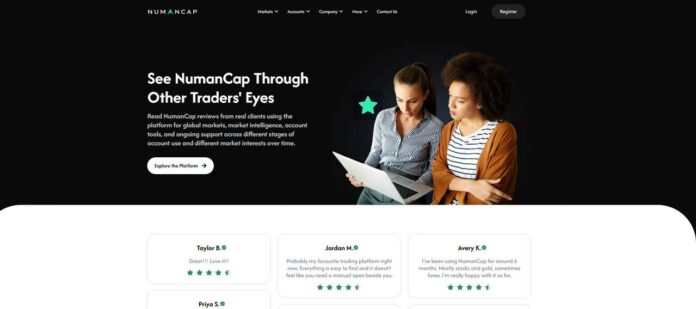

Not long ago, trading meant calling a broker, paying a hefty commission, and waiting for a confirmation in the mail. Today you can open a position on oil, gold, the S&P 500, or Bitcoin from a laptop in a few clicks, or from your phone during a lunch break.
That accessibility is a big step forward, but it brings a new challenge. With so many markets open and so much information flying around, the hard part is no longer placing a trade. It’s understanding why a market is moving, deciding whether it deserves your attention, and managing risk once you’re in.
A good online trading platform should help with all of that. It should give you access to the markets you care about, explain what’s driving them, protect your account, and let you trade from wherever you are.
This next NumanCap Review looks at how NumanCap approaches each of these, from the markets it offers and how margin works to fees, security, and education.
What Is NumanCap?
NumanCap is an online trading platform launched in 2026, designed mainly for Canadian traders who follow more than one market. Its tagline, “a platform for the wealth you’re still building,” sums up the idea: it’s aimed at people who are actively growing their trading and want a platform that grows with them.
The thinking behind it is that a price on its own is only the start. NumanCap keeps market data, charts, economic calendars, and the order ticket in one connected workflow, so the reasons behind a trade stay in view from research to execution. You don’t have to jump between a news site, a charting tool, and a separate trading app.
All trading on NumanCap is done through CFDs (contracts for difference). New users can explore everything on a free demo account before opening a live account from $250.
Range of Markets
One NumanCap account covers six asset classes, each driven by its own set of forces:
There’s also a futures section for traders who want contract-based exposure.
The real advantage is seeing these markets side by side. They don’t move in isolation. Crude oil often pulls the Canadian dollar with it, interest-rate expectations push gold around, and a strong earnings season at the big banks can lift the whole TSX. NumanCap is built so you can follow those connections from one screen, which makes it especially useful for traders who follow the bigger economic picture rather than a single market.
Account Opening
Getting started with NumanCap is simple, and you can take it at your own pace:
Try the demo first. Open the free demo account and practise with simulated funds. You can explore the charts, the markets and the order process without depositing anything.
Fill in your application. When you’re ready for a live account, complete the online application with your personal details.
Verify your identity. Follow the verification steps shown during setup. You’ll usually need a government-issued ID and proof of address, and NumanCap may ask for more depending on your account.
Choose your account level and fund it. Look over the funding options in your account and pick the level that suits you. Most traders start on Core, from $250.
Place your first trade. Pick a market, check the information around it, review your order, and submit.
NumanCap offers five account levels, and each one adds more service:
Margin Trading – How It Works
Margin trading means opening a position worth more than the money you put up. The amount you commit is the margin, and the ratio between the position and the margin is the leverage.
With 1:25 leverage, $400 of margin controls a $10,000 position. If the market moves 2% in your favour, you gain $200, which is half your margin. If it moves 2% against you, you lose the same $200.
Leverage on NumanCap
NumanCap links leverage to your account level:
- Core, Plus and Pro: up to 1:25
- Premium: up to 1:100
- VIP: up to 1:200
Starting everyone at a moderate 1:25 is a sensible approach. New traders get enough flexibility to take meaningful positions without the extreme multiples that can wipe out an account in minutes. Higher leverage is reserved for larger, experienced accounts that also come with closer support. These are maximums, and the actual margin requirement can vary by instrument, so check it before you open a trade.
Trading on Margin Responsibly
Use less than the maximum. Many experienced traders use a fraction of the leverage available to them.
Risk a small, fixed share of your account per trade. Many traders use 1–2%, and size each position to match.
Plan your exit before you enter. Know where you’ll take profit and where you’ll cut a loss.
Watch your free margin. In fast markets, open positions can use up available margin quickly.
Remember the cost of time. Positions held overnight usually carry a financing charge.
Mobile Trading
NumanCap treats your phone as another way into the same account, not as a separate, stripped-down product. Your markets, open positions and account activity stay in sync between mobile and desktop, so you can start researching at your desk and check in later from your phone without losing track.
With the NumanCap mobile app, you can:
- Follow all six markets available on your account
- Go back to your watchlist and see what has changed since you last looked
- Check price charts and recent moves
- Monitor your open positions
- Review your account activity and balance
This makes mobile ideal for staying in touch. You can see that gold has jumped on a rate headline or that your oil position is nearing your target, and decide quickly whether to act. A good rule of thumb is to do your deeper analysis on a bigger screen and use your phone to monitor and adjust.
On mobile, security is mostly in your hands. Only use the official NumanCap app, keep your device updated, and avoid logging in over public Wi-Fi.
Fees
With CFD platforms, it helps to know where costs typically come from:
Spreads: the difference between the buy and sell price, and the main cost on most CFD trades
Overnight financing: a charge (or occasionally a credit) for positions held past the daily cut-off
Commissions: charged on some instruments or account types
Account-related fees: such as currency conversion, withdrawal or inactivity charges, depending on the provider
NumanCap says its charges depend on the products and services available on your account, and fees are shown inside the platform rather than as a public price list. Before you fund, ask support for the spreads, overnight rates, and any deposit or withdrawal fees on the markets you plan to trade. Getting them in writing is a good habit with any broker, and it lets you work out the real cost of your trading style.
Also remember that live trading costs can differ a little from the demo, especially around fast-moving news. Use the demo to learn the platform, and your first few small live trades to see what trading actually costs you.
Security
NumanCap explains its approach to account protection in plain language on a dedicated security page. Protection is shared: the platform provides the safeguards, and you take care of the parts only you control.
On the platform’s side:
- Identity verification when you open an account
- Account-access controls, with extra authentication options where available
- Records of logins, transactions, and funding status you can review in your account
- Deposit and withdrawal routes shown only inside your official account
On user side:
- Use a strong, unique password and turn on any extra login protection
- Always check you’re on the official site or app before signing in
- Keep your devices updated
- Never follow payment instructions that arrive by email, text or social media
- Check your account activity regularly
- Contact support straight away if anything looks unfamiliar
NumanCap is clear that genuine payment details only ever appear inside your account. If someone contacts you claiming to be from the platform and asks you to send money elsewhere, treat it as a red flag and contact official support directly. Before funding, it’s also sensible to ask for the platform’s company and licensing details and check them with your local regulator.
Education
NumanCap’s education section is one of its strengths, and it’s written with Canadian traders in mind.
Market guides that explain the “why.” The blog covers topics such as how Bank of Canada rate decisions move the loonie, why USD/CAD tracks crude oil, the gap between WTI and Western Canadian Select, how the TSX differs from the S&P 500, and how earnings season affects Canada’s big banks.
Clear explanations of the basics. There are guides on pips, lots, and spreads (using USD/CAD examples), stock CFDs compared with buying shares, and crypto ETFs, crypto CFDs, and owning coins compared, which is a practical choice many Canadians face.
Deeper topics for growing traders. Articles cover futures rollover, contango and backwardation, the gold/silver ratio, Bitcoin halving and why crypto is so volatile.
A glossary of around 375 terms. It runs from A to Z and covers everything from liquidity and market capitalisation to implied volatility, the Sharpe ratio and value at risk.
The demo account. Practice is the best teacher. The demo lets you apply what you’ve read, test strategies, and see how leverage affects a position, all without risking real money.
Conclusion
Online trading has never been easier to get into, and that makes choosing the right platform more important. NumanCap’s appeal is that it brings the pieces together. You get six markets in one account and a workflow that keeps context next to the price. Margin starts at a moderate level and rises with experience, and mobile access keeps you connected wherever you are. Behind that sit education built for Canadian traders and practical security guidance.
The best way to get to know it is step by step. Start with the demo, read a few of the guides, ask support about fees and company details, and then open a Core account with a modest amount and low leverage. Let your experience set the pace, and move up as your trading grows.
Risk warning:
Trading CFDs, forex, crypto, and other leveraged products involves significant risk, and you can lose some or all of your money. Leverage magnifies both gains and losses. This article is for information only and is not financial advice.


