


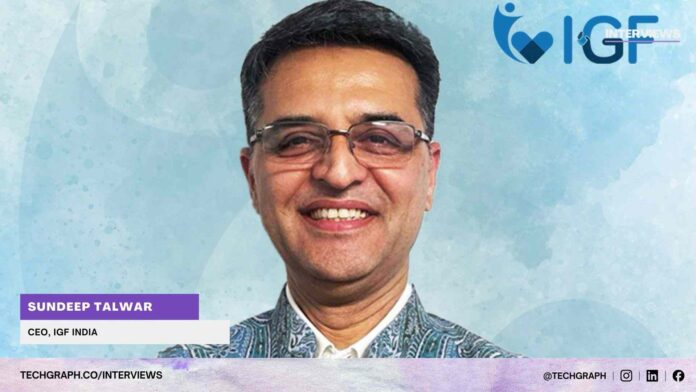

Speaking with TechGraph, Sundeep Talwar, CEO of IGF India, discussed the foundation’s decade-long journey has evolved from providing curative medical aid to building a preventive, community-focused healthcare model has reshaped its approach to saving lives, and and how initiatives such as early screening, health-awareness programmes, and doorstep doctor consultations through Care on Wheels mobile medical units are helping women’s and undeserved communities access timely medical support without the burden of travel or delayed care.
Talwar further explained how IGF India is strengthening healthcare delivery by working closely with government hospitals and PHCs, expanding system-level interventions like the ANGEL programme to upskill nurses and ASHA workers, and integrating digital and AI-enabled tools, including health kiosks and transparent donor-monitoring systems that ensure underserved communities receive dignified, affordable, and continuous care while helping build a sustainable and resilient public health ecosystem.
Read the interview in detail:
TechGraph: IGF began in 2014 with a mission to make healthcare more accessible and equitable. After a decade in the space, how has the organization evolved its approach to saving lives, especially in areas where public health systems still struggle to reach?
Sundeep Talwar: IGF began in 2014 with a strong focus on curative care, providing financial aid support for critical & curative illnesses, where treatment costs were overwhelming for families. This support saved many lives, but the COVID-19 pandemic changed our perspective. Infrastructure support to government hospitals, medical equipment, followed by upskilling of Nurses through the ‘ANGEL’ program, were early initiatives of direct implementation of CSR programs on the ground. Based on the studies and recognising the alarming fact that India has one of the largest Diabetic populations globally, and in parallel, we saw that preventable conditions were turning into crises simply due to delayed care, lack of awareness, and limited access.
This realisation pushed us to expand our philanthropic work from purely curative support to a more preventive healthcare, community-focused model. We strengthened early screening, follow-ups, and linkages to existing health systems. Our mobile medical unit, Care on Wheels (C.O.W./Mobile Medical Units), became a key part of this shift. It reaches communities—especially women—who struggle to spend an entire day travelling to hospitals. With C.O.W., consultations happen at their doorstep within minutes, reducing both time and travel costs in the rural and slum areas.
Over time, this evolution has helped us reach underserved regions more effectively and ensure that fewer families fall into crisis before receiving care.
TechGraph: Over time, the Foundation’s focus has expanded from funding treatments to implementing preventive and curative programs. What pushed that shift, and how do you measure whether those interventions are genuinely reducing long-term health risks?
Sundeep Talwar: Our shift toward preventive care became significantly stronger during COVID-19. That period reminded all of us how powerful simple preventive behaviours can be—frequent handwashing, sanitising essentials, and being mindful about exposure. As a country, we realised that preventing illness often protects more lives than treating it later.
This understanding deepened when we worked closely with underserved communities. Many families were avoiding hospitals, living in unhygienic conditions, and often ignoring early symptoms. It became clear that without preventive action, curative cases would only continue to rise.
The experience that truly shaped our thinking came through our Care on Wheels (COW) programme. Today, 28 COW units operate across the country, and together they have provided treatment to over 3.3 lakh individuals. In just the last nine months, we have conducted 455 awareness sessions, building a culture of early health-seeking behaviour.
One incident remains deeply etched in our minds. An elderly woman fainted near our COW unit, and our team rushed to help. She was found with dangerously high BP and uncontrolled diabetes. After we referred her to the government hospital, women from the same community shared that they too had faced similar issues earlier—but regular COW check-ups had helped them understand and manage their health better. That moment showed us how preventive care truly empowers communities.
A similar realisation came from an experience in Ahmedabad. In a case involving a 22-year-old pregnant woman who was too weak to reach the hospital during labour, our field team identified the emergency only because of routine home-based monitoring and rapid response protocols. This timely intervention led to a safe delivery and prevented what could have become a fatal complication. Experiences like this made it clear that prevention and early care are not optional—they are lifesaving.
Our preventive approach is strongly reflected in our scale. More than 500 people have participated in our cancer screening camps, nearly 6,000 individuals have attended our eye camps, and thousands more have undergone basic health check-ups through COW. On World Diabetes Day alone, our teams across India served around 10,000 people in a single day—offering screenings, counselling, and medication. We also organised awareness marches to encourage communities to prioritise early detection.
This shift is not just an organisational decision; it represents a remarkable change in community mindset. Preventive care has helped people take charge of their health, ask questions, seek help early, and break patterns of neglect. Today, this behavioural transformation is reducing long-term health risks far more effectively than treatment alone ever could.
TechGraph: The healthcare sector often struggles with uneven access and affordability. Given that IGF works across diverse regions, how do you ensure that your interventions don’t just fill temporary gaps but also strengthen local health systems in a lasting way?
Sundeep Talwar: Our effort to build lasting impact goes beyond providing medical support—we work to strengthen the local systems that families rely on. IGF partners closely with government hospitals, PHCs, and government schools, ensuring that our work complements existing public services. These tie-ups allow us to create smooth referral pathways so that patients can move to the right level of care without delay. A major challenge we recognised early on was that many people simply did not know where to go, which schemes they were eligible for, or how to navigate the system. Through IGF’s community mobilisation efforts and consistent outreach, we have been able to close this awareness gap.
Our ANGEL programme is one of the strongest examples of how we support system-level strengthening. This initiative was recognised across the country, especially during COVID-19, when the need to upgrade the skills of nurses and ASHA workers became urgent. In collaboration with Microsoft, we developed an interactive software that allowed frontline workers to learn, revise concepts, and upskill themselves at their own pace. The platform also included live tele-support—so if an ASHA or nurse needed assistance, someone was available to guide them immediately. It became a fully integrated support system that helped improve the quality of care at the grassroots level and strengthened the capacity of our public health workforce.
Alongside upskilling, we also work on improving the physical infrastructure that communities rely on. Our renovation efforts in Anganwadis and PHCs are designed to help the government create environments where children, mothers, and frontline workers can truly flourish. Whether it is improving sanitation, reorganising spaces for better service delivery, or ensuring essential equipment is available, the goal is to build safe, functional, and dignified spaces that enable better health outcomes. These improvements reduce operational gaps, enhance service quality, and ultimately reinforce the overall public health ecosystem.
Along with health services, we run programs that build financial and digital literacy, helping families manage their budgets, reduce fraud risks, and make informed decisions. We also support them in enrolling for essential schemes such as ABHA, Ayushman Bharat, and other government benefits so they can access the care and entitlements available to them.
By strengthening knowledge, building confidence, and ensuring strong institutional linkages, we are not just filling temporary gaps—we are helping communities become more empowered, informed, and connected to the health systems around them.
TechGraph: Many CSR partnerships start with strong intent but fade when economic cycles turn. How does IGF protect the continuity of its programs when funding volatility becomes a challenge?
Sundeep Talwar: CSR norms in India are evolving constantly, and this has led to shorter funding cycles. While this brings challenges for both organisations and CSR partners, we have addressed it by building relationships that are rooted in trust, transparency, and consistent communication. Our strong reporting systems and clear outcome tracking help partners see the tangible value of their investment, which has encouraged many of them to stay committed even in uncertain phases.
We also design our programs with sustainability in mind so that essential support continues even when funding fluctuates. For instance, our sanitary pad vending machines installed in public utilities (including stations, bus stands, schools) come with both Coin & QR-based payment options. This ensures that women can continue accessing sanitary pads without hesitation, even in periods when external funding is temporarily unavailable. Our aim is to create models that keep serving the community with dignity, irrespective of funding gaps.
Most importantly, we remain honest and open with our stakeholders—donors, partners, and the communities we work with. Their trust and continued belief in our mission have been central to sustaining our programs, and we hold deep gratitude for the support they extend to us.
TechGraph: India has seen a rise in digital health platforms and AI-driven diagnostics. How then does IGF decide which technologies are worth integrating into its model without losing sight of the human realities it was built to serve?
Sundeep Talwar: The rise of digital health and AI-driven tools marks one of the most significant global shifts in decades—perhaps the biggest transformation since mobile phones changed the way we live and connect. As this new wave of technology emerges, we see AI as a powerful enabler, provided it strengthens care without distancing us from the human realities we serve.
We integrate technology only when it adds real value. One example is our contactless physiological monitoring system, where a user simply sits in front of a laptop webcam. The AI captures subtle facial cues—skin tone variations, micro-expressions, and other indicators—and processes them in real time to extract vital signs with medical-grade accuracy. The results are displayed instantly and can be securely pushed into existing systems through APIs. This makes screening safer, faster, and more accessible for communities that often face barriers to early detection.
Beyond patient care, AI is becoming a crucial part of our internal operations as well. We use AI-enabled systems for monitoring, reporting, and data management, which helps us improve accuracy, streamline workflows, and make more informed program decisions. This means IGF is not only bringing advanced tools to the field but also evolving as an organisation—becoming more efficient, data-led, and future-ready.
A good example is the Health Kiosk initiative of the Government of Uttar Pradesh, where IGF served as the implementing partner. These self-service kiosks offer quick, non-invasive tests—blood pressure, heart rate, BMI, oxygen levels, and nearly 2,500 diagnostics—with simple interfaces and instant results. They even enable telemedicine consultations for people who may never otherwise speak to a doctor. By helping deploy 44 kiosks across Lucknow, Varanasi, and Gorakhpur, we saw how the right technology can decentralise diagnostics, reduce pressure on PHCs, and make preventive care accessible at the doorstep—without replacing the human touch.
For us, technology is most meaningful when it enhances dignity, deepens trust, and allows both our team and our communities to move forward with confidence.
TechGraph: Healthcare philanthropy in India has often been criticized for being reactive rather than strategic. How has IGF tried to move beyond crisis-led giving to create more sustained, data-driven change in the sector?
Sundeep Talwar: Our strategy is built on learning from patterns, voices from the ground and baseline studies, not just responding to emergencies. Over the years, we have invested in technology, partnerships for innovations, data systems, community mapping, and evidence-based models that allow us to anticipate needs rather than react to them. By understanding why certain illnesses go untreated or why communities delay care, we design targeted interventions that break these cycles.
For us, technology must strengthen care—not complicate it. A powerful example is our AI-enabled contactless vitals assessment system. Instead of relying on physical devices, an individual simply sits before a laptop webcam, and the software analyses minute facial changes—blood-flow patterns, micro-movements, and tonal shifts—to generate accurate vital signs within seconds. These readings are instantly visible to the user and can be seamlessly integrated into existing digital health records through secure APIs.
This approach helps us move from crisis response to long-term health security, ensuring that support is not event-driven but rooted in sustained, measurable change.
TechGraph: Fundraising fatigue and donor scepticism have become more visible in recent years. What has IGF done differently to maintain public trust and keep supporters emotionally and financially invested in your mission?
Sundeep Talwar: Donor fatigue and scepticism are real challenges today, but what has helped IGF sustain trust is the deep alignment we share with our supporters. Both donors and our team are driven by the same intention—to reach people who genuinely need support and to create change that is visible, meaningful, and lasting.
Our work on the ground speaks for itself. The impact is not abstract; it is seen in the lives of families who receive timely care, in communities that now access preventive services, and in the growing confidence of people who feel supported with dignity. When donors witness these outcomes, they feel emotionally connected to the mission, not just financially involved.
We maintain strong accountability through transparent reporting, reliable data, and honest communication, thus building ‘Trust’ with our donor partners. This clarity helps donors feel reassured that their contributions are being used responsibly and effectively. Because of this shared alignment and openness, our supporters continue to stand with us—even during difficult times—knowing that their partnership directly benefits the people who need it most.
TechGraph: Transparency and trust are crucial for any non-profit, especially one dealing with healthcare. What systems have you put in place to ensure accountability not just to donors but to the patients and communities who depend on you?
Sundeep Talwar: Transparency is the first and most important value at IGF, and that’s the core value too. We hold ourselves accountable not only to our donors but also to the beneficiaries who place their trust in us during some of the most vulnerable moments of their lives. Our aspiration is to become one of the most transparent NGOs in India.
To ensure this, we have built systems that make our work visible and verifiable. For instance, we have installed cameras in our C.O.W.’s (MMUs) so that donors can observe the work happening on the ground in real time. Health Management Application captures the real-time data, and the donor partner has access to the application. At the community level, our team members consistently address questions from families who may initially be unsure or suspicious—many wonder why a service is free or whether there is an agenda behind it. By early next year, we shall also be launching our beneficiary/patient app so that they can also track their health parameters, beyond visiting our C.O.W operations. We believe these doubts deserve honest, patient responses.
Through sustained engagement, partnerships with local stakeholders, and clear communication, we make sure families understand every step of the process. This openness helps build a two-way relationship of trust, which is essential for long-term change. When communities feel informed and respected, and when donors see the integrity of our work, it strengthens the bond that makes our impact possible.
Transparency is not just a principle for us—it is the foundation on which we build confidence, dignity, and meaningful transformation.
TechGraph: Looking ahead, how do you see the future of healthcare-focused non-profits in India evolving? Do you believe the sector is moving toward deeper collaboration, more tech-led solutions, or a fundamental rethink of how health equity is pursued?
Sundeep Talwar: The future of healthcare-focused non-profits in India is clearly moving toward deeper collaboration and technology-led solutions, and IGF is strongly aligned with this direction. As we build systems that are increasingly data-driven and tech-enabled, we are also committed to ensuring that these innovations genuinely improve lives and bring care closer to the people who need it most.
A powerful example of this approach is our work in developing a convertible wheelchair—a device that functions both as a normal wheelchair and a motorised one. This technology has been designed and built in India in collaboration with IIT Madras & young minds, and we are proud of how it has transformed mobility for individuals who previously struggled with even basic movement. We collaborate closely with government departments to identify people with locomotor disabilities, understand their needs, and provide solutions that restore both independence and dignity.
Through this experience, we have also seen how disability impacts far more than physical movement—it deeply affects emotional well-being. Many individuals we met were not only dealing with mobility challenges but also facing a silent mental burden. Their confidence had diminished, and their sense of self often suffered. By providing tech-led mobility solutions and consistent follow-up support, we have witnessed a powerful shift: improved mobility has helped them regain confidence, participate more actively in daily life, and feel emotionally stronger.
This case study reflects where the sector is heading—a thoughtful blend of technology, community partnerships, and a holistic understanding of health. For IGF, the goal is not just to alleviate medical challenges but to help people reclaim their independence, dignity, and mental strength.