



As Budget 2025 approaches, experts from the NBFC, finance, and business sectors are voicing their hopes for clearer and more consistent tax treatment across asset classes, particularly between mutual funds and alternative investments, to address existing inefficiencies.
Additionally, experts are calling for tailored measures to support NBFCs in driving infrastructure growth, including tax-free bonds and funding programs aimed at lowering borrowing costs.

Read the Union budget 2025 expectations in detail:
Vivek Banka, Co-Founder, GoalTeller

The Finance Minister in the budget presented earlier this year mentioned the government’s objective of simplifying the tax structure and hence had made capital gains uniform across various asset classes. Unfortunately, due to legacy issues, a lot of complexity still exists in the form of purchase dates of debt funds, international funds, and even Gold Funds which have subsidized taxation only from 1st April 2025, these inconsistencies have created a lot of confusion in the minds of retail investors.
Further uniformity can be bought by converging tax rates of different sub-asset classes viz. International Equities to Domestic Equities on par, debt funds on par with Gold Funds, and Gold Funds on par with Gold ETFs for example. These things will go a long way in helping achieve clarity amongst investors, which unfortunately is still quite ambiguous. Also unless a strong reason, actions should not be retrospective of too much in the future viz. The taxation of Gold Funds that come into effect only from 1st April 2025
Added to this an increase in section 80c despite the government focus on the new tax regime, a pause in the increase of long-term capital gains, and finally a more accurate and updated TIS and AIS statements will be immensely helpful for the middle-class investors.
Prashasta Seth, CEO, Prudent Investment Managers LLP

From an Alternate Investment Industry perspective the key expectation is the synchronization of the tax treatment with the mutual funds. Today the tax structure of the Alternative investment industry is very inefficient e.g. fees paid isnt tax deductible, and tax has to be paid on a trade-by-trade basis. This is hampering the growth in the industry at a time when the SEBI is providing more flexibility to the mutual funds to compete with the alternate investment managers.
From a capital market development perspective, the biggest expectation is to take measures to boost consumption growth, which has eased out considerably and has started to impact the GDP growth numbers. Strong economic growth provides the foundation for a robust market which is needed to make India a middle-level economy.
Devam Sardana, Business Head, Lemonn

In the last budget, there was a dual impact of STT increase and LTCG increase (on listed shares) on the users with an increase in trading costs as well as an impact on the profitability of the users. Given that the revenue generation would have significantly increased with STT, this can potentially be used to revert the LTCG to 10% to ensure even higher market participation and incentivize long-term investment which is critical for the users and the capital market stability. This can also address the reduction in the flight of capital from India towards global markets and potentially contribute to rupee appreciation as well.
Kaushik Chatterjee, Founder & CEO, lendingplate (UCIL)

The Union Budget 2025 is a chance to address critical bottlenecks for NBFCs offering short-term loans to salaried employees. Reducing the SARFAESI Act threshold to ₹1 lakh will significantly enhance the recovery process for smaller-ticket loans, ensuring better cash flow for lenders and faster access to credit for borrowers.
Additionally, a 10% TDS exemption on interest income will free up liquidity, enabling NBFCs to provide more affordable and seamless lending experiences. As salaried professionals increasingly rely on short-term credit for emergencies and lifestyle needs, these reforms will empower players like us to continue driving financial inclusion while maintaining sustainable growth.
Vikkas Goyal, Founder, Rupee112

As the Union Budget approaches, we anticipate policy measures that recognize the pivotal role of NBFCs in driving infrastructure growth. Infrastructure financing has been a core area where NBFCs can make significant contributions, given our flexibility in underwriting and customized solutions.
To this end, we expect the government to announce long-term funding mechanisms or partial credit enhancement programs, tailored specifically for NBFCs. Measures to reduce the cost of borrowing, such as extending the benefit of tax-free infrastructure bonds to NBFCs, can further boost our ability to channel credit into critical sectors like transportation, energy, and urban development.
We also urge the government to streamline regulatory guidelines to reduce compliance costs and encourage public-private partnerships. This year’s Budget should emphasize enhancing credit flows while reducing operational barriers, enabling NBFCs to contribute meaningfully to India’s vision to become a fast-growing economy.
Manish Aggarwal, Founder & CEO, FINQY
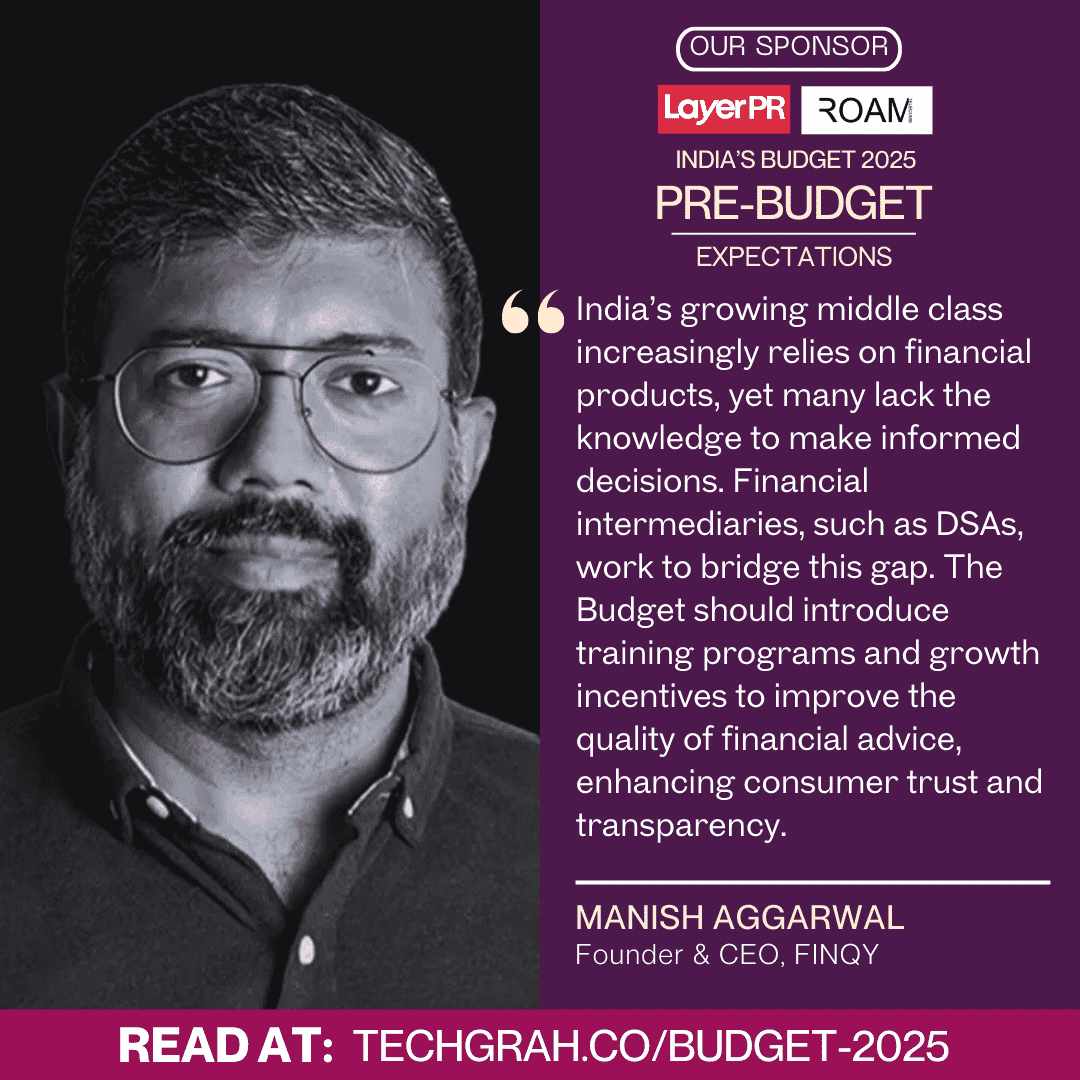
As we approach the Union Budget, three key areas in personal finance deserve attention: easing MSME compliance, enhancing financial intermediary education, and rationalizing the tax burden.
MSMEs, the backbone of India’s economy, face overwhelming regulatory complexities. Simplifying compliance through streamlined tax structures and automated digital processes will empower these businesses to focus on growth and innovation, fostering economic resilience.
India’s growing middle class increasingly relies on financial products, yet many lack the knowledge to make informed decisions. Financial intermediaries, such as DSAs, work to bridge this gap. The Budget should introduce training programs and growth incentives to improve the quality of financial advice, enhancing consumer trust and transparency.
Finally, rationalizing the tax burden is critical for boosting household savings and investments. Raising income tax thresholds, increasing Section 80C deduction limits, and expanding incentives for financial instruments can provide much-needed relief. These measures will enhance disposable income, encourage long-term wealth creation, and stimulate consumption.
At FINQY, we believe these reforms will foster financial inclusion, empower individuals, and promote economic stability. We look forward to a Budget that simplifies personal finance and prioritizes the financial well-being of all Indians.
Kapil Garg, MD, Mufin Green Finance

As we look toward the Union Budget 2025, it is crucial to recognize the role NBFCs play in driving electric vehicle adoption in India. One of the significant challenges in the EV sector is the high upfront cost, which often acts as a barrier for consumers. NBFCs can address this by offering innovative financing solutions, but supportive policy measures from the government are essential to scale these efforts effectively.
We urge the government to prioritize the inclusion of EV financing under the Reserve Bank of India’s Priority Sector Lending guidelines, which would incentivize financial institutions and lower borrowing costs for consumers. Tax exemptions on TDS for NBFCs, similar to banks, could also help improve cash flow and enable competitive lending rates.
To further boost the sector, introducing government-backed refinance options through institutions like SIDBI would strengthen NBFCs’ capacity to extend credit. Simultaneously, allocating funds to build robust and widespread charging infrastructure is essential to address range anxiety and foster consumer confidence in electric mobility.
With these measures, the budget can help transform the EV financing ecosystem, enabling NBFCs to play a pivotal role in accelerating the transition to sustainable mobility and supporting India’s environmental and economic goals.
Firoz Thairinil, Founder & Chief Executive Officer, UniAthena
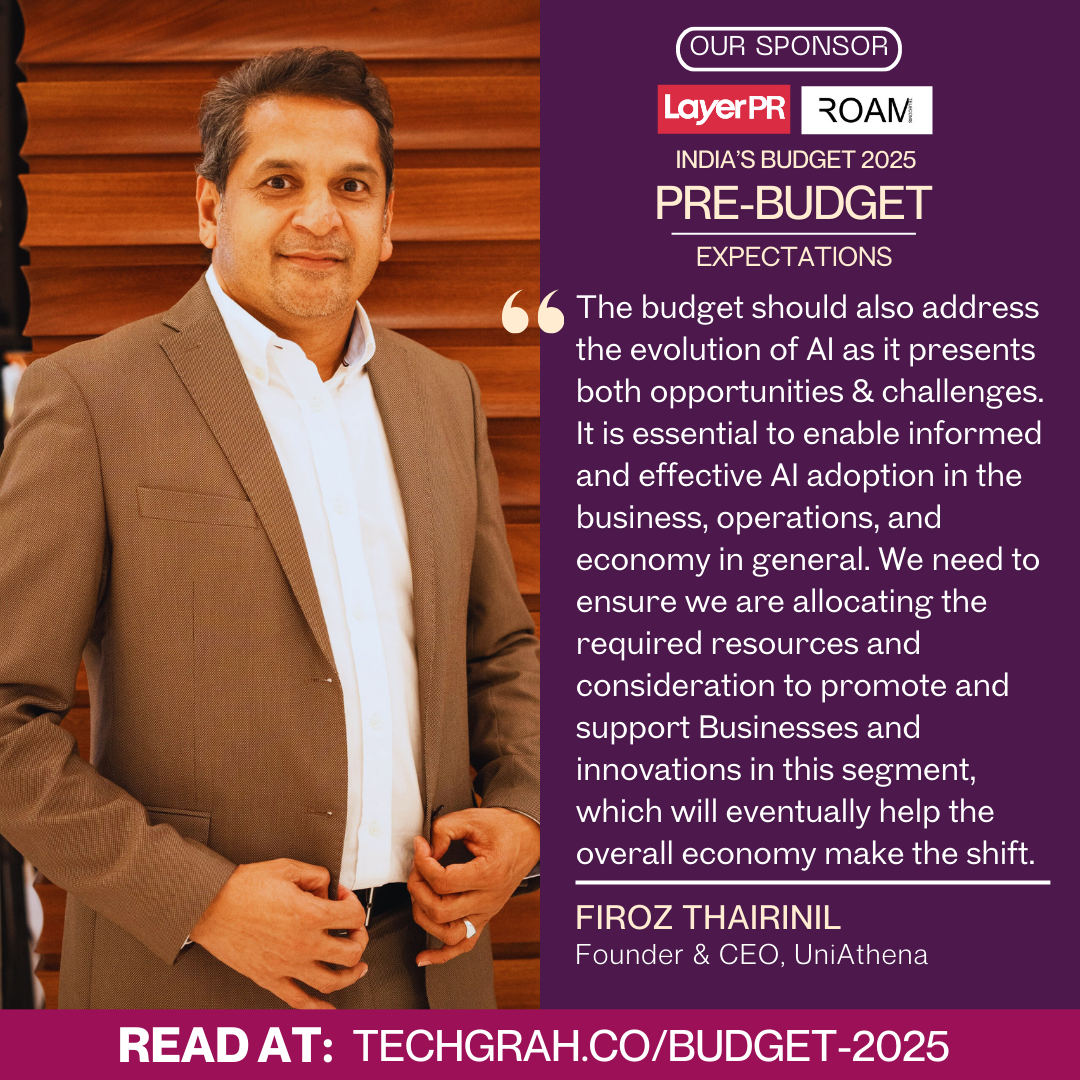
The upcoming Government of India Pre-Budget is a chance to address key challenges while driving sustainable and inclusive growth. To ensure equitable progress, I’d like to see strong investment in digital infrastructure and skill development, particularly for underserved communities.
The budget should also address the evolution of AI as it presents both opportunities & challenges. It is essential to enable informed and effective AI adoption in the business, operations, and economy in general. We need to ensure we are allocating the required resources and consideration to promote and support Businesses and innovations in this segment, which will eventually help the overall economy make the shift.
Especially, our workforce should be well versed to leverage the technology and the changing industry landscape owing it. Public-private partnerships in education will also be key if the gaps between academia & industry are to be bridged. With the right focus, this budget can set the stage for a future built on innovation & responsible technology adoption.