
Union Budget 2025 Expectations: Investors and Startups Call for Tax Relief, EV Incentives & Support for Creator Economy

Date:

Trending

- Advertisement -

As Finance Minister Nirmala Sitharaman prepares to unveil Budget 2025, there is a strong consensus among investors and the startup community on the need for reforms that streamline tax compliance and incentivize sectors such as AI, electric vehicles, and music tech.

Stakeholders in the startup ecosystem are also calling for policies that make it easier to access capital and navigate intellectual property issues, all while empowering the growth of India’s dynamic creator economy.

Read the expectations in detail:

Swati Bhargava, Co-Founder, CashKaro and EarnKaro
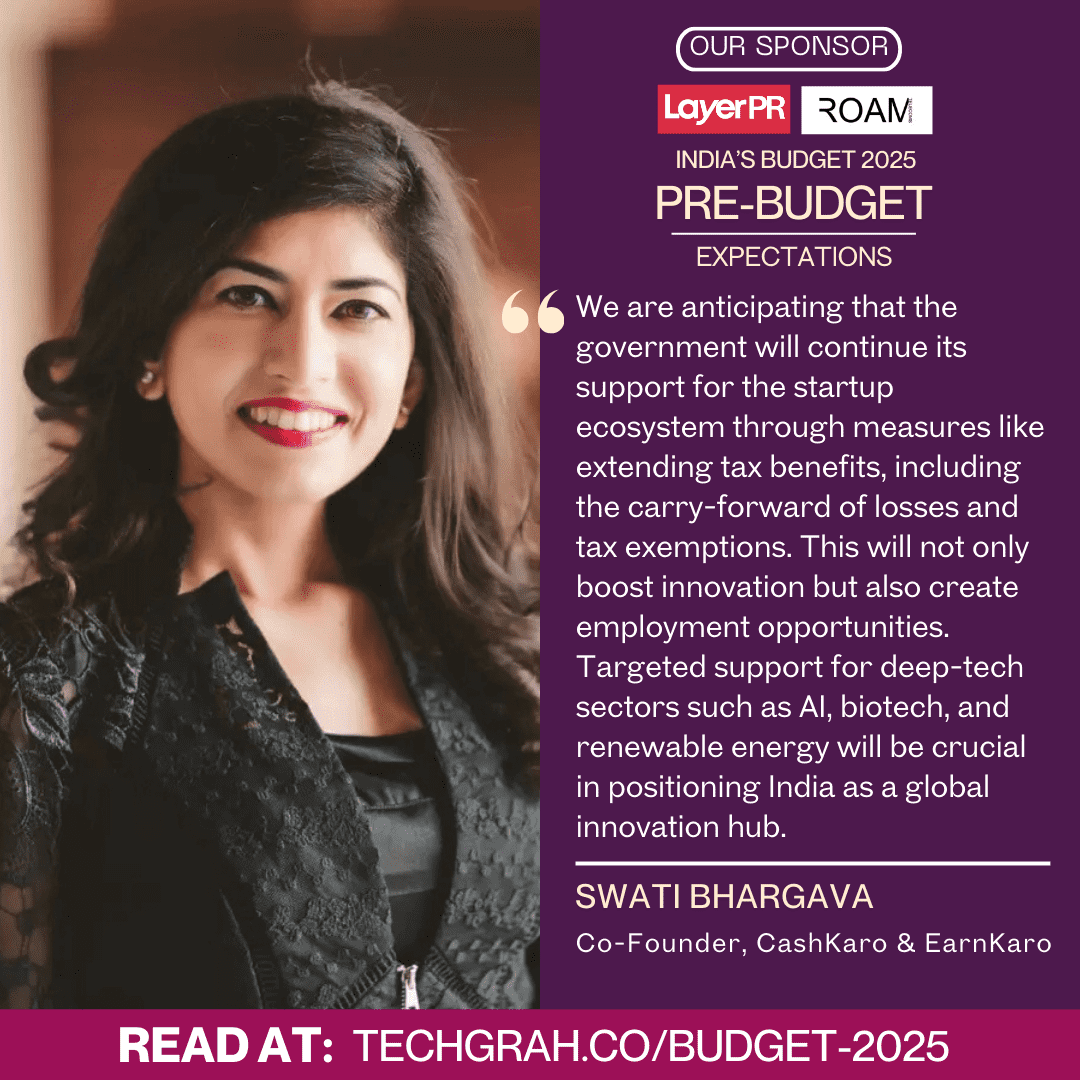
As we approach Budget 2025, We are anticipating that the government will continue its support for the startup ecosystem through measures like extending tax benefits, including the carry-forward of losses and tax exemptions. This will not only boost innovation but also create employment opportunities.

Targeted support for deep-tech sectors such as artificial intelligence, biotechnology, and renewable energy will be crucial in positioning India as a global innovation hub.

Raja Singh Bhurji, CEO and Incubation Director of The StepUp Ventures

The government’s commitment to accelerating startups has been evident in recent years. The Union Budget 2025-26 is poised to further strengthen India’s startup ecosystem, a vital driver of economic growth and innovation. Key measures, including a focus on emerging technologies like AI, IoT, and quantum computing, can foster a supportive environment for entrepreneurship. Simplifying the tax system and enhancing domestic venture capital competitiveness will attract more investors and fuel growth.

- Advertisement -

Additionally, easing compliance burdens for early-stage startups will offer much-needed flexibility. We are optimistic that Budget 2025 will bolster the EV ecosystem by increasing incentives under the FAME-II scheme, lowering GST on EV components, and promoting localized manufacturing of batteries and charging infrastructure.

Gaurav Dagaonkar, Co-founder & CEO, Hoopr

Last year’s budget introduced several encouraging measures for the startup ecosystem, such as the extension of tax benefits for startups, a focus on developing digital infrastructure, and the establishment of a ₹1 lakh crore corpus for low-interest loans to startups. Building on this momentum, I am eagerly anticipating the upcoming Union Budget.

For music-tech startups like ours, initiatives that further simplify and strengthen intellectual property regulations, provide access to affordable capital, and incentivize innovation in areas like AI and music technology will be crucial. We need a policy framework that not only supports the growth of India’s ₹10,000 crore creator economy but also fosters responsible innovation and empowers creators to thrive.

I am hopeful that the upcoming budget will continue to create a conducive environment for the music-tech sector to flourish and contribute significantly to India’s economic growth.

- Advertisement -

Maninder Singh Nayyar, CEO & Founder, CEF Group

The Union Budget 2025 is a crucial opportunity for the Indian startup ecosystem to gain the momentum it needs to thrive. Startups are the backbone of innovation and the right support—be it through extended tax holidays, simplified compliance, or better funding access—can make a world of difference.

For startups in the sustainability space, like ours, the stakes are even higher. These ventures are tackling some of the most pressing challenges of our time, from renewable energy to waste management, and need tailored incentives to scale their impact.

I believe targeted measures for research and development, along with a push for streamlined processes, can unlock immense potential for startups across sectors. If this budget focuses on sustainability and innovation, it won’t just help startups grow—it’ll help build a better future for all.

Sumit Singh, CEO & Co-founder, DashLoc
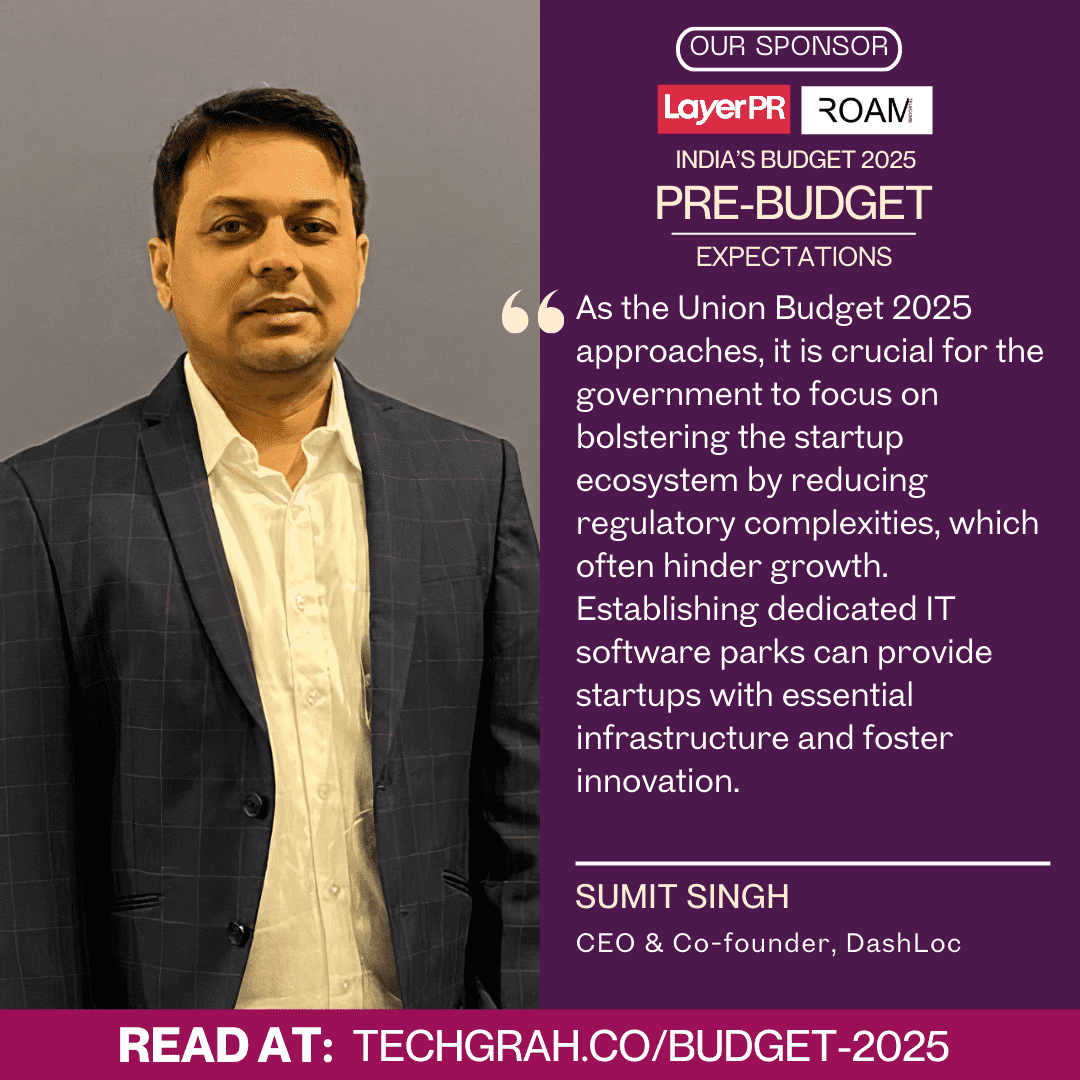
As the Union Budget 2025 approaches, it is crucial for the government to focus on bolstering the startup ecosystem by reducing regulatory complexities, which often hinder growth. Establishing dedicated IT software parks can provide startups with essential infrastructure and foster innovation.

Additionally, simplifying access to loans through banks and government-backed schemes will ensure that startups can secure funding more efficiently, enabling them to scale and contribute significantly to the economy. These measures will create a conducive environment for startups to thrive and position India as a global leader in innovation.

Budget 2025 presents a crucial chance to strengthen the startup ecosystem, particularly in fintech. Extending the tax holiday under the Startup India initiative or reducing corporate tax rates for startups can provide much-needed financial relief. Encouraging the adoption of advanced technologies like AI and blockchain and supporting digital payment infrastructure will foster innovation. Additionally, simplifying GST compliance and introducing funding-friendly policies will empower startups to scale efficiently. Startups are pivotal to India’s economic progress, and focused measures in this budget can propel their growth and solidify India’s position as a global fintech leader.

THE SNAPSHOTS

Sign up to get quick snaps of everyday happening, directly in your inbox.

We don’t spam! Read our privacy policy for more info.

- Advertisement -
Krishna Mali
Krishna Mali
Founder & Group Editor of TechGraph.

More Latest Stories

More Articles

From IP to Global Leadership: Aum Ventures’ Chetan Mehta on India’s Next Deeptech Breakout Companies

Speaking with TechGraph, Chetan Mehta, Founding Partner at Aum Ventures, outlined why deeptech remains one of the most underpriced opportunities in India’s startup ecosystem...

How Machine Learning Is Redefining Short-Term Borrowing for Tech-Savvy Consumers

Short-term lending has long relied on limited snapshots of a borrower’s history. That approach often left gaps, especially for people with thin credit files or recent financial shifts. Machine learning changes the equation by pulling in wider signals such as payment patterns from utility...

Why Players Buy LoL Boost and How the Process Works

If you’re researching why players buy lol boost, you’re usually trying to understand two...

CasinoBonusesFinder UK: how filters, Telegram alerts and real bonus matching work in practice

Anyone who has spent serious time on casino bonus hunting knows the drill. You...

The Importance of Keeping Up to Date With Auto Maintenance

Auto maintenance is one of the most important responsibilities that comes with owning a...

PatexOne: Could This Platform Be Smarter Than Your Impulses?

Australian investors are used to platforms that shout about leverage and “opportunity”. PatexOne takes...

India’s Air Crisis Needs a Deeptech Answer, Not a Consumer Gadget

Twenty years ago, an air conditioner in an Indian home was a luxury. Today...

India’s Cloud Cost Crisis: Why Startups Are Rethinking Their Tech Stack

Over the last ten years, startups in India have experienced an incredible boom driven...

The Detroit Region’s Role in Modern Global Supply Chains

As global commerce continues to expand its reach, the Detroit region has emerged as a pivotal player in modern supply chains. Strategically positioned along...

Top No-KYC Crypto Casino Sites in 2026

Most online casinos demand a lot of personal information from you before you can...

Redrob AI Launches Professional AI Platform for India’s Workforce

In a bid to help students and professionals navigate an increasingly fragmented digital work...

The Business of Recycling: Profit, Waste, and Sustainability

The business of recycling stands at the intersection of environmental responsibility and economic opportunity....

Why Resume-Based Hiring Is Failing India’s Workforce

India needs a shift from credential-first hiring to skill-first validation

Why BFSI Is Moving from AI Experiments to AI Systems

For the past few years, Artificial Intelligence in banking, financial services, and insurance has been all about trying new things. Organizations started projects to...

Capabilities Over Credentials: Scrabble’s Naveen Tiwari on the Changing Nature of Leadership Hiring

Speaking with TechGraph, Naveen Tiwari, Co-Founder of Scrabble, discussed how leadership hiring is shifting from a credentials-led approach to one focused on demonstrated capabilities, and how organisations are increasingly seeking executives who can create measurable impact from the outset. Tiwari also highlighted how Scrabble uses...

From Intuition to Analysis: How AI Is Becoming Every CEO’s Second Brain

Most CEOs are making important decisions with partial information. The challenge is not just...

Rethinking Executive Search: Venator Search Partners’ Deepraditya Datta on Leadership Hiring in a Changing Talent Market

In an interview with TechGraph, Deepraditya Datta, Founder and Managing Director of Venator Search...

AI and Fake Content: Can Technology Win the Battle Against Misinformation?

Artificial Intelligence has transformed how content is created, manipulated, and distributed at scale. News,...

Why Micro Learning at 3 Minutes Works Better Than Lectures at 3 Hours

In the fast-moving world of digital education, there is one myth that continues to...

More Than Just a Scratch: The Importance of Windshield Care

Maintaining your vehicle’s windshield often appears as a seemingly minor task that can easily...

The world’s largest crypto market is building in the dark

India remains one of the few significant economies without a comprehensive crypto and stablecoin...

Beyond Nvidia: The Hidden Winners of the AI Stock Rally

Nvidia stock (NASDAQ:NVDA) has returned roughly 1,200% since ChatGPT launched in late 2022. Most...

What PM Modi’s Appeal to Avoid Gold Buying Could Mean for India’s Jewellery Economy

When Prime Minister Narendra Modi recently urged citizens to avoid purchasing gold for a...

Serhii Tokarev Spoke About The Third Season Of The Generation H Accelerator

Serhii Tokarev spoke about the Generation H 3.0 HealthTech accelerator, which is opening applications...

The Business of Recycling: Profit, Waste, and Sustainability

The business of recycling stands at the intersection of environmental responsibility and economic opportunity....

“Budget should focus on reducing taxes on capital gains,” Says Abhishek Gupta of Hex N Bit

Speaking in the upcoming Union Budget 2021, Abhishek Gupta, Founder, and CEO, Hex N...

“China is a Global thief” Rep. Tom Rice on Uyghur Forced Labor Prevention Act

Speaking at the House on Uyghur Forced Labor Prevention Act, Rep. Tom Rice (R-SC)...

How AI is Rewriting the Economics of India’s $300 Bn IT Services Sector

When Microsoft CEO Satya Nadella recently disclosed that artificial intelligence now generates nearly 30...

Why India Must Own Its Education Intelligence Stack

India has rapidly digitised large parts of its education ecosystem over the last decade....

Why Resume-Based Hiring Is Failing India’s Workforce

India needs a shift from credential-first hiring to skill-first validation

Alphabet Discloses $2.14 Billion in Public Equity Holdings as of June 30

Alphabet Inc. disclosed $2.14 billion in equity securities held across 39 positions as of...

The Role of Edtech in Addressing Equity Gaps in Higher Education

In the fast-paced world of EdTech today, the opportunity to bridge educational gaps and...

India to generate $100 bn from telephonic investments

India expects to attract $100 billion in investments in the telecom sector, a union...