




With the Union Budget 2025 on the horizon, the education and skill development sector has emphasized the need for targeted funding to enhance both accessibility and quality. Leaders are calling for subsidies and tax breaks for education expenses and dedicated support to improve digital tools, internet connectivity, and skill-oriented teacher training. Industry-academia collaborations also remain a key area of focus to prepare students for the evolving job market.
Read the Union budget 2025 expectations from industry experts in detail:
Prof. Supriya Pattanayak, Vice Chancellor, Centurion University, Odisha

The previous budget had put adequate focus on enhancing higher education and skill development in India. Skill India for instance was reported to have already trained more than 1.4 crore youth while upskilling and reskilling over 54 lakh others. The budget also mentioned setting up new higher educational institutions, including IITs, IITs, IIMs, AIIMS, etc.
We expect the coming budget to lay further emphasis on upgrading skill education across existing universities and institutions. A dedicated budget allocation to facilitate increased industry-academia partnership is the need of the hour.
While it will encourage more institutions to integrate action & experiential learning in their education delivery model, it will enable the creation of a valuable industry-ready workforce, which would be well acquainted with the requirements and challenges of respective industries by the time the curriculum is completed. Education is a fundamental pillar of nation building and thus, we expect the Union Budget to announce the highest-ever allocation for the education sector, especially in the wake of India’s young population.
Mayank Kumar, Co-founder, upGrad

A stronger budget allocation is essential to upskill not only India Inc. but also government employees in emerging technologies. This initiative can drive greater women’s participation in the workforce, especially in STEM fields. To establish India as a creator’s economy, robust AI infrastructure and an expanded network of AI ‘Centres of Excellence’, supported by public-private-global collaborations, are crucial. These efforts will accelerate innovation, inclusivity, and progress toward India’s 2047 vision.
Amit Taneja, CEO, Educate Online
2024 has been nothing short of a game-changer for the education technology space, a year where we tossed old playbooks and unlocked new possibilities. It has been about breaking down outdated assumptions and building solutions with innovation and a problem-solving mindset at the core.
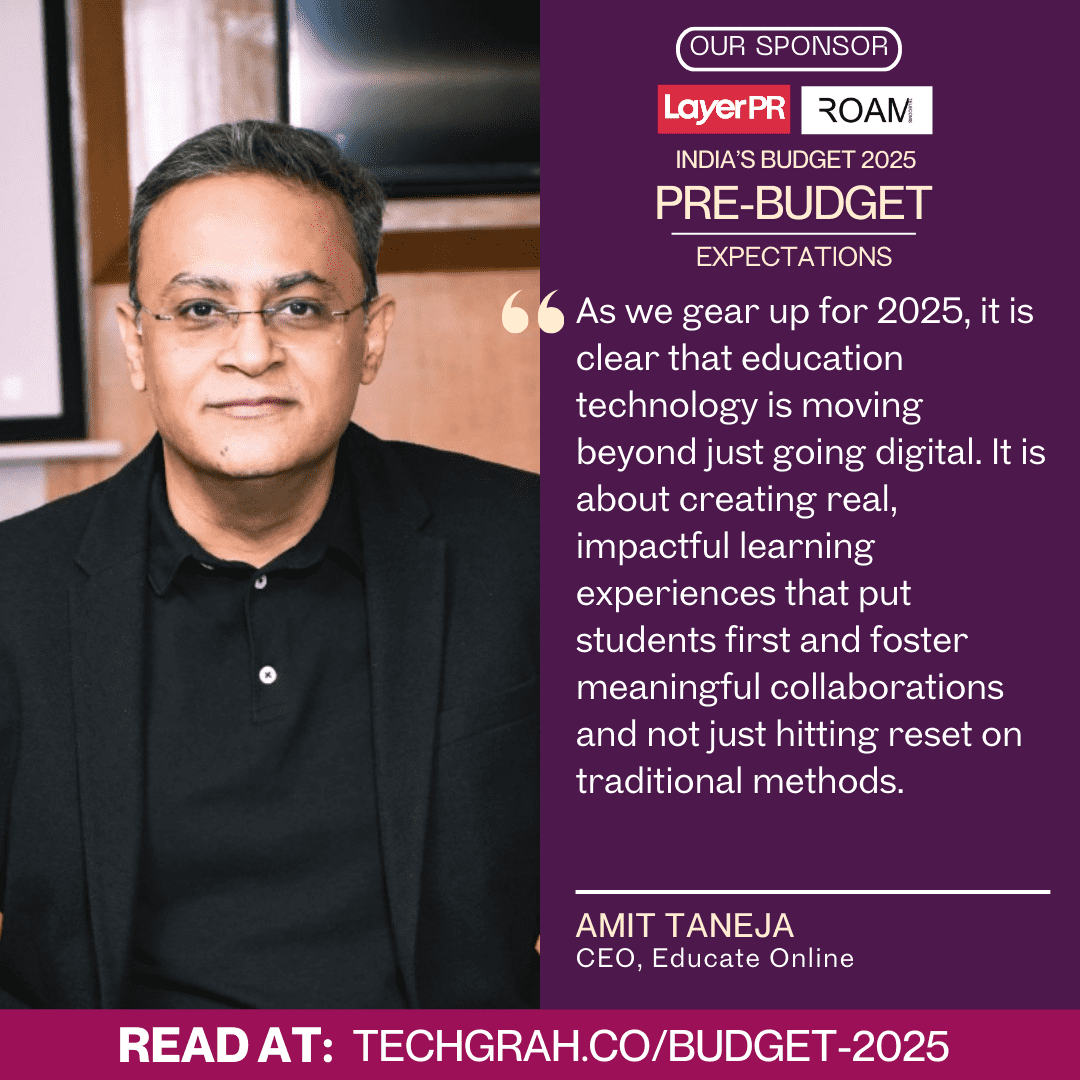
As we gear up for 2025, it is clear that education technology is moving beyond just going digital. It is about creating real, impactful learning experiences that put students first and foster meaningful collaborations and not just hitting reset on traditional methods.
What truly stands out in this transformation is the evolving relationship between traditional and digital learning environments. They are no longer in competition but are teaming up to deliver optimized, student-focused solutions. It is a mindset shift, proving that the future isn’t about choosing sides and is more about making them work together.
The path ahead is clear! We must continue to innovate while keeping student success at the heart of every decision, creating solutions that truly serve the needs of learners in our evolving educational landscape.
Anurag Gupta, Co-Founder, STEMROBO Technologies

We believe that the Union Budget 2025-26 can play a key role in addressing gaps in the education sector. While the FY 2024-25 allocation of ₹73,498 crore for School Education was a positive move, there are still significant gaps, especially in rural and semi-urban areas, where access to high-speed internet, digital devices, and smart classrooms is still limited.
We urge the government to dedicate funds to improve infrastructure, like high-speed internet and digital tools, in schools. It is very important to invest in teacher training programs that focus on new technologies like AI, coding, and robotics. This will help educators adapt to the future needs of students.
Investments in AI, STEM, and robotics labs in schools will support hands-on learning and innovation. Investing in STEM education will equip students with the skills they need for future jobs, encouraging problem-solving and creativity. This is a key step in achieving the goals of the National Education Policy (NEP) 2020, especially the inclusion of AI, coding, and robotics in the curriculum.
The drop in student enrolment by 37 lakh shows the need for more support for underprivileged students. We suggest offering more scholarships to help students from disadvantaged backgrounds access education. Providing financial support will help ensure that students from all communities have equal access to opportunities., can help increase enrolment and participation. We urge the government to support Ed-Tech companies that offer affordable, AI-based, and adaptive learning tools for underserved areas. More funding for research in AI, robotics, and IoT can help drive new ideas and innovation.
Jasmeet Singh Chhabra, Co-Founder, Crimson Schools

The school education sector is witnessing a growing need for modern infrastructure, which can be addressed through supportive policies and regulatory measures. With over 4 billion sq. ft. of additional educational space required by 2034-35, Budget 2025 must urgently address these issues through targeted reforms and investments. One key expectation is a shift to lease-based models for school infrastructure. Such models can reduce the capital-intensive nature of setting up new schools and free up resources to enhance teaching quality and student engagement. Policies encouraging this approach will enable schools to expand faster and more efficiently.
Another pressing issue is the 18% GST on affiliation and accreditation services, which significantly strains institutions. Reducing this tax rate would provide relief and allow schools to allocate more funds toward improving physical and digital infrastructure. Sustainability, too, must take center stage. Educational institutions are increasingly adopting green and eco-friendly practices, aligning with global standards. Incentivizing these efforts through tax breaks and subsidies will encourage schools to embrace sustainability and contribute to long-term cost savings and environmental resilience.
Furthermore, lifting restrictions on foreign direct investments (FDI) and external commercial borrowings (ECB) for educational trusts and societies could unlock much-needed funding for infrastructure development. Streamlining approvals and foreign grant processes will ensure timely access to these resources.
Rohit Gajbhiye, Founder & MD, LEO1

As Budget 2025 approaches, the Edu-Fintech industry stands optimistic about progressive measures to enhance financial accessibility and innovation in education. Addressing affordability through interest-free or subsidized schemes, digital financial solutions, and tax incentives for education-related expenses can empower students and institutions alike.
Policies encouraging partnerships between fintech players and educational institutions will accelerate the adoption of technology-driven financial systems, bridging funding gaps and improving cash flow management. This budget has the potential to champion equitable education access while driving innovation and collaboration in the Edu-Fintech space, contributing to India’s economic and social progress.