


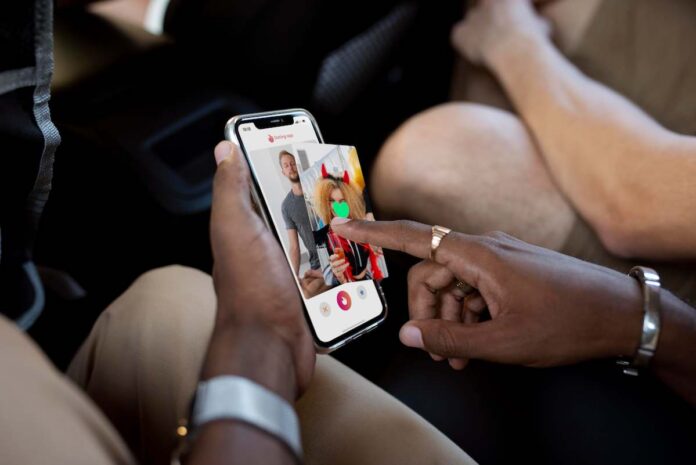

Marriages that begin online end slightly less often than marriages that begin offline. A 2013 study published in the Proceedings of the National Academy of Sciences surveyed 19,131 Americans who had married between 2005 and 2012. By the time of the survey, 5.96% of those who met their spouse online had separated or divorced, compared with 7.67% of those who met offline, and the online group also reported slightly higher marital satisfaction. The study was commissioned by an online dating company, and its lead author, the psychologist John Cacioppo, was a paid adviser to that company.
Online Meeting in Pew’s 2022 Survey
A Pew Research Center survey of 6,034 American adults, conducted in July 2022, found that 30% had ever used a dating site or app and 9% had used one in the past year. Among partnered adults, 10% met their current partner on one of these platforms. The share is 20% among partnered adults under 30 and 24% among lesbian, gay and bisexual partnered adults. Pew’s figures cover dating sites and apps together, without separating one platform from another. Users were close to evenly split on the result, with 53% describing their time on the platforms as positive and 46% as negative.
Volume, Options and Pace
Pew asked users how many options they saw. 43% said the number was about right and 37% said there were too many, while 13% said there were too few.
Message volume affects men and women differently, and 55% of all recent users said they had felt insecure about it at least sometimes. 54% of recent female users said they often or sometimes felt overwhelmed by the number of messages they received, and 64% of recent male users said they often or sometimes felt insecure about how few messages they got.
The number of matches also changes how people date offline, because every match that goes anywhere still has to be met in person. A serial dater can arrange a new meeting every few days from the same pool of matches, and each person is then judged against a long and recent list of others. A long-term relationship needs a second and third meeting with the same person, and a steady supply of first meetings makes those later meetings easier to skip.
The Rejection Mindset
Psychologists Tila Pronk and Jaap Denissen measured that drift in 3 studies published in 2020. With single, heterosexual participants aged 18 to 30, people shown a series of potential partners became steadily more likely to reject them, and the chance of acceptance fell by about 27% from the first profile to the last. In 2 of the studies, the steepest drop came within roughly the first dozen profiles. The first study alone involved 315 participants, who were shown sets of 45 or 90 photographs of potential partners and asked to accept or reject each one.
Their paper, published in Social Psychological and Personality Science, argued that continued access to a nearly unlimited supply of potential partners makes people more pessimistic and more likely to say no. The researchers linked this rejection mindset to falling satisfaction with the photographs on offer and a falling sense of dating success. For women, it also reduced the number of romantic matches. The effect builds within a single session, which suggests that the format of browsing many profiles in a row works against the patience a long-term relationship requires.
Couples Formed Through Apps
The couples who do form relationships through apps are as committed as other couples in at least one large sample. A Swiss study by Gina Potarca of the University of Geneva used the Swiss Federal Statistical Office’s 2018 family survey, with responses from more than 3,000 people who had met their partner in the previous decade.
Couples who met through an app reported stronger intentions to live together than couples who met offline, and their intentions to marry were the same. Potarca noted that the survey could not show how long those couples planned to live together, and she suggested that some of them treat living together as a trial before marriage.
Relationship satisfaction and life satisfaction showed no general difference between couples who met through apps and couples who met elsewhere. Women who met a partner through an app reported stronger desires and intentions to have children. App couples were also more likely to differ in education and to have lived farther apart before meeting, which means the apps put together pairs that would rarely have met otherwise.
Fatigue Among Users
In a 2024 survey of 1,000 American adults who had used a dating app in the previous year, commissioned by Forbes Health and conducted by OnePoll, 78% said the apps had left them emotionally, mentally or physically exhausted at least some of the time.
Women reported it more often than men, at 80% against 74%. The survey was conducted between March 27 and April 1, 2024, and its reported margin of error was 3.1 percentage points, though it was commissioned for editorial coverage and has not been peer-reviewed. Dating app fatigue is highest among younger users, with 80% of millennials and 79% of Gen Z reporting it.
The leading cause, cited by 40% of respondents, was the inability to form a good connection with anyone. Being disappointed by the people they met was second at 35%, and rejection was third at 27%. A person who is exhausted by the search is less likely to give a promising match the extra meetings a relationship needs.
Marital Satisfaction by Meeting Place
The 2013 study also broke offline marriages down by where the couple met. Its satisfaction measure combined happiness with the marriage and the affection and communication between the spouses. Satisfaction scores ranged from 5.31 for couples who met on a blind date to 5.59 for couples who met at school, with bars and workplaces in between. Couples who met online averaged 5.64, and in that sample meeting online slightly raised the odds of a lasting marriage, so the venue that produces the most first meetings did not produce weaker marriages among the people who married.
39% of Couples
Stanford sociologist Michael Rosenfeld analyzed a nationally representative 2017 survey of American adults and reported that meeting online had become the most common way American couples meet, ahead of introductions through friends. In Rosenfeld’s survey, about 39% of heterosexual couples said they had met their partner online, against 22% in 2009.


