


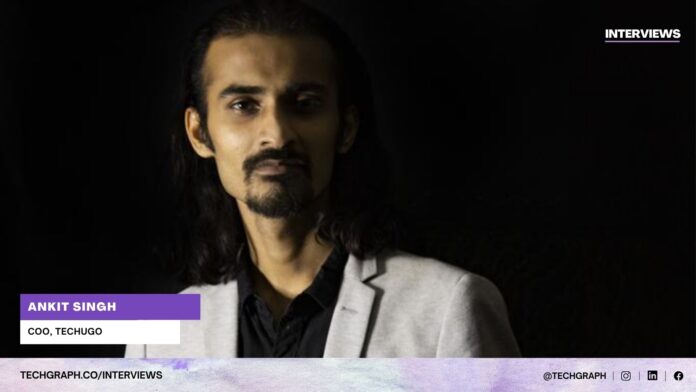

Speaking with TechGraph, Ankit Singh, Chief Operating Officer of Techugo, discussed how mobile applications have evolved from being customer engagement channels to becoming the centerpiece of business strategy, and how technologies such as AI-driven personalization, predictive analytics, and intuitive design are helping companies transform digital interactions into trust, loyalty, and measurable market advantage.
He further explained how Techugo is implementing these capabilities across sectors including BFSI, food, and government to help enterprises build adaptive, insight-led platforms that move beyond transactions, enabling brands to deliver personalized experiences at scale and achieve stronger customer retention.
Read the interview in detail:
TechGraph: The app economy has moved from being a channel to becoming the core of business strategy. Do you think most companies actually understand this shift, or are they still treating apps as side projects?
Ankit Singh: Today, most of the companies say that they understand the importance of apps, but in reality, many of them still treat apps as just another channel, which is an outdated mindset. In the real world, apps are where customers shop, purchase, pay, and earn loyalty as they are not side activities but the core of the business.
Such leaders will make seamless UX a priority, use AI-powered insights for stronger customer engagement & personalization, and layer in technologies like AI and cloud to personalize a marketing channel, making apps a force for rapid expansion.
Those who ignore this transformation will remain stuck in catch-up mode. At Techugo, we’ve seen both approaches, and it’s clear that brands that treat apps as a strategic priority earn stronger customer trust, higher engagement, and a larger market share.
TechGraph: Everyone talks about innovation, but often what clients really want is reliability and growth. How do you strike the balance between chasing the next big feature and building apps that genuinely move the needle for businesses?
Ankit Singh: Innovation is exciting, but it won’t pay the bills on its own, because ultimately, clients require apps that deliver measurable results, produce income, and scale as economically as possible. That is why at Techugo, we start with a prototype and prioritize establishing business goals initially, not technology, and think about each feature in terms of its real-world impact. If a feature does not increase efficiency, retention, or revenue, it stays on the drawing board.
For this, we employ advanced technology like Artificial Intelligence, not just in writing code or UX/UI, but in creating a prototype that aligns with the business goals and the founder’s pocket. With expansion being the top driver of every decision, we create apps that are not only stable and robust but also responsive to changing market needs and user demands.
TechGraph: With generative AI now influencing design, development, and even customer interactions, where do you see the biggest risks for businesses that rush to adopt without a long-term strategy?
Ankit Singh: The risk isn’t AI itself, as the risk is rushing into it without a long-term strategy, which will introduce short-term and severe repercussions. When companies rush to incorporate generative AI into their applications or platforms, three significant risks immediately arise. First, inconsistent customer experiences, for poorly trained AI can confuse or mislead customers, eventually affecting trust.
Second, privacy issues with data, as sloppy handling of confidential information can lead to legal and reputational hazards. Third, superficial effect, as swift solutions might be innovative in nature but less likely to support business objectives, making AI a substitute instead of an actual growth engine. For example, in the food sector, those brands that adopted AI-based chatbots in a hurry for order management were disappointed when the bots failed to manage local languages or menu options, leading to customer disappointment.
Similar to this, in BFSI, banks that launched AI advisory software too hastily threatened regulatory penalties and customer mistrust as a result of incomplete compliance verification. We at Techugo guide customers to treat AI not as a hack but as a strategic platform and approach it accordingly so that it provides substance-driven growth without compromising on trust, reliability, and long-term business value.
TechGraph: User expectations around app experience evolve quickly with trends like hyper-personalization, AI integration, and immersive design. Which of these shifts do you believe will truly redefine how businesses use apps over the next few years?
Ankit Singh: Each of the three trends, i.e., hyper-personalization, AI integration, and immersive design, is important in its own right, but the combination of hyper-personalization and AI integration will actually disrupt business apps in the future.
Hyper-personalization will extend beyond the use of name to greet customers as apps will pre-empt user intent, inferring needs ahead of time, crafting an anticipatory experience that fosters loyalty. AI integration serves as the foundation for this transformation, driving intelligent recommendations and predictive analytics, turning apps into tools and transforming them into digital partners.
Additionally, immersive design will grow even more, but especially in industries such as retail, real estate, and education, as its rollout is slower than that of personalization and AI, both of which already produce measurable ROI. At Techugo, we’re seeing this firsthand across food, BFSI, and even government projects, where AI-driven personalization is central.
TechGraph: Global users are becoming less forgiving of slow or clunky digital products. What practices have you embedded at Techugo to make sure user experience is treated as a business priority, not just a design checklist?
Ankit Singh: First of all, user experience is not a checkbox but a business result for us. At Techugo, we’ve embedded certain practices into every project to ensure speed, ease, and reliability that are never compromised.
User-first discovery – Even before a line of code is written, our team sits down with clients to map actual customer journeys so that we can design flows that make sense, not just screens.
Default performance – Speed is considered a feature, and we employ light architectures, cloud-native builds, and ongoing performance testing so apps remain fast even at scale.
Continuous feedback loops – Real users test early builds. We learn to iterate faster, so that usability problems don’t survive till launch.
Design with business convergence – Each design decision is attached to a metric that may be retention, conversion, order value, or whatever. It’s not about how the app appears, but it’s more about how it generates growth.
UX is a trust currency for us, and when an app annoys people, a business can lose downloads as well as trust, which we don’t allow to occur at Techugo.
TechGraph: Security and data privacy remain pressing concerns, especially for apps dealing with financial or personal data. What concrete steps has Techugo taken to make security a competitive strength rather than just a compliance checkbox?
Ankit Singh: Security and data privacy are the foundational requirements at most of the organizations. At Techugo, we are catering to the sensitive sectors like healthcare, finance, and government, where an organizational error immediately causes a loss of trust. Hence, security is ingrained from the very beginning in the design process and carries through deployment.
Our methodology would contain encryption at every stage, stringent role-based security access control, systematic audits, penetration testing, strict cloud security practices, multi-faceted monitoring, and everything else one can think of. When customers feel their money and data are safe, they spend more, and this becomes a competitive advantage.
TechGraph: In conversations with large enterprises versus startups, what’s the most common misconception you hear about building successful apps, and how do you break that perception?
Ankit Singh: One common myth in startups is the belief that a “next big feature” will guarantee overnight success. In this pursuit, they often ignore critical aspects like scalability, backend stability, and long-term retention. We emphasize that true success doesn’t come from a single feature launch it comes from treating the app as a living product that evolves through consistent iterations and improvements.
Big companies, however, at times think that their brand value can alone push adoption, considering applications as an add-on instead of the centerpiece of their strategy. We reinforce that even giants can’t get away with a poorly designed, uninspiring app so that users can compare experiences with the best availability in their market, not only to its competitors.
At Techugo, we shatter these myths by emphasizing the fundamentals that is intuitive user experience, solid reliability, and quantifiable business outcomes. We enable clients to view apps as engines of growth, with each feature and update bringing value to long-term success.
TechGraph: Looking ahead, if you had to bet on one technology or approach that will fundamentally change how businesses think about mobile apps in the next decade, what would it be and why?
Ankit Singh: If I had to place a bet on a single technology that will change how businesses think about mobile apps in the coming decade, it would be predictive analytics and personalization powered by AI, as apps are evolving into more intelligent companions of people and companies, rather than mere tools. Due to need forecasting, procedure automation, and even pre-decision-making for humans, AI revolutionizes not just engagement, but revenue, retention, and operational effectiveness.
Additionally, we have already seen the early stages of this shift in industries such as food, e-commerce, and government, where personalized suggestions, intelligent workflows, and intelligent insights are increasing user expectations. In the coming decade, brands that integrate AI as a fundamental function of their applications rather than just as a feature will be the ones that lead their industries. At Techugo, we closely work with companies to apply these strategies with purpose, making AI drive meaningful impact and long-term success.