


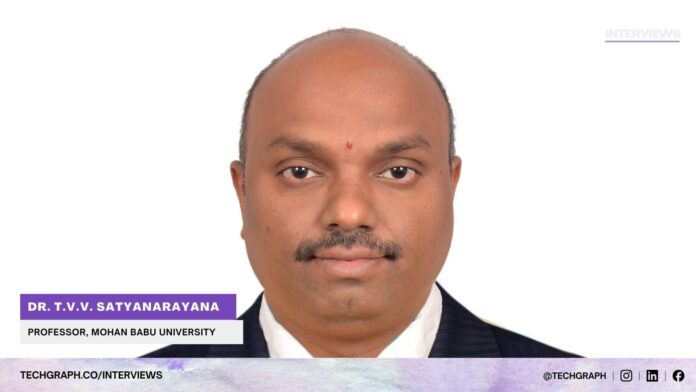

Speaking with TechGraph, Dr. T.V.V. Satyanarayana, Professor at Mohan Babu University (MBU), discussed how IECom-2025 was curated not as a traditional academic conference but as a platform to signal India’s transition toward convergence-led research in intelligent electronics, and how the event is positioning MBU as a bridge between academia, industry, and global research that reflect where the field is heading rather than where it has been.
Dr. Satyanarayana also explained how the conference’s selective review process and international participation from institutions in China, Romania, and leading Indian IITs and NITs reinforce MBU’s goal of evolving beyond isolated research outputs to collaborative system-level innovation, with a focus on applied work, prototyping, and cross-domain integration that aligns with national priorities in smart grids, quantum communication, satellite systems, and sustainable intelligent infrastructure.
Read the interview in detail:
TechGraph: Conferences like IECom are often seen as academic milestones, but this year’s edition felt more like a statement about where Indian research in intelligent electronics is heading. When you were curating the event, what was the bigger goal you wanted it to achieve for MBU and for the research community at large?
Dr. T.V.V. Satyanarayana: IECom-2025 is designed as a transformative platform—not just an academic event, but a catalyst for India’s leadership in intelligent electronics. The idea is to go beyond routine paper presentations and reshape how Indian academia works with industry and global research networks.
For Mohan Babu University, IECom serves three clear objectives. First, it strengthens MBU’s position as a research institution by showcasing our faculty and student work in areas such as VLSI design, biomedical signal processing, AI-ML, and next-generation communication systems. Second, it positions the ECE department as a bridge between theory and real engineering solutions. Third, it deepens our networks by connecting with worldwide institutions in China, Romania, etc., and leading Indian institutes like IITs and NITs.
Equally important, we wanted to highlight that the future of Indian research lies in convergence—where low-power electronics, edge computing, AI-ML, and communication technologies come together. Our four tracks (Low Power Electronic Devices, Electrical Control and Instrumentation, Communication Technologies, and Computational Techniques) were structured around this idea. We are not preparing researchers for narrow silos but for integrated solutions in smart cities, healthcare, agriculture, and disaster management.
TechGraph: The sheer number of paper submissions shows that there’s no shortage of academic output. The real question is quality and impact. Based on the review process this year, where do you think Indian research stands when it comes to originality and industry relevance?
Dr. T.V.V. Satyanarayana: In the current scenario, research quality is unequivocal—when properly curated and rigorously reviewed. There is a clear distinction between volume and value. During the peer review process, a blind evaluation system is employed with technical committees comprising leading experts from IITs, NITs, and international reviewers from the University Politehnica of Bucharest (Romania).
This international panel brought no-compromise standards to our selection process. Out of 210 submissions received, only 106 papers were selected for presentation, which address frontier challenges, representing a 50.47% acceptance rate—a threshold comparable to international conferences.
Regarding industry relevance, I observed three encouraging trends during the review and presentation phases:
First, applied research is increasingly dominant, which bridges the gap between algorithmic innovation and practical deployment.
Second, cross-domain integration is accelerating, where such research increasingly couples AI-ML with hardware design (VLSI), communication systems with sensing, and edge computing with biomedical applications.
Third, there is growing alignment with national priorities, viz., smart grids, sustainable energy systems, 5G/6G technologies, quantum communication, and aerospace applications (UAV communication, satellite integration), which resonate with India’s Digital India, Make in India, and self-reliant India (Atmanirbhar Bharat) initiatives.
TechGraph: You had participation from institutions in China and Romania, alongside IITs and NITs. That’s quite a global mix. Beyond the exchange of ideas, are you seeing a genuine willingness among international researchers to collaborate with Indian universities on joint projects or labs?
Dr. T.V.V. Satyanarayana: Certainly, and this is clearly reflected through our keynote speakers, who represent the depth and scope of international collaboration potential.
Dr. Arvind R. Singh, Associate Professor at Hanjiang Normal University, China, is a leading expert in power system protection, smart grids, microgrids, and renewable energy optimization. His research focuses on sustainable and intelligent energy systems, including demand side management and distributed energy resources.
During his keynote, he emphasized the importance of integrating smart grid technologies with artificial intelligence and communication networks—areas where Indian researchers have strong capabilities. His work aligns with and complements Mohan Babu University’s emphasis on AI and communication technologies, creating abundant opportunities for joint research in energy-efficient, intelligent systems, and sustainable infrastructure.
Prof. Prabhat Kumar Upadhyay, Dean of International Relations and Professor at IIT Indore, specializes in wireless and mobile communications, cooperative relay communications, MIMO systems, and simultaneous wireless information and power transfer. His expertise in cutting-edge communication protocols and systems aligns well with the themes of IECom-2025.
He highlighted the critical role of collaborative research to develop next-generation communication standards and AI-powered wireless systems tailored for Indian and global contexts.
Both keynote speakers expressed a strong interest in establishing formal partnerships with Indian institutions. From discussions, it was clear that the international research community sees Indian universities not just as knowledge recipients but as equal partners capable of contributing original ideas and technologies.
TechGraph: The sessions on AI–ML, edge computing, and low-power design drew the most interest. These areas are converging rapidly in industry as well. How do you think academia can stay relevant when technological change in this field is happening faster than academic cycles can adapt?
Dr. T.V.V. Satyanarayana: To ensure that academia stays relevant in the face of rapid technological advancements, it is essential to foster a more agile research ecosystem. At MBU, we are focused on creating research infrastructure that encourages experimentation and cross-disciplinary collaboration, particularly in emerging fields like AI-ML and edge computing.
We also ensure that faculty and students are constantly engaging with the latest industry trends through partnerships and research labs like the AICTE-IDEA Lab and the DST-STI Hub. The integration of real-world industry challenges into academic research ensures that academia can keep pace with technology and remain a valuable resource for future innovations.
TechGraph: MBU has been investing heavily in its research infrastructure, from the DST-STI Hub to the AICTE-IDEA Lab. How do you ensure these initiatives are not just facilities, but part of a larger research culture that encourages experimentation and risk-taking among faculty and students?
Dr. T.V.V. Satyanarayana: At MBU, we view these state-of-the-art facilities as integral to building a vibrant research culture that thrives on experimentation and innovation. The DST-STI Hub and AICTE-IDEA Lab are not just physical spaces; they are catalysts for fostering a mindset of curiosity and risk-taking.
We encourage faculty and students to step beyond conventional research and explore new ideas that challenge existing paradigms. This is facilitated by a culture of collaboration, where interdisciplinary teams work on high-impact projects.
Additionally, we regularly organize workshops, hackathons, and industry collaborations that expose our researchers to real-world problems, thus inspiring them to think outside the box.
TechGraph: One of the big criticisms of academic research in India is that it often stops at publication. How are you pushing your teams and collaborators to think beyond papers and move toward prototypes, patents, or partnerships with industry?
Dr. T.V.V. Satyanarayana: We are committed to breaking the cycle of just publishing papers. At MBU, the focus is on transforming academic knowledge into tangible innovations that have real-world applications. We encourage our faculty, who are the real researchers, along with students and research scholars, to develop prototypes, file patents, and seek industry partnerships for commercialization. The establishment of specialized research labs and dedicated innovation hubs plays a crucial role in this process. Our collaboration with industry partners ensures that research is aligned with market needs, and our students are exposed to opportunities for internships, hands-on projects, and real-world problem-solving scenarios.
TechGraph: What’s the next evolution of IECom that you’re envisioning? Do you see it continuing as a platform for discussion or becoming a catalyst that influences how India positions itself in the global electronics and communication ecosystem?
Dr. T.V.V. Satyanarayana: IECom-2025 is just the beginning of what we envision as an influential, global platform for collaboration. While it will continue to serve as a space for academic discussions and knowledge exchange, we foresee the conference evolving into a major catalyst that influences India’s position in the global electronics and communication ecosystem.
We aim to facilitate joint research initiatives, foster international industry collaborations, and showcase India as a leader in intelligent electronics research. In future editions, we hope to include more practical, hands-on sessions, industry-driven challenges, and a stronger focus on innovation and commercialization, bridging the gap between academia and industry.