


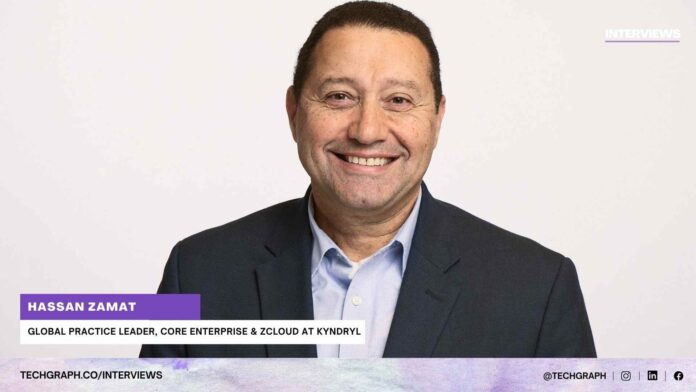

During an interview with TechGraph, Hassan Zamat, Global Practice Leader for Core Enterprise & zCloud at Kyndryl, talked about how enterprise modernization has evolved into a continuous, AI-enabled journey where mainframes are no longer siloed but seamlessly integrated into hybrid cloud environments, enabling organizations to accelerate transformation while maintaining reliability, security, and performance.
He further explained how Kyndryl is combining generative AI, workforce transformation, and sustainability-focused modernization frameworks to help enterprises align technology upgrades with long-term business resilience and agility.
Read the complete interview in detail:
TechGraph: The report points to stronger returns from modernization while costs continue to decline. Beyond the numbers, what shifts in technology, talent, or strategy are making modernization more achievable today compared to just a few years ago?
Hassan Zamat: Mainframe modernization has become a nimble, iterative process enabled by AI, hybrid IT, and cultural transformation. The most transformative shift is the use of AI—especially generative and agentic AI—with mainframe environments, which enables, for example, the conversion of legacy code into modern languages, the mapping of application dependencies, and the generation of documentation; this is significantly speeding up modernization timelines.
Also, mainframes are no longer siloed; they’re increasingly integrated into hybrid environments. The platform is now seen as a secure, high-performance anchor for AI and cloud workloads. This hybrid approach allows organizations to modernize without abandoning the reliability and security of the mainframe.
In terms of talent, enterprises are now seeking cross-platform fluency, people who can navigate mainframe, cloud, and AI environments seamlessly. To bridge the capability gaps, organizations are adopting a range of talent strategies, such as upskilling existing employees, automating processes to reduce dependency on specific skill sets, and leveraging AI to supplement human expertise.
Due to the growing need for real-time business adaptability, the dominant strategy we see now is “run-transform-run”—a phased and pragmatic approach that allows for continuous improvement, lower risk, and faster, incremental ROI realization.
TechGraph: Generative AI features prominently in the report as a driver of savings and growth. From your vantage point, what is the most realistic way AI will enhance mainframe environments in the near term, and what expectations should enterprises keep in check?
Hassan Zamat: In the near term, generative AI is being used to convert legacy code and create application documentation. This is leading to a reduction in code analysis and documentation time, for faster and less resource-intensive modernization. Furthermore, AI automates routine tasks like capacity management, performance tuning, and incident response. Platforms such as Kyndryl Bridge enable proactive management of mainframe systems, reducing manual intervention and improving uptime. Also, AI models are being deployed directly on mainframes to detect anomalies in real time, enhancing fraud prevention and compliance. These models can process transactional data without moving it off-platform, preserving security and performance.
In addition, AI-powered assistants help developers understand complex legacy systems, generate test cases, and optimize code. This is especially valuable given the shortage of cross-platform talent—AI can help bridge the gap between mainframe and cloud skill sets. And lastly, AI facilitates smoother integration between mainframe and cloud environments. Enterprises are using AI to orchestrate workloads across platforms, enabling agentic AI deployments that adapt dynamically to business needs.
While AI can augment human capabilities, it doesn’t eliminate the need for deep domain expertise. Successful deployment requires understanding both mainframe architecture and AI tooling, so enterprises must invest in upskilling. Training large AI models still requires cloud or adjacent environments. Mainframes can host inference engines, but model development and training must happen elsewhere due to compute constraints. AI introduces new risks, especially around data privacy and model bias. Enterprises must adopt responsible AI practices, including explainability, auditability, and governance frameworks.
Some use cases—like full-stack application generation or autonomous decision-making—are still in the early stages. Enterprises should focus on incremental wins rather than expecting AI to solve all modernization challenges overnight. AI can deliver impressive ROI, but only when aligned with business goals and modernization roadmaps.
TechGraph: A consistent theme in the report is the shortage of skills in areas like AI, cloud, and integration. How is Kyndryl addressing this challenge in its own teams, and how are you helping clients manage the risk that modernization efforts could stall due to talent gaps?
Hassan Zamat: We are taking a multi-pronged approach to strengthen our internal capabilities. We have upskilled more than 5,000 of our mainframe professionals in AI and generative AI skills. This is part of a broader effort to ensure that Kyndryl’s workforce can support hybrid cloud transformation and AI-enabled modernization. Overall, our experts have tens of thousands of certifications, including from hyperscalers. Furthermore, we have specialized training programs that are being scaled across regions to develop cross-platform expertise. These programs integrate AI tools and coaching to prepare professionals for complex customer engagements. Additionally, Kyndryl is investing in regional AI hubs that sponsor hackathons, internships, and cooperative education programs to build local talent pipelines.
The Mainframe Modernization Survey reveals that 70% of enterprises struggle to find the right talent, and 74% of surveyed organizations rely on external providers like Kyndryl to access the skills needed for modernization. For customers, we are offering tailored solutions to mitigate talent risks, and we have a vast pool of more than 7,000 mainframe experts globally that they can access. Through Kyndryl Consult, customers receive guidance on deploying responsible AI, optimizing workloads, and navigating hybrid environments. These services help customers overcome internal skill limitations and accelerate their transformation.
TechGraph: Sustainability is becoming a factor in IT decision-making, although the report suggests it still ranks below cost and risk. Do you believe enterprises will begin to weigh sustainability more seriously as part of modernization strategies, and how is Kyndryl preparing for that shift?
Hassan Zamat: Yes, we believe sustainability is moving from a secondary consideration to a more strategic imperative, and we are actively evolving to meet that demand. While cost and risk still dominate IT decision-making, sustainability is gaining traction due to stricter regulations, investor and customer pressure for transparent sustainability reporting, and AI’s energy footprint, which is pushing IT leaders to prioritize infrastructure efficiency. Organizations are increasingly aware of the urgency to act.
We are embedding sustainability into our core offerings and operations and expanding our sustainability services. We can help customers reduce compute costs and emissions by modernizing their application portfolios and IT infrastructure, on cloud or on premise. Via our Green Guild and Mission Net Zero programs, we have trained thousands of employees to understand and support sustainability engagements.
Kyndryl Bridge now includes AI-powered observability and optimization tools to reduce energy usage and carbon intensity. This can help customers align with regulations such as the Corporate Sustainability Reporting Directive and the International Sustainability Standards Board. Furthermore, we can provide rapid assessments to evaluate a customer’s sustainability maturity and define actionable roadmaps.
Kyndryl was ranked as a Leader in the Sustainability & ESG IT Solutions and Services Quadrant of the 2024 ISG Provider Lens Study, and has positioned itself to lead this shift by integrating sustainability into hybrid IT modernization strategies, co-creating solutions with hyperscalers and alliance partners to optimize energy use, and participating in global forums to shape industry dialogue.
TechGraph: The report highlights an interesting paradox – executives describe mainframes as less strategically important, yet actual usage continues to rise. How do you interpret this, and what advice do you give to clients who may feel torn between reducing reliance and investing further?
Hassan Zamat: How we use mainframes has changed—it used to be that mainframes operated in a siloed environment, but now 99% of respondents use mainframes as part of their hybrid IT estate. We believe this is why they are viewed as less strategically important: because they are part of a larger strategy. Within that larger strategy, they are actually being used more, as the survey highlighted.
Organizations should not feel torn about investing in mainframes. There will be a place for them for many years to come, due to their adaptability and ability to leverage new technologies such as AI. They serve a critical purpose for most enterprises, and the only way to leverage this is to continue to invest in them and ensure they are future-ready.
TechGraph: Looking ahead, what do you expect will be the defining conversation about enterprise infrastructure five years from now, and how do you see Kyndryl’s role in shaping that future?
Hassan Zamat: We believe the defining conversation will center on AI-native infrastructure, agentic systems, and resilient hybrid ecosystems—and we aim to position ourselves as the architect of this transformation. By 2030, enterprise infrastructure will be shaped by three converging forces:
Infrastructure will evolve from static automation to agentic intelligence—systems that learn, adapt, and act autonomously across complex workflows. Kyndryl’s Agentic AI Framework supports this shift, with agentic agents embedded in delivery services, z/OS subsystems, and DevSecOps environments.
Hybrid cloud will be the default. Enterprises will rely on hybrid ecosystems that balance performance, cost, and compliance. Our deep integration with hyperscalers like AWS, Google, and Microsoft, combined with our open platform Kyndryl Bridge, enables seamless orchestration across hybrid IT environments.
Resilience will be a core design principle. Infrastructure will be judged not just by uptime, but by its ability to adapt to disruption, minimize environmental impact, and support ethical AI. Kyndryl’s work on quantum-safe cryptography, zero-trust architecture, and ESG-aligned modernization reflects this shift.
In summary, as the enterprise infrastructure landscape rapidly evolves, Kyndryl is committed to leading the way and empowering organizations to thrive in an AI-driven, resilient, and hybrid future.