


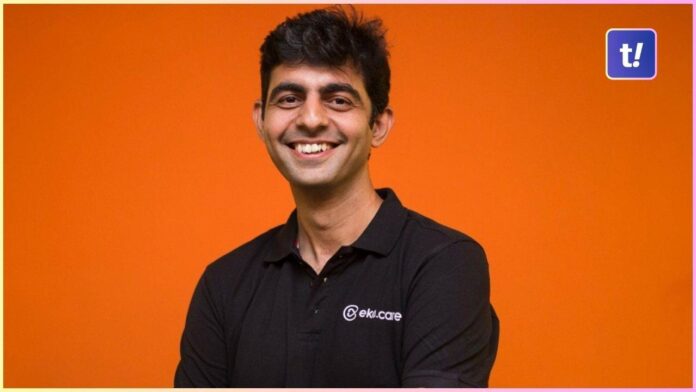

Speaking to the TechGraph, Vikalp Sahni, CEO of Eka Care, discusses the company’s efforts in bringing this digital infrastructure to tier-2 and tier-3 cities, aiming for a future where health data continuity supports better outcomes and ensures timely interventions across India’s diverse health landscape. Shani also explained how projects like Ayushman Bharat Health Account (ABHA) and ABDM have laid the technical foundation to assist doctors and support patients over time.
Read the complete interview:
TechGraph: Eka Care is at the forefront of using artificial intelligence (AI) in healthcare. From your perspective, how do you see AI changing the way doctors and hospitals deliver care in India today?
Vikalp Sahni: AI is no longer a futuristic concept in healthcare. It is actively reshaping how care is delivered across India, especially in high-pressure environments like outpatient departments and primary clinics.
At Eka Care, we’ve embedded AI into the day-to-day practice of doctors. Through DocAssist, doctors are able to access structured summaries of a patient’s complete medical history within seconds, including vital signs, medication patterns, and clinical red flags. This level of instant insight is crucial in India, where the average doctor sees more than 60–100 patients per day, often with limited access to records.
We’ve also built Eka Scribe, a voice-enabled consultation assistant that listens to the doctor-patient conversation and automatically generates prescriptions and electronic medical record (EMR) entries in real-time. It removes the need to type or dictate separately and enables the doctor to stay focused on the patient without compromising documentation. This also means hospitals and clinics are generating higher-quality, structured EMR data without requiring doctors to adapt to a different form-based user experience.
At the hospital level, AI is enabling smarter triage with health assessments and load balancing, especially when paired with ABHA-linked longitudinal records. And for patients, it’s enabling proactive, personalised care instead of just episodic treatment.
We believe that in India’s context, AI is the only scalable way to bridge the gap between the growing demand for quality care and the limited supply of clinicians. But to do that, AI needs to be contextual, localised, and integrated seamlessly into the provider’s workflow—which is exactly the problem we’re solving at Eka Care.
TechGraph: With the government pushing for wider adoption of ABHA, what role do you think digital health IDs can play in improving access and continuity of care, especially in underserved regions?
Vikalp Sahni: Ayushman Bharat Health Account (ABHA) is one of the most transformative public digital health infrastructure projects in the world. It lays the foundation for health data portability, allowing every Indian citizen to carry their medical records across states, hospitals, and care providers.
We see ABHA as the UPI of health, enabling continuity of care even in remote regions where infrastructure is limited. Eka Care has helped create over 1.4 crore ABHA IDs, and we’re actively working to ensure that doctors and patients—even in tier-2 and tier-3 towns—can benefit from a connected health ecosystem that knows their history and supports better outcomes.
TechGraph: There’s a growing conversation around how technology can reduce the burden on healthcare providers. How is Eka Care using AI to support doctors without taking away the human element in patient care?
Vikalp Sahni: Our philosophy is simple: AI should work in the background so that doctors can be more present in the foreground. We’re building assistants, not replacements.
Features like medical summaries auto-generated by DocAssist, structured transcriptions by Eka Scribe, and auto-suggested medications are designed to save doctors’ time on data entry and not decision-making. When we free them from repetitive tasks, doctors spend more time listening, explaining, and connecting with patients. AI at Eka Care is empathetic by design—always augmenting the human experience, never replacing it.
TechGraph: There’s a fine line between using AI to improve healthcare and over-automating sensitive decisions. How do you approach that balance while designing tools for doctors who are already pressed for time?
Vikalp Sahni: That’s a critical line and we draw it with intention. Our AI tools never make autonomous clinical decisions. Instead, they present structured data, summaries, or contextual suggestions, always leaving the final decision to the doctor. We call it human-in-the-loop design.
Doctors are overloaded, not overruled. We ensure that every AI output is transparent, editable, and auditable, so that the doctor remains in control while benefiting from machine efficiency.
TechGraph: Data privacy and security are huge concerns, particularly when it comes to personal health records. How is Eka Care approaching these challenges while scaling its digital health solutions?
Vikalp Sahni: Security is non-negotiable when it comes to health data. All our data is encrypted in transit and at rest, processed inside private virtual clouds, and governed by role-based access controls. We are Ayushman Bharat Digital Mission (ABDM)-certified and Foundational Technical Review (FTR)-approved by Amazon Web Services, which validates our commitment to high security standards.
Additionally, we conduct annual vulnerability assessment and penetration testing (VAPT) for application security. We are also in the process of obtaining ISO 27001 and HIPAA compliance certifications. Beyond compliance, we practice data minimisation, only processing what’s necessary and always with patient consent. Trust is the foundation of healthcare, and we are committed to earning and preserving it every day.
TechGraph: India’s healthcare system still struggles with access gaps between urban and rural areas. Do you think AI, along with ABHA, can bridge this divide in a meaningful way? And how?
Vikalp Sahni: Absolutely. The future of healthcare access in India is digital-first and AI-assisted. ABHA allows any doctor in any village to access a patient’s longitudinal history. There’s no need to guess or rely on verbal recall. Combine that with our AI tools, and suddenly, even a solo practitioner in a remote area has the intelligence of a tertiary hospital at their fingertips.
With AI and ABHA, we’re not just bringing healthcare to rural India. We’re bringing smart healthcare that understands context, trends, and urgency.
TechGraph: Looking at the current healthcare trends in India, such as the rise in telemedicine and preventive care, where do you see the biggest opportunities for innovation over the next few years?
Vikalp Sahni: The future of healthcare in India lies in building continuous, AI-assisted care ecosystems, not isolated interactions. For doctors, the opportunity is in AI-driven augmentation—automating repetitive EMR workflows, improving clinical accuracy, and reducing burnout. Tools like Eka DocAssist and Eka Scribe will evolve into intelligent copilots that assist in diagnosis, summarise key symptoms, and even prompt clinical decisions, while always keeping the doctor in control.
For hospitals, the EMR is no longer just a database—it’s becoming a strategic asset. AI can unlock that data to optimise resource allocation, identify care gaps, and enable predictive alerts for high-risk patients. With Eka Care’s ecosystem already interoperable with ABDM, hospitals will soon be able to integrate national health data layers directly into their systems, ensuring continuity of care across providers.
For the healthcare system as a whole, preventive and personalised care will take centre stage. India has a vast pool of unstructured health data—lab PDFs, prescriptions, vitals—and AI is the key to converting this into actionable, structured insights. Eka’s small custom large language models (LLMs), for instance, are already parsing these documents to detect trends and flag early warning signs.
We see a future where every Indian has a digital health twin—a longitudinal record that is continuously updated, analysed by AI, and shared securely with care providers. The biggest opportunity now lies in enabling early-stage startups to build innovative tools on top of trusted healthcare application programming interfaces (APIs) like ours, while ensuring data is used responsibly and ethically.
In essence, India’s healthtech future will be built on three pillars: open infrastructure (like ABDM), AI-first tools (like Eka Care’s), and ecosystems of innovation where startups, hospitals, and doctors co-create solutions.
TechGraph: Finally, from a policy and ecosystem perspective, what do you think needs to happen next to make India’s digital health space thrive?
Vikalp Sahni: India is leading the way with public digital infrastructure like ABDM, but we need greater collaboration between public infrastructure and private innovation.
Policies should encourage open APIs, interoperability, and data portability. At the same time, we must invest in developer ecosystems that build on top of the rails, not recreate them.
The future of healthtech isn’t just about startups building apps, but also about creating platforms and partnerships that enable shared innovation across hospitals, insurers, pharma, and care providers. We’re proud that Eka Care is helping shape this future—responsibly, securely, and at scale.