


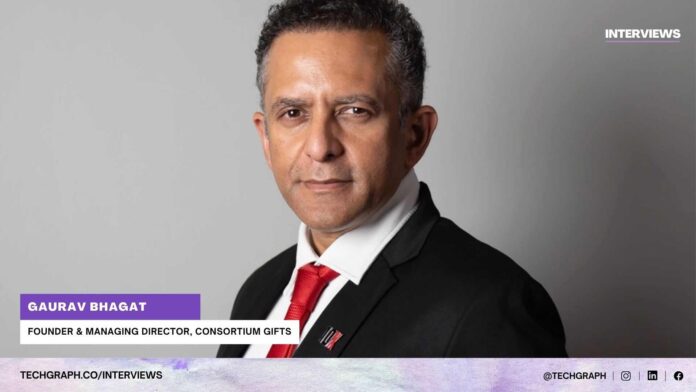

Speaking with TechGraph, Gaurav Bhagat, Managing Director of Consortium Gifts, discussed how India’s corporate gifting landscape is evolving from transactional exchanges to thoughtful, value-led engagement as companies increasingly view gifting as a way to express identity and build emotional equity with employees and stakeholders.
He further explained how Consortium Gifts is bringing this transformation to life through design-led thinking, technology-enabled brand stores, and sustainable sourcing models that connect emotion with measurable outcomes, turning gifting into a continuous engagement channel that helps organizations build loyalty, relevance, and long-term relationships.
Read the complete interview in detail:
TechGraph: What gaps did you observe at Consortium Gifts observe in the changing business culture that convinced you companies were ready to invest in more thoughtful, brand-led gifting?
Gaurav Bhagat: When I started Consortium Gifts back in 1999, the corporate gifting landscape in India was almost entirely transactional; gifts were a checkbox: calendars, sweets, impersonal merchandise. What I observed over the years was a gradual but unmistakable shift: companies began recognising that relationships matter, that employees, clients, and partners want to feel seen.
Some of the gaps we observed in the traditional corporate gifting space were quite telling. To begin with, many gifts lacked emotional resonance; they didn’t feel authentic or relevant, often coming across as generic tokens that did little to foster loyalty or strengthen relationships. There was also a distinct misalignment between brand values and gifting decisions. For example, a brand may claim to be sustainable, design-led, or innovation-centric in its positioning, yet the gifts that it gave out communicated a very different story, thus not aligning identity with expression.
Another challenge was the one-size-fits-all mentality. Organizations used to send the same product to employees, clients, dealers, and distributors without thinking about the special relationship or setting that each of the categories meant. This made gifts feel impersonal rather than thoughtful. Finally, we noticed rising expectations. As Indian companies grew more global in outlook, their stakeholders began to compare corporate gifts with what they encountered elsewhere. This brought pressure for greater creativity, higher quality, and stronger alignment with brand values.
Together, these insights convinced us that companies were ready to move beyond “standard” gifting to something more thoughtful and strategic. They began to see gifting not as a mere cost centre, but as a powerful brand instrument capable of creating lasting impressions.
TechGraph: When companies use merchandise to represent themselves, it often carries the weight of both identity and intention. How does Consortium Gifts ensure a product does not feel generic but instead becomes a subtle extension of the company’s story?
Gaurav Bhagat: For us, each gift must have meaning, and we carefully seek to make that happen. It starts with profound discovery. If a client approaches us, we don’t just ask about their budget or the piece they are thinking of. Rather, we dig deeper into their brand values, the recipient’s profile, the impression they desire to create, and what they would like people to recall. This means we are able to choose products, materials, designs, and packages that reflect the company’s personality.
There is also the critical layer of customization and design. Not only do we include names, logos, or packaging, we are highly attentive to styles, materials, finishes, and colours that align with the brand aesthetic. Through our in-house designers and creative partners, we have full control to make sure even the most minute items have a consistent and deliberate brand presence. Quality and craftsmanship are also high priorities for us. An ill-crafted gift is always remembered for the wrong reasons, and that’s why we are adamant on robust, fine-finished products that appear premium. Quality, by itself, speaks credibility and shows that the brand truly cares about its relationships.
Meanwhile, we concentrate on constructing curated stories. Much of our gifting programmes or bundles are theme-driven, like a welcome package for new hires or a thank you bundle for long-term partners. These sets are more than individual components, because the manner in which they are arranged and presented is a story that supports the brand’s intention.
Last but not least, we are dedicated to innovating beyond the clear. Through tracking global trends, local cultural adaptations, and feedback, we continually update our solutions. Customers today seek environmentally friendly, experiential, and technologically savvy gifts, and we incorporate these into our solutions so that each gift is fresh, topical, and influential.
TechGraph: The global gifting industry often sets trends that filter into India, yet Indian businesses have their own cultural codes and expectations. How does Consortium Gifts balance global inspiration with local relevance in the way you curate your offerings?
Gaurav Bhagat: It’s a delicate balance, but one we feel is simply indispensable. We are always monitoring global trends, closely following the international gifting fairs and the innovations in materials, technology, and sustainability. Trends such as green materials, experience gifting, and digital integrations give us inspiration and ideas.
We also understand that India is not homogeneous. There are different preferences for metro cities such as Mumbai or Bangalore, versus Tier 2 or Tier 3 towns, so we go out of our way to localize products and services by region, city, and client segment. Lastly, we use feedback loops. Through soliciting feedback from both recipients and clients, we continue to hone our products, aware that what may feel upscale to one party may be too much for another. This back-and-forth process allows us to stay responsive and pertinent.
In other words, global inspiration makes sure that we are never parochial, while local adaptation ensures that we are never irrelevant.
TechGraph: Cost pressures are real in procurement, but gifting is also about signaling value and building trust. How do you persuade decision-makers that cutting costs here can dilute long-term relationships in ways they might not immediately recognize?
Gaurav Bhagat: This is one of the biggest challenges we face, but we approach it with a combination of evidence and narrative. One of the most effective ways to persuade decision-makers is by showing ROI beyond immediate cost. We often share case studies where thoughtful gifting directly improved client retention, dealer loyalty, or employee morale. Another critical factor is the cost of brand perception. When a company distributes low-quality or generic gifts, it can make them appear cheap or indifferent, impressions that eventually erode trust. These “soft costs” may not show up immediately on a balance sheet, but over time, they can be far more damaging.
We also highlight the cost versus value trade-off. By showing options side by side, a cheaper option versus one that is slightly higher but much more durable, memorable, and emotionally meaningful, we make clients realize that the difference in marginal cost is small in relation to the much larger impact produced.
Lastly, we highlight our capability to expand cost efficiencies. Since we work at scale, we can produce high-quality, sustainable, and well-crafted products at decent margins. This translates to clients not having to sacrifice affordability for meaningful gifting. Through meaningful sourcing and proper planning, they can attain both.
TechGraph: Sustainability has moved from being a buzzword to a firm expectation, yet eco-friendly products often face doubts about durability and desirability. How are you addressing those doubts while scaling options that remain commercially viable?
Gaurav Bhagat: For us, sustainability isn’t a checkbox; it’s a standard. We’ve proven that eco-friendly can also mean durable, desirable, and commercially viable. From designing premium green products that meet the quality expectations of our retention-driven clientele, to scaling collections that balance aesthetics with responsibility, we’ve consistently shown that businesses don’t need to compromise when choosing sustainability.
Beyond products, our CSR initiatives, whether it’s winter donation drives or providing educational materials and essentials to underprivileged schoolchildren, reinforce our commitment to creating impact that lasts. For us, sustainability is not only about conscious gifting but also about building a future where responsibility and growth go hand in hand.
TechGraph: With digital platforms reshaping how companies track engagement, loyalty, and retention, what role does technology now play not only in delivering gifts but in transforming the entire gifting experience for corporates?
Gaurav Bhagat: Technology has shifted corporate gifting from being a transactional gesture to becoming an experiential journey, and Consortium Gifts has been ahead of that curve. Through our successful digital brand store experiences, we’ve enabled companies to seamlessly integrate gifting into their employee engagement, appreciation, and retention strategies.
Today, gifting is no longer about what you send, but how it’s experienced, tracked, and remembered. That’s why we’ve invested in tech-led platforms that allow businesses to measure impact, personalize interactions, and create loyalty-driven touchpoints.
At the same time, our own recognition as a ‘Great Place to Work’ dual-certified company underscores that we practice what we preach, building thoughtful experiences that enhance retention, strengthen culture, and set the right benchmark for the industry. For us, technology isn’t just about delivery; it’s about transforming gifting into a measurable, meaningful brand asset.
TechGraph: Seasonality has always been a defining rhythm of this industry, but businesses today want consistent engagement touchpoints. How does Consortium Gifts convert a cycle traditionally driven by festivals into an all-year strategic opportunity?
Gaurav Bhagat: As of 2025, we’ve redefined seasonality into strategy. While festivals remain cultural milestones, today’s businesses seek year-round engagement, and that’s where we step in. From opening India’s first-ever exclusive corporate gifting experience stores, starting with marquee names like HCL, to launching integrated PR and marketing campaigns that build visibility nationally, regionally, and globally, and making waves across Forbes India recently in their August 2025 edition, we are creating consistent touchpoints that extend well beyond Diwali or the New Year. Our approach ensures that gifting isn’t just an event, it’s a sustained brand dialogue. By blending innovation, retail presence, and global positioning, Consortium Gifts is transforming what was once a festive rhythm into an all-year strategic opportunity for our partners.


