

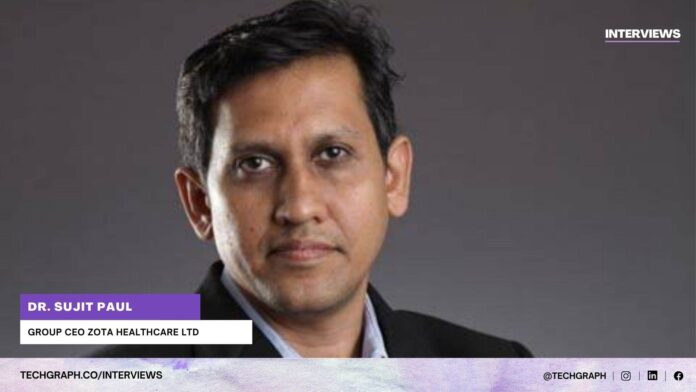
Building Healthcare Equity: Zota Healthcare CEO Dr. Sujit Paul on DavaIndia’s Push for Accessible Generic Medicine

PUBLISHED:

See more TechGraph stories in your search results.
Google Add TechGraph on Google

Speaking with TechGraph, Dr. Sujit Paul, Group Chief Executive Officer of Zota Healthcare Ltd., discussed how India’s healthcare ecosystem is entering a new phase of affordability and accessibility driven by high-quality generic medicines, and how Davaindia’s retail model is bridging treatment gaps by offering pharma-grade generics at transparent prices through an expanding nationwide network.

He also highlighted the company’s focus on chronic therapies, pharmacist-led education, and transparent price comparisons that are reshaping perceptions around generics and helping patients achieve comparable therapeutic outcomes at significantly lower costs while advancing healthcare equity across both urban and rural India.

- Advertisement -

Read the interview in detail:

TechGraph: Davaindia has built its identity around making quality generic medicines widely accessible at affordable prices. Given the growing global conversation on healthcare equity, how do you see the role of generics evolving in bridging treatment gaps across different sections of society?

Dr Sujit Paul: Generics are at the heart of healthcare equity; they reduce the cost barrier for critical medicines and facilitate increased access across income groups. Davaindia’s model illustrates this: making quality generics  available across a large retail network.

The company lowers out-of-pocket expenses for chronic and acute therapies, rendering treatment within reach for many who otherwise forego or defer medicines. This is how generics scale impact from individual savings to systemic access. 

TechGraph: The Indian pharmaceutical sector is often described as both highly competitive and deeply fragmented. How then has Davaindia managed to carve out a distinctive position in the minds of consumers who have traditionally placed trust in branded medicines?

Dr Sujit Paul: Trust is fostered by regular quality, transparent prices and broad availability. Davaindia combines pharma-grade manufacturing quality with visible price comparisons against branded equivalents at the point of sale. Its retail presence, company-owned and franchise stores, also assists with a uniform customer experience and pharmacist advice that reinforces generic confidence.

TechGraph: Trust is central in healthcare, yet consumer perception around generics has historically been mixed. What specific strategies have you found most effective in reshaping attitudes and building long-term confidence in the quality of generic alternatives?

Dr Sujit Paul: Education and convenience. On-shelf price transparency, pharmacist interaction, community outreach and digital touchpoints (app/online ordering) make generics less of a mystery. Consistent results, patients enjoying identical therapeutic benefit for much reduced costs, fuel word-of-mouth. Davaindia’s focus on chronic therapies (repeat prescriptions) also makes generics more of the norm.

TechGraph: India is seeing rapid changes in regulation, digital infrastructure, and distribution networks. How are these shifts influencing the way Davaindia approaches its expansion and the delivery of medicines to smaller towns and semi-urban areas?

Dr Sujit Paul: Stricter regulatory transparency and digital logistics enable us to scale quickly into Tier II/III and semi-urban segments. Davaindia is taking a hybrid company-owned and franchise approach to balance control with local entrepreneurialism, and real-time inventory and predictive stocking, minimise stockouts in smaller stores. 

TechGraph: Technology is now deeply intertwined with how patients access care and medicines. In what ways is Davaindia leveraging digital tools not just for operational efficiency but also for improving patient awareness and healthcare outcomes?

Dr Sujit Paul: In addition to operational effectiveness, digital technologies drive patient education (apps, SMS reminders), telepharmacy connections, and adherence tracking. Predictive inventory and AI-driven supply chains guarantee drugs are in supply when required, improving adherence and outcomes directly, particularly for chronic diseases.

TechGraph: With global discussions around supply chain resilience and affordability of essential drugs gaining momentum, what role do you see Indian companies like Zota Healthcare playing in shaping more stable and accessible healthcare systems beyond India?

Dr Sujit Paul: Indian generics manufacturers and retail platforms can be allies to international health systems by providing quality, affordable medicines at scale and assisting in establishing last-mile distribution models in low-resource environments. Export capacity, along with a strong domestic network, makes Indian companies natural partners in enhancing global drug affordability.

Stay ahead of the curve, every day.

A daily briefing covering news, interviews, and the trends driving the world forward. Curated for readers who want news, not noise.

We don’t spam! Read our privacy policy for more info.

- Advertisement -
Krishna Mali
Krishna Mali
Founder & Group Editor of TechGraph.

Top Gainers · Global

View all
NamePriceChange
BNSScotiabank C$129.52 +32,313.48%
SHOPShopify C$239.71 +34.56%
TECHMTech Mahindra ₹1,790.00 +8.48%
WIPROWipro ₹184.40 +5.95%
TCSTata Consultancy Services ₹2,465.00 +4.89%

Latest Stories

The best CRM for a small business with a remote sales team is the one that answers at 11 p.m.

Every month, 18,100 people in the US search for...

NumanCap Review 2026 | Markets, Margin and Mobile

Not long ago, trading meant calling a broker, paying...

The Rise of Retail Spaces in India’s Emerging Cities

Organized retail in India remained more or less restricted...

The Death of India’s Unicorn Obsession

As funding becomes more selective and M&A and secondary buyouts gain ground, India’s startup ecosystem is beginning to rethink what success looks like beyond the billion-dollar unicorn valuation.

How vertical SaaS can modernise India’s laundry and garment-care industry

Ask anyone in an Indian city how they get...

Related Articles

The best CRM for a small business with a remote sales team is the one that answers at 11 p.m.

Every month, 18,100 people in the US search for “best CRM for small businesses with remote sales teams” (Semrush, October 2026). The phrase is...

NumanCap Review 2026 | Markets, Margin and Mobile

Not long ago, trading meant calling a broker, paying a hefty commission, and waiting for a confirmation in the mail. Today you can open a position on oil, gold, the S&P 500, or Bitcoin from a laptop in a few clicks, or from your...

The Rise of Retail Spaces in India’s Emerging Cities

Organized retail in India remained more or less restricted to a select few metro...

The Death of India’s Unicorn Obsession

As funding becomes more selective and M&A and secondary buyouts gain ground, India’s startup ecosystem is beginning to rethink what success looks like beyond the billion-dollar unicorn valuation.

How to Set a WordPress Maintenance Budget Without Guessing

Build a practical WordPress care budget by separating recurring support, renewals, planned improvements and work that needs a separate decision.

From Alerts to Answers: How AI Is Rewriting Fraud Detection in Financial Services

Every bank, credit union, and payments company runs on a quiet paradox. The systems...

5 Best Gift Card Management Software Platforms for Growing Brands

Gift cards have quietly become one of the most valuable tools in a brand’s...

Who Needs to Comply With NIS2? A Sector-by-Sector Guide

Understand who NIS2 applies to, how Essential and Important Entities are classified, and what organisations need to do to strengthen cybersecurity compliance and operational resilience.

Scalefusion Launches Veltar Vulnerability Management for Endpoint Security

Veltar Vulnerability Management connects vulnerability detection with Scalefusion UEM, allowing security and IT teams to assess endpoint risks and move towards remediation within the same workflow.

Who Needs to Comply With NIS2? A Sector-by-Sector Guide

Understand who NIS2 applies to, how Essential and Important Entities are classified, and what organisations need to do to strengthen cybersecurity compliance and operational resilience.

Scalefusion Launches Veltar Vulnerability Management for Endpoint Security

Veltar Vulnerability Management connects vulnerability detection with Scalefusion UEM, allowing security and IT teams to assess endpoint risks and move towards remediation within the same workflow.

Where Driver Dollars Are Really Going

Owning a motor vehicle involves a wide variety of ongoing costs that go far...

How is the extensive use of AI causing cyber threats?

At times, when artificial intelligence is involved in routine procedures without even being noticed,...

What Will Happen to Your Home After a Divorce?

Divorce can affect nearly every part of a person’s life, including where they live...

How vertical SaaS can modernise India’s laundry and garment-care industry

Ask anyone in an Indian city how they get their clothes cleaned, and you'll probably hear the same story. A neighbourhood press-wallah who's been...

Where Driver Dollars Are Really Going

Owning a motor vehicle involves a wide variety of ongoing costs that go far...

How is the extensive use of AI causing cyber threats?

At times, when artificial intelligence is involved in routine procedures without even being noticed,...

Meta COO Javier Olivan Reports $3.3 Million Share Sale

Meta Platforms Inc. () COO Javier Olivan has sold 5,354 shares of the company's...

Meta COO Javier Olivan Reports $3.3 Million Share Sale

Meta Platforms Inc. () COO Javier Olivan has sold 5,354 shares of the company's...

Why AI Adoption Fails in Enterprises; and What Leaders Can Do Differently

Artificial Intelligence has become a boardroom priority. Organisations across industries are investing in AI...

Nebius Acquires AI Inference Startup Inferize

Inferize will join Nebius Token Factory, bringing technology designed to reduce model loading times and idle GPU capacity as Nebius expands its production AI inference capabilities.

What Does India’s First Tokenised Bond Pilot Mean for the Debt Market?

India has successfully completed its first tokenised bond issuances, marking a major step for Demat 2.0. While the pilot proves tokenised bonds can operate within the existing financial system, the next challenge is whether the technology can improve liquidity, trading and broader participation in the debt market.