


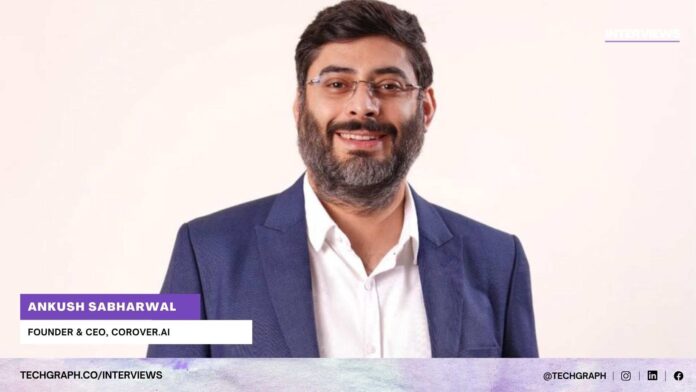

Speaking with TechGraph, Ankush Sabharwal, Founder and CEO of CoRover AI, discussed how the company’s BharatGPT platform is helping enterprises adopt conversational AI that emphasizes local-language engagement and data sovereignty to connect with users in their preferred languages across voice, video, and text to deliver inclusive and accessible customer experiences.
He further explained how CoRover’s full-stack Conversational Agentic AI solutions enable this transition to deliver scalable deployments that reduce costs, increase revenue, and strengthen customer engagement across industries.
Read the interview in detail:
TechGraph: The AI landscape is evolving quickly, yet many enterprises still struggle to balance innovation with practical adoption. How is CoRover seeing large organizations move beyond pilots and proofs of concept in conversational AI, and what separates those who scale successfully from those who stall?
Ankush Sabharwal: At CoRover, we’ve observed that enterprises that successfully move beyond pilots in Conversational AI share three common traits: a clear business problem statement, a scalable architecture, and a change management mindset.
Many organizations get stuck in pilot purgatory because they experiment with generic models or siloed solutions that don’t integrate into their enterprise ecosystem. In contrast, leaders who scale focus on domain-specific models, seamless integrations with existing workflows, and measurable ROI from the very beginning.
What sets successful adopters apart is their recognition that Conversational AI isn’t just a technology upgrade; it’s a strategic shift. By deploying secure, multilingual, multimodal AI agents at a population scale, our clients drive tangible outcomes: 70% cost reduction, 10X revenue growth, and significantly improved customer satisfaction.
Enterprises that embrace responsible AI, continuous learning, and sovereign models like BharatGPT are moving fastest from proof of concept to enterprise-wide adoption. It’s about balancing innovation with trust, scalability, and impact.
TechGraph: Generative AI has opened new possibilities for dialogue systems, but concerns around accuracy, bias, and compliance remain front and center. How is CoRover making sure the platform stays reliable and trustworthy when deployed at scale in sensitive enterprise environments?
Ankush Sabharwal: We recognize that accuracy, bias, and compliance matter in enterprise settings. We cater to this through Responsible AI practices, such as hybrid models made of Generative AI, Classic NLP, and RAG pipelines to ground contexts. Our Prompt Response Layer implements guardrails, audit logs, authenticity checks on content, and data governance practices that guarantee outputs at scale as being reliable, compliant, and explainable. We have even signed SLAs with 99%-100% accuracy, and we delivered.
The competitive field is crowded, with global players pushing their own conversational AI solutions. What kind of differentiation do you believe matters most in earning enterprise trust, especially in markets like India, where cost and scalability weigh so heavily?
Ankush Sabharwal: In markets such as India, enterprises seek full-stack solutions that are sovereign, scalable, cost-effective, and secure. What differentiates us at CoRover is our capability to offer BharatGPT, an Indian, multilingual, multimodal LLM, deployed on sovereign infrastructure and even on-premise for compliance.
While most generic platforms emphasise training with publicly available data, we concentrate on domain-specific and enterprise-specific training and fine-tuning, ease of integration, as well as enterprise-grade governance, fostering long-term trust in relations with clients.
Moreover, our full-stack Conversational Agentic AI platform provides enterprise solutions for various problems/use cases across functions, which are not just Q&A machines, but also transactional to help them improve revenue, save cost and make their end consumers/users happy.
TechGraph: Traditional chatbots often struggled with rigidity and limited context, while generative AI promises more fluid, human-like conversations. Given this shift, how do you at CoRover define the threshold for what truly qualifies as “human-centric” in conversational AI?
Ankush Sabharwal: We believe in human-centric AI as systems not just fluid and contextual, but empathetic, inclusive, and accessible too. To us, it means AI Agents that can converse in 100+ languages, adapt over voice, video, and text channels, and work in low-bandwidth environments and even function as interactive digital twins (AI VideoBots) to provide personalized and immersive user experiences. Human-centricity means reaching people where they happen to be, not compelling people to fit into one-size-fits-all interactions.
TechGraph: Regulation around AI is picking up pace, particularly in Europe and the US. What impact do you expect emerging frameworks to have on conversational AI platforms, and how is CoRover preparing for a future where compliance could shape product design as much as technology?
Ankush Sabharwal: Regulation will propel the sector to safer, more transparent, and user-protective configurations. We see this as good news. Our platforms are being designed with watermarking, auditability, consent-based data handling, and explainable AI frameworks built in. Contrary to inhibiting innovation, compliance will ensure trust at scale, which is fundamental for enterprise adoption. We are DPDPA and GDPR compliant and possess certifications like ISO 27001 | ISO 9001 | ISO 27701 | ISO 20000-1 and more.
TechGraph: With the rise of multilingual and multimodal AI, users increasingly expect to interact in their preferred language and channel seamlessly. How are you addressing these demands, and what do you see as the biggest challenges in making that inclusivity work at scale?
Ankush Sabharwal: We have invested significantly in making conversational AI truly inclusive. With BharatGPT, CoRover supports 14+ Indian languages natively and scales across voice, video, and text channels, and Telephony AI, which works without the internet.
The biggest challenge lies in ensuring accuracy across dialects and delivering performance in low-connectivity regions. We address this by combining fine-tuned LLMs, lightweight edge deployments, and multimodal integrations, ensuring that inclusivity is delivered without compromising performance.
TechGraph: There is always tension between the speed of deployment and the depth of integration. How do you think enterprises should approach rolling out conversational AI in a way that avoids fragmented or short-lived implementations?
Ankush Sabharwal: The key is to have a balance between integration depth and modularity. Enterprises roll out hastily without integration, and they risk having short-lived, fragmented implementations. Basic AI Agents can be created in just a couple of minutes, which can even be integrated with APIs and launched via Website, App, and other social media channels. And, we can keep adding more use cases and integrations based on the need and feedback.
We would recommend an incremental roll-out strategy starting from high-impact use cases like customer support automation, and then ramping up to pre-sales, sales, and post-sales across functions. It yields quick business results while establishing an enterprise-wide scalable conversational AI fabric.