


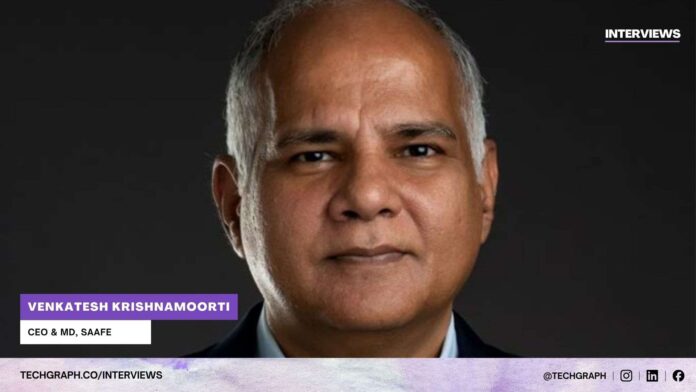

In an interview with TechGraph, Venkatesh Krishnamoorti, CEO and Managing Director of Saafe, discussed how India’s Account Aggregator (AA) framework is expanding access to credit and financial services through a secure, consent-driven data-sharing model that enables citizens and small businesses to access finance with transparency and trust.
He also spoke about how Saafe is supporting this transition through partnerships and policy engagement that strengthen interoperability and standardized data access across institutions, helping build a more balanced and innovation-friendly financial ecosystem for both established players and emerging fintechs.
Read the interview in detail:
TechGraph: Account Aggregation is still at a relatively early stage in India’s financial ecosystem. How do you see adoption shaping up among individuals and businesses, and what are the practical hurdles slowing down its wider use?
Venkatesh Krishnamoorti: When it was launched four years ago, the Account Aggregator (AA) framework represented a big step towards democratizing financial data access through a secure, consent-based model. Since then, the ecosystem has matured steadily, with millions of users and hundreds of institutions now participating.
Today, it is at forefront of India’s digital public infrastructure, enabling citizens to access credit and other financial services with consent, trust and transparency. With 2.12+ billion accounts enabled for consent-driven data sharing and ₹1.6 lakh crore in estimated loan disbursement powered by AA in 2025 alone, the ecosystem has been scaling newer heights with every passing year.
However, the wider adoption of the Account Aggregator (AA) ecosystem in India is hampered by a few hurdles.
The main challenges are:
- Low awareness about AA amongst the citizens.
- The supply side (i.e., Financial Information Providers – FIPs) is not democratized, with data disparity & incompleteness.
Examples of Incompleteness & Data Disparity: The schema for securities data (stocks, mutual fund units) does not include purchase prices (it is available only from MF Central, a CAMS & KFintech JV). Wealth Managers & RIAs are pushed to use the more expensive MF Central for accessing mutual fund units data of their Customers. EPF, PPF, Bonds, etc, are not yet part of the AA system.
- Tech challenges such as FIP downtime, inconsistent data formats, and restricted access windows further reduce reliability and user trust.
We believe that reforms related to Account Aggregators, combined with the implementation of the DPDP Act, will provide the much-needed impetus to sensitize citizens in Data privacy and nudge them to adopt AA as their default mode of sharing data, rather than the insecure paper / scanned bank statements that potentially compromise their security.
TechGraph: The regulatory framework around NBFC-AAs is designed to prioritise data privacy and consent. Given that, how do you balance strict compliance with building customer-friendly experiences that don’t feel cumbersome?
Venkatesh Krishnamoorti: Balancing strict regulatory compliance with customer-friendly experiences in the NBFC-AA framework requires thoughtful design that simplifies consent journey flows without compromising data privacy.
While the framework mandates robust security and explicit user consent, the challenge lies in making these processes intuitive and seamless—so users feel empowered rather than burdened.
We, at Saafe Account Aggregator, have achieved this by using clear language, minimizing friction in digital interfaces, and ensuring that users understand what they are consenting to without feeling overwhelmed.
TechGraph: Traditional banks have been cautious in adopting AA infrastructure, while fintechs tend to move faster. Given this uneven pace, how do you see the balance of power between incumbents and digital-first players shifting in the AA-driven future?
Venkatesh Krishnamoorti: With fintechs rapidly embracing the AA infrastructure and traditional banks adopting it more gradually, the balance of power is shifting toward digital-first players. These agile innovators are better positioned to leverage real-time, consent-based financial data to deliver personalized, efficient services.
As the AA ecosystem matures, incumbents will need to accelerate their integration and rethink legacy processes to remain competitive, or risk ceding ground to nimbler, data-driven challengers.
TechGraph: One of the strongest promises of AAs has been improving credit access for MSMEs who remain underserved despite years of policy focus. What evidence are you seeing on the ground, and what structural challenges still block this vision?
Venkatesh Krishnamoorti: There is growing evidence that the AA framework is improving credit access for MSMEs in India, particularly by simplifying data sharing and reducing the cost and complexity of loan applications. For MSMEs, long excluded from formal finance, transaction data through AA now serves as collateral, unlocking an affordable & instant source of working capital.
For example, as per Sahamati, Loan approval timelines have been cut from weeks to under 48 hours for many MSMEs, with loans being approved in just a few clicks.
However, structural challenges persist. Currently, the AA framework primarily supports individual accounts, which limits its utility for businesses and families that operate shared financial arrangements. Enabling the Joint & Corporate account should further increase the reach and acceptability of the AA ecosystem.
Further, many MSMEs remain data-dark, lacking formal credit histories or adequate documentation, which makes it difficult for lenders to assess their creditworthiness. Additionally, awareness of the AA framework is still low among MSMEs, especially micro-enterprises, many of which continue to rely on personal capital and unorganized lenders rather than formal credit.
TechGraph: Globally, open banking has become as much about competition policy as it is about technology. Do you believe India’s AA framework is ambitious enough on that front, or are we still treating it as an inclusion experiment rather than a competitive reform?
Venkatesh Krishnamoorti: India’s AA framework has made significant strides in financial inclusion, but its ambition as a tool for market reform and competition policy is still evolving. Unlike open banking models in the UK or EU, which were explicitly designed to foster competition by breaking data monopolies held by incumbent banks, India’s AA framework has so far been more focused on democratizing access to financial services using a consent-based architecture.
That said, the AA system empowers users with control over their financial data, enabling them to seamlessly share it with fintechs, insurers, and wealth managers—thus levelling the playing field between traditional banks and digital-first players. This shift is already encouraging innovation and new business models, particularly among fintechs that can now offer personalized services without needing legacy infrastructure.
However, the regulatory narrative still leans heavily toward inclusion and data empowerment, rather than explicitly promoting competition and market disruption. For AA to fully realize its potential as a competitive reform tool, policymakers may need to strengthen interoperability mandates, ensure equal access to data across institutions, and incentivize incumbents to participate more actively.
TechGraph: The commercial model for AAs is still evolving, and some argue it risks being utility-like without clear monetisation levers. How are you thinking about long-term viability, and what revenue streams do you believe will prove most resilient?
Venkatesh Krishnamoorti: The commercial viability of the Account Aggregator (AA) model in India is still evolving, with early revenue streams primarily driven by data fetch fees paid by Financial Information Users (FIUs). Currently, this model faces challenges due to low pricing, limited product differentiation, and the risk of becoming a commoditized play without strong monetization levers.
Further, strict restrictions on AAs from pursuing any other business model or revenue stream also affect the profitability of AAs.
As a critical cog in the financial sector, we believe that there will be positive developments from the regulatory front, and consolidation would certainly make AA a very strong value play.
In the long run, the most resilient revenue streams are likely to come from deep integrations with FIUs, a newer type of entity that can participate in the AA ecosystem and industry-specific solutions that leverage AA data for smarter, more inclusive financial products. As the ecosystem matures and adoption grows, these models could help AAs move beyond basic data sharing into more strategic roles within India’s digital financial infrastructure.
TechGraph: With multiple licensed AAs entering the market, technology alone may not differentiate players for long. Beyond compliance, what qualities will separate leaders from also-rans once the ecosystem matures?
Venkatesh Krishnamoorti: Unlike the CICs, where there was a clear mandate to restrict the number of players to only 4, a larger number of AA licensees (19) have been issued.
As the AA ecosystem matures and technology becomes a baseline, the qualities that will separate leaders from laggards go beyond compliance and infrastructure. True differentiation will come from user-centric design, trust-building, and ecosystem partnerships. Players that offer seamless, intuitive consent journeys, build strong relationships with financial institutions, and deliver actionable insights from the journey will stand out.
Moreover, those who can scale responsibly while maintaining transparency and reliability will earn long-term user loyalty and institutional trust.