


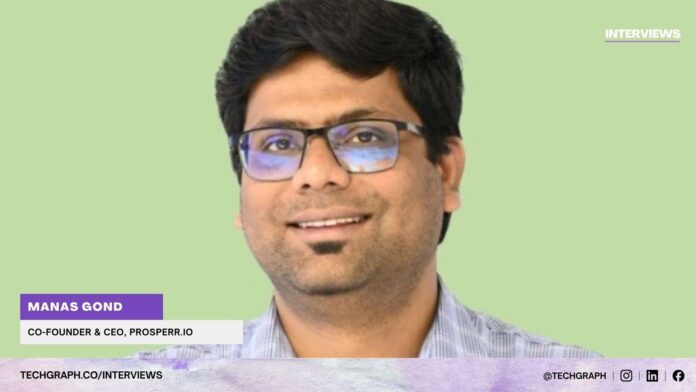

During an interview with TechGraph, Manas Gond, Co-founder and CEO of Prosperr.io, outlined how artificial intelligence is simplifying India’s taxation landscape by providing salaried individuals with timely clarity on compliance and enabling them to optimize financial benefits without navigating complex rules, and how the company is using technologies to help them make confident decisions while expanding access to expert-grade tax management.
Gond also spoke about Prosperr’s financial operating system, which combines real-time compliance guidance, dynamic payroll, and personalized planning in a single framework to keep financial decisions aligned with regulations and give users a structured way to improve tax outcomes throughout the year.
Read the interview in detail:
TechGraph: Taxation in India is often seen as overly complicated, and even digitally savvy individuals find it hard to navigate without making errors or missing out on potential savings. How do you think AI is genuinely shifting that landscape and making tax management less intimidating for people?
Manas Gond: Tax is not overcomplicated. It’s just that people are not up to date with the compliance requirements. People miss the confidence and clarity to approach taxation in a timely manner. AI gives access to information to people, which gives predictive nudges in a timely manner and has the potential to customize tax solutions for individuals, segmenting and profiling them as per their unique contextual and personal information to ensure 100% tax compliance. AI can bring accuracy and quality at scale while maintaining the best-in-class tax expert experience.
TechGraph: Prosperr.io promises guaranteed maximum savings through its subscription model. Given that tax laws change frequently, how do you balance the reliability of those savings with the uncertainty of ever-evolving regulations?
Manas Gond: Helping individuals save more money is a by-product of our larger business offering of managing people’s finances and sharing with them actionable insights. We match people’s personas with the changing regulations, ensuring compliance clarity while catering to their needs accordingly.
So, irrespective of the regulatory shifts or other uncertainties, we match the most suitable financial solution for our audience. A subscription model ensures democratization of our offerings across our target audience, irrespective of the ever-changing regulations and tax complexities. We support the users in their tax journey throughout the year without any hidden costs involved.
TechGraph: Many financial-tech players are now building AI-driven tools that claim to simplify personal finance. What is the unique solution that Prosperr.io is bringing in?
Manas Gond: We are building a financial operating system for salaried individuals, and the OS will function like a personal CFO to help users make their financial decisions in a much more guided way. This OS will power the customer’s overall financial journey in a personalized manner.
We partner with enterprises as well and offer Dynamic Payroll and Flexi Benefits Plan (FBP) to automate tax-free allowances, boost employee take-home pay, and ensure 100% compliance, while reducing HR operational costs at the same time. Our goal is to equip the salaried individuals with decision-making abilities that HNIs in our country have through access to information, personal CFOs, and other facilities.
TechGraph: Trust plays a central role when people hand over sensitive financial information. How do you approach building user confidence not just in your product but also in AI as a decision-making partner for something as critical as taxes?
Manas Gond: We use AI to bring in clarity, confidence, and compliance, empowering individuals to take control of their finances confidently, while giving CFOs and enterprises assurance that their tax processes are accurate, optimized, and secure.
Our AI is powered by a continuously updated rule engine aligned with tax laws and payroll regulations. This ensures that recommendations are not just smart but also accurate, compliant, and reliable, minimizing errors and risk.
While AI provides real-time guidance, expert human support is available whenever needed. This combination of AI efficiency and human judgment reassures users that critical financial decisions are backed by both technology and expertise.
TechGraph: India has a large population that is still under-served when it comes to professional tax guidance. Yet there is also a growing urban class willing to pay for premium financial services. How do you see Prosperr.io balancing accessibility with exclusivity in the way it scales?
Manas Gond: In India, a very small number of people pay taxes, have a high purchasing power, and have the ability to utilize financial products. These are individuals earning a salary between 15L and 2Cr. This is also the underserved segment in India, who are the tax-paying affluent and high-affluent individuals.
The ones outside this segment are either not in the tax-paying bracket or are HNIs who have access to personalized financial experts. Prosperr is trying to cater to this underserved segment to make their financial journey as good as that of HNIs.
TechGraph: Subscription models in financial services can be tricky because customers often expect immediate and visible returns. How do you tackle the challenge of making people see long-term value rather than looking at tax optimization as a one-off yearly exercise?
Manas Gond: Tax is not a once-in-a-year event. The majority of people believe that tax filing defines taxation and that’s the only important event; however, tax compliance is a year-long journey and must be planned throughout the year.
TechGraph: With global interest in AI-powered financial services growing rapidly, do you see Prosperr.io positioning itself primarily as an India-first solution, or is the technology adaptable enough to enter other markets with very different tax regimes?
Manas Gond: We are building in India for India, but we’ll be going to other geos eventually. The Indian market is such a complex problem to solve, and there’s a lot to tap into in India. People think India is not a high-paying market, but that’s not the case in the taxation or finance ecosystem.
Having said that, we will keep an eye out for opportunities in other geos as well, and wherever our TG is matching, we’ll be expanding our business. The regulations might change, the policies may be different, but our technology is adaptable, and day 1 in any other geo is going to be easier than day 1 in India because we already have a learning curve.