


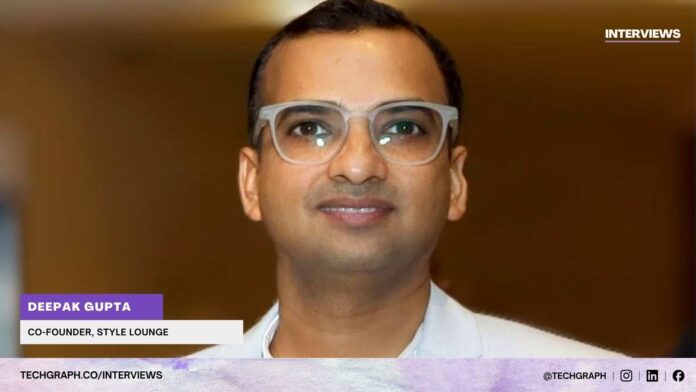

Speaking with TechGraph, Deepak Gupta, Co-Founder of Style Lounge, discussed how the company’s facial scanning technology is delivering personalised skincare guidance that goes beyond basic skin categories by analysing detailed features such as tone, texture, and hydration, along with lifestyle variables, to help users receive recommendations they can trust rather than generic or trend-driven advice.
He also spoke about Style Lounge’s Human-in-the-Loop approach, which combines intelligent automation for assessment and scheduling with expert-led care to ensure that technology strengthens personal relationships instead of replacing the human touch at the heart of beauty and wellness.
Read the interview in detail:
TechGraph: Beauty and wellness apps are often judged on how personal they can get with recommendations. Since Style Lounge uses facial scanning to suggest remedies and treatments, how do you make sure the technology avoids generic advice and actually feels trustworthy to users?
Deepak Gupta: Style Lounge uses a special facial scanning system to give personal skincare advice that feels real and trustworthy, not just generic tips. Instead of just looking at basic skin types, we analyze detailed features like skin color, wrinkle depth, and moisture level.
We also consider important things like the person’s age, budget, weather, and pollution where they live. This way, even if two people have similar skin problems, they get unique skincare plans that fit them perfectly. We build trust by showing real results, tracking how the skin improves over time, and connecting customer feedback to the treatments they received.
TechGraph: The salon industry in India has largely worked on walk-ins and personal referrals. With your booking system now powered by Agentic AI for confirmations and scheduling, what shifts do you see in how customers are beginning to interact with salons digitally?
Deepak Gupta: We are noticing three major changes in how customers behave:
First, appointment bookings are shifting from a “try my luck” approach, where people just hope there is an available slot, to a “time-certain” system. This is possible because our AI quickly manages stylist schedules, suggests alternative times if needed, and completes the booking with instant confirmations. This makes the booking process much more reliable and convenient for customers.
Second, salons are seeing real benefits with fewer missed appointments and more efficient use of their time. Thanks to instant confirmations and smart reminders sent to customers, the demand is better spread out throughout the day. This helps salons avoid big gaps or overbooking, making daily operations smoother and more profitable.
Finally, customers now expect real proof instead of empty promises. After each service, feedback is directly linked to both the specific treatment and the stylist who provided it. This creates a transparent and responsible environment, encouraging high-quality service. This kind of accountability is something traditional walk-in salons cannot easily provide, giving our system a strong advantage in building trust and customer satisfaction.
TechGraph: There’s often skepticism about how much AI can really understand human needs in areas as intimate as skin and hair care. How then do you balance the efficiency of automation with the human touch that people still expect from these services?
Deepak Gupta: We see AI as a support tool, not the focus. It takes care of routine tasks like managing bookings, sending confirmations, and warning about product clashes. This saves time so the stylist or therapist can fully focus on the client.
The true value comes from the human touch—understanding concerns, showing empathy, and providing expert advice—which only a person can offer. Our system gathers and organizes the information, creating the right environment for the expert to listen, comfort, and build trust with the client.
TechGraph: Beauty tech is expanding quickly, but it is also a crowded space with wellness apps, e-commerce players, and independent salons trying to digitize their services. Given that, where do you see the biggest gap that Style Lounge is uniquely positioned to fill?
Deepak Gupta: The current market is scattered and divided. E-commerce platforms focus on selling products, at-home service providers send freelancers, and many apps only handle appointment bookings. What is missing is a complete connection between an accurate assessment and clear results. Style Lounge starts with an objective facial scan, which we use to create a personalized care plan tailored to each client.
We then match the client with the right service and expert for their needs, and continue supporting them by tracking their progress over time. Our unique advantage is that we do not just offer a product or a one-time service; we provide reliable, measurable results, establishing ourselves as a trusted partner in the client’s long-term wellness journey.
TechGraph: Many salons still hesitate to adopt technology because they worry it might replace the personal connection they have with loyal clients. Yet, you’re betting big on digital mediation. How do you convince partners that this model actually strengthens their business instead of weakening it?
Deepak Gupta: Our main message to our partners is that while technology helps market and manage your available time, it’s you who delivers the true experience to your clients. We don’t disrupt or replace the personal bond between you and your customers; instead, we strengthen it. By automating tasks like confirmations, we make sure appointment slots are efficiently filled, eliminating wasted time spent on manual follow-ups and preventing the risk of overbooking that can frustrate both clients and staff.
Moreover, each booking carries the client’s full history, including stylist notes and individual preferences. This continuity allows your team to deliver a consistent, personalized experience every time, making clients feel recognized and valued, even if there are changes in the salon staff.
Ultimately, our platform provides the essential tools and support to streamline operations, but the trust, loyalty, and deep relationships always belong entirely to the salon. You remain at the heart of the client experience, with technology simply amplifying your ability to connect and care.
TechGraph: With facial scans and personal profiles involved, privacy becomes a real concern. What kind of safeguards have you put in place to reassure users that their data stays safe and isn’t being misused?
Deepak Gupta: Privacy is a fundamental part of our platform’s design, not something we address later. We strictly comply with India’s Digital Personal Data Protection (DPDP) Act, 2023, as well as global standards for data security and privacy. Users always maintain full control over their personal information—their consent is obtained clearly and specifically, and they can revoke it at any time. They have the absolute right to access, update, or delete their data whenever they choose.
Our approach is based on the principle of “less is safer,” which means we collect only the minimum necessary data and promptly delete it upon user request. All data is protected with strong end-to-end encryption during transmission and storage, and access to this data is limited strictly based on user roles to ensure maximum security. Additionally, for payments, we use certified gateways with tokenization so that sensitive card information never enters our servers.
We view ourselves as responsible stewards of user data, fully dedicated to ethical practices and ensuring that users retain complete ownership and control over their personal information at every stage. This commitment to privacy underpins everything we do and builds the foundation of trust with our users.
TechGraph: As trends in beauty keep evolving fast, people often chase new treatments without much awareness of what works for them. With Style Lounge sitting at the intersection of AI and beauty, how do you see the role of technology in guiding people towards choices that are not just fashionable but also sustainable for their well-being?
Deepak Gupta: In a fast-changing beauty market, technology helps users make smart, lasting choices instead of just following short-lived trends. It does this by filtering out fads and focusing on what truly works for each person. Safety is a top priority, with ingredient scanners checking products against Indian and global rules to avoid unsafe options.
The advice is customized for India, taking into account different skin types and the local environment, rather than using one-size-fits-all global tips. Most importantly, the app tracks real, long-term progress and, if a treatment isn’t working after a few weeks, it gently recommends better, more sustainable solutions.