


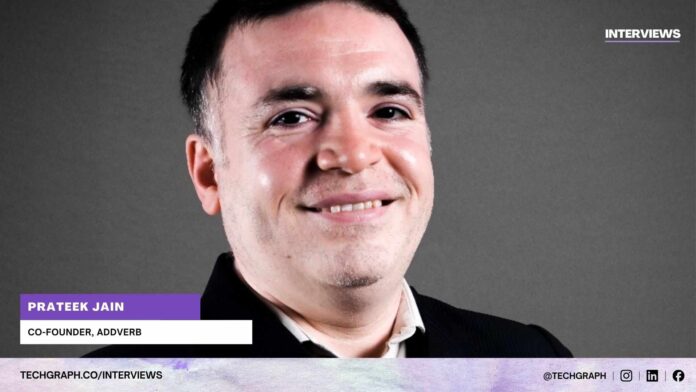

In an interaction with TechGraph, Prateek Jain, Co-Founder of Addverb, outlined how India’s rapid progress in manufacturing and technology is laying the foundation for global leadership in automation, and how the company is contributing to this shift by developing advanced robotics solutions that address the evolving needs of modern industrial operations.
Jain further explained how Addverb’s next-generation humanoid systems and its specialized solutions for semiconductor and electronics logistics like Vertix, are helping position India as a technology exporter and strengthen the country’s role in the global automation landscape.
Read the interview in detail:
TechGraph: Robotics in supply chains is shifting from being a tool for cost efficiency to becoming central to resilience and agility. How is Addverb driving that shift, and what signals from global clients point to this change?
Prateek Jain: At Addverb, we have seen robotics evolve from being viewed primarily as an efficiency driver to becoming central to resilience and agility. While we customize solutions to meet immediate client requirements, we also invest in long-term readiness to prepare them for the future. In the industry, this shift is visible in the rising demand for scalable systems like ASRS and mobile robots.
Our global clients have benefited from these deployments through improved uptime, faster recovery from demand peaks, and continuity in unpredictable conditions. At the same time, our work in cobots and quadrupeds reflects how human–robot collaboration is shaping the next phase.
The growing emphasis on predictive maintenance, digital twins, and modular software across markets is a clear signal: agility now stands shoulder to shoulder with efficiency as a business priority.
TechGraph: Many warehouse automation players emphasize hardware, while Addverb highlights modular software alongside it. How critical is that integration to staying ahead in such a competitive market, and how do you see it redefining global benchmarks for automation?
Prateek Jain: In warehouse automation, hardware alone cannot provide a sustainable advantage. Intelligent software is critical, but without precision components and advanced chips, its potential remains constrained. India’s strength in software provides a natural edge; however, achieving true global scalability requires a robust domestic hardware ecosystem.
At Addverb, currently, approximately 30-40 percent of the hardware and controls in our products are localized. We hope to reach 80 to 90% by the end of this year. Our software is entirely developed in-house, and mechanical components are already fully localized. This is why we pursue vertical integration, producing steel, electronics, and controls within our own facilities.
Such integration ensures quality, accelerates innovation, and reduces dependency, while enabling hardware and software to evolve in tandem. In the future, the true benchmark for automation will be how swiftly solutions adapt to changing workflows and scale with business needs. That is the standard we are building toward.
TechGraph: With AI rapidly embedding itself into logistics, how do you balance the promise of intelligent robots with the practical challenges of large-scale adoption in industries that are often slow to change?
Prateek Jain: AI is reshaping logistics by adding precision, speed, and flexibility to every link in the chain. Intelligent robots can make supply chains safer and more reliable, but industries built on legacy systems don’t change overnight. The path forward is deliberate, begin with pilots, prove the value, and then scale with confidence. People remain central to this journey.
At Addverb, we ensure that safety-critical decisions remain with humans, while our systems handle repetitive and high-risk tasks. Alongside, we invest in training to upskill operators and build trust in technology. This balance of human judgment and intelligent automation makes adoption practical and helps even the most traditional industries move toward transformation.
TechGraph: As sustainability becomes non-negotiable for global businesses, what role can warehouse robotics play in reducing carbon footprint without undermining speed or cost efficiency?
Prateek Jain: Sustainability is a core business mandate. Integrating robots helps to reduce waste, lowers lifecycle costs, and extends product utility. For instance, ASRS systems enable vertical stacking, cutting down physical sprawl.
Further, intelligent orchestration ensures robots move with purpose, reducing wasted energy. Predictive maintenance keeps machines operating at peak efficiency, lowering unnecessary consumption. At Addverb, we also design modular robots that can be upgraded and retrofitted, extending their lifecycle and avoiding full replacements.
TechGraph: The debate around automation often swings between optimism about productivity and concern over workforce displacement. How should companies balance the push for robotics with the need to retain and reskill human talent?
Prateek Jain: The equilibrium is achieved through the centralization of people in innovation. At Addverb, we are applying robotics to replace repetitive or physically demanding tasks, but keep the areas that demand creativity, problem-solving, or situational awareness under human control. It is about empowering individuals to work on more valuable tasks.
In order to achieve that, we invest in training programs and academic partnerships that prepare workers for robotics, data, and digital operations. Once reskilling is made a fundamental element of adoption, automation becomes a catalyst, unlocking productivity while preserving and expanding human potential.
TechGraph: Robotics adoption in India, Europe, and North America is shaped by very different infrastructure realities. What contrasts stand out most to you, and how does Addverb adapt its approach across these regions?
Prateek Jain: The Indian robotics environment is unique. These warehouses are heterogeneous in their design; they may have uneven floors, and power outages are frequent. The only way to build systems that can survive in this environment is to have resilience at its core and have robots that are capable of adjusting to variability and still providing a consistent performance.
Addverb has developed a solid competitive advantage there. We have designed our solutions to manage the complexities of India and position it to grow scalably.
In Europe, compliance and sustainability are the focus, whereas scale and rapid deployment are the focus in North America. Every market is unique, yet the things we learn in India, engineering towards resilience and adaptability, are our greatest assets when we provide globally.
TechGraph: With warehouse robotics attracting intense competition from global giants and startups alike, what does true differentiation look like for Addverb in this crowded field?
Prateek Jain: For Addverb, true differentiation comes in providing quick, adaptable solutions that consistently produce results in a range of settings. We achieve this through vertical integration, controlling quality from steel to electronics, and modular software that makes fleets adaptive and future-ready.
Our digital twin ecosystems accelerate design and testing, while training and adoption support ensure real-world success. It’s this end-to-end integration of innovation, execution, and human readiness that sets us apart in a crowded market.
TechGraph: India is positioning itself as a hub for advanced manufacturing and technology exports. What does that mean for Addverb’s global ambitions, and how are you planning to leverage this momentum?
Prateek Jain: India can surpass global efficiency benchmarks in the next five years with greenfield warehouses, rising 5G adoption, and a tech-savvy workforce. We at Addverb are working towards a future of autonomous, self-learning robotics capable of real-time adaptation with minimal human intervention.
Humanoid robots play a central role, bringing intelligence and dexterity into dynamic industrial settings. Sector-specific solutions like Vertix, an ASRS for semiconductor and electronics components, demonstrate precision, space optimization, and reliability.
Combining humanoids, hybrid autonomy stacks, and frictionless human-machine interfaces, Addverb is accelerating India’s rise in global automation and moving decisively toward a billion-dollar milestone, redefining the future of industrial operations.


