


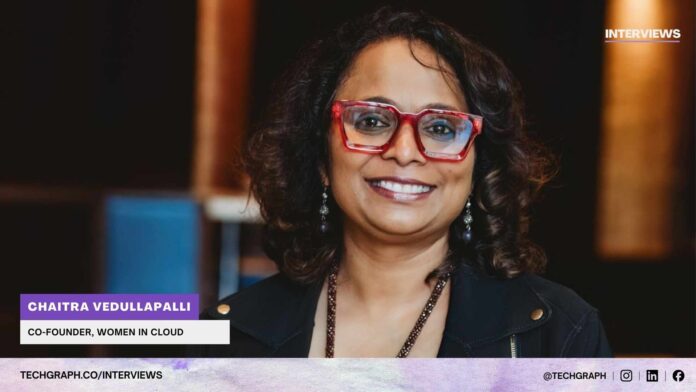

In an interview with TechGraph, Chaitra Vedullapalli, Co-Founder of Women In Cloud, discussed how women remain underrepresented as founders and decision makers in the global tech economy despite exponential growth in cloud and AI markets, and how Women In Cloud is addressing these gaps by positioning economic access as a measurable outcome rather than treating progress as mentorship or networking alone.
She further explained how Women in Cloud’s Colaunch GTM Accelerators enable women-led companies to secure hyperscaler partnerships and enterprise contracts that demonstrate product-market fit and commercial traction, creating conditions for capital to follow on stronger and more equitable terms while positioning access to markets as the primary driver of long-term economic power.
Read the interview in detail:
TechGraph: The global tech economy has expanded at a scale few could have imagined two decades ago, yet women remain underrepresented as founders and decision makers. What structural barriers still hold women back from entering on equal terms, and how does Women in Cloud approach these challenges differently from traditional industry groups?
Chaitra Vedullapalli: Even though the global tech economy has exploded, women remain underrepresented because of structural barriers from limited access to capital and markets, a lack of board-level sponsorship, and policies that were never designed with women founders in mind.
At Women in Cloud, we approach these challenges differently by focusing on economic access as a measurable outcome. Traditional industry groups often focus on mentorship or networking, which are important, but we take it further by creating AI-, Cloud-, and Cyber-powered pathways that unlock actual contracts, jobs, and investment opportunities.
Our mission is to democratize $1B in economic access by 2030, and every program is designed to convert community energy into tangible results.
TechGraph: Community energy often begins with events and campaigns, but sustaining that momentum once the spotlight fades can be difficult. What strategies have proven most effective in turning initial engagement into lasting opportunities such as contracts, jobs, and partnerships?
Chaitra Vedullapalli: Events create energy, but transformation happens when you create intellectual property and digital assets that keep delivering for years. For example, our Certification Programs prepare women for $70K+ jobs in AI and cybersecurity. Our Colaunch GTM Accelerators help startups secure strategic partnerships with hyperscalers like Microsoft.
Our ICONS film and OPULIS book elevate women leaders while funding AI scholarships. We’ve even set Guinness World Records to galvanise entire movements. These assets live far beyond a single event, embedding impact into the ecosystem so contracts, jobs, and partnerships keep flowing.
TechGraph: Even after years of effort, women-led startups continue to receive only a small fraction of venture capital. How does your model of ecosystem building address this funding gap, and do you see access to markets as ultimately a more powerful lever than access to capital?
Chaitra Vedullapalli: Women founders receive less than 3% of global venture funding. That number hasn’t moved much in decades. Our model addresses this by flipping the equation: capital follows customers. Through our Colaunch GTM Accelerators, we focus on market access as the primary lever helping women-led companies land hyperscaler partnerships and enterprise customers. When revenue and demand are in place, capital becomes easier to unlock and on better terms.
TechGraph: Partnerships with large enterprises and governments are critical to scaling impact, but they also risk becoming symbolic. What safeguards or frameworks help ensure these alliances create measurable access for women leaders rather than token inclusion?
Chaitra Vedullapalli: I’ve seen too many partnerships become token gestures. The safeguard is simple but powerful: focus on products and offers that solve real customer problems. When women-led companies bring solutions that customers truly want—whether powered by AI, Cloud, or Cyber tech—the partnership becomes commercially relevant, not symbolic. At Women in Cloud, we build frameworks that ensure every alliance is tied to measurable outcomes like contracts signed, certifications earned, or jobs created.
TechGraph: Technology is advancing faster than policy can adapt, and women are often absent from the rooms where regulation is shaped. Which policy interventions would most directly shift the trajectory for women entrepreneurs in the cloud and AI economy?
Chaitra Vedullapalli: This one worries me deeply: women are often missing from the policy rooms shaping AI and Cloud regulation. That absence means consumer protections, workforce readiness, and inclusion often get overlooked. We need corporations, communities, and policymakers working together.
Through networks like Voices for Innovation, I engage directly with legislators, and in my role as an AI Advisor to the Office of the Insurance Commissioner, I bring perspectives on consumer protections in AI. My message to women leaders is clear: find ways to serve on advisory boards and influence local representatives. Policy only shifts when we are in the room.
TechGraph: Operating across more than 12o countries means balancing a shared mission with very different local realities. How do you decide when to drive a single global agenda and when to adapt strategies to fit specific cultural, economic, or political contexts?
Chaitra Vedullapalli: Operating in 120+ countries, we’ve learned that economic access is both global and local. The UN Sustainable Development Goals give us a global north star: economic stability, inclusion, and sustainability, but execution requires local tailoring.
In India, we focus on Cyber and AI skilling at scale with WICxShaksham Initiative. In the U.S., we prioritise enterprise GTM acceleration with Microsoft. In Africa, it may be mobile-first entrepreneurship. The mission is constant, but the tactics flex to fit cultural, economic, and political realities.
TechGraph: Looking to the decade ahead, what would a mature and self-sustaining global ecosystem for women in technology look like, and what are the most critical steps needed to reach it?
Chaitra Vedullapalli: A mature global ecosystem for women in tech will be one where access is systemic, sustainable, and self-renewing. To get there, I see seven powerful solutions:
AI & Cloud Certification Pathways → ensuring millions of women are job-ready.
Global GTM Accelerators → democratizing access to markets and hyperscaler ecosystems.
Impact Capital Models → funding tied to revenue and ecosystem outcomes.
Policy & Advocacy Networks → women represented in regulatory and governance bodies.
IP & Media Assets → books, films, and digital platforms that normalise women’s leadership stories.
Corporate + Government Alliances → anchored in measurable contracts, not symbolic commitments.
Sustainable Funding Pools → scholarships, foundations, and recurring revenue tied to community growth.
When these seven come together, we will see an ecosystem where women no longer have to ask for access it will be baked into the system.