


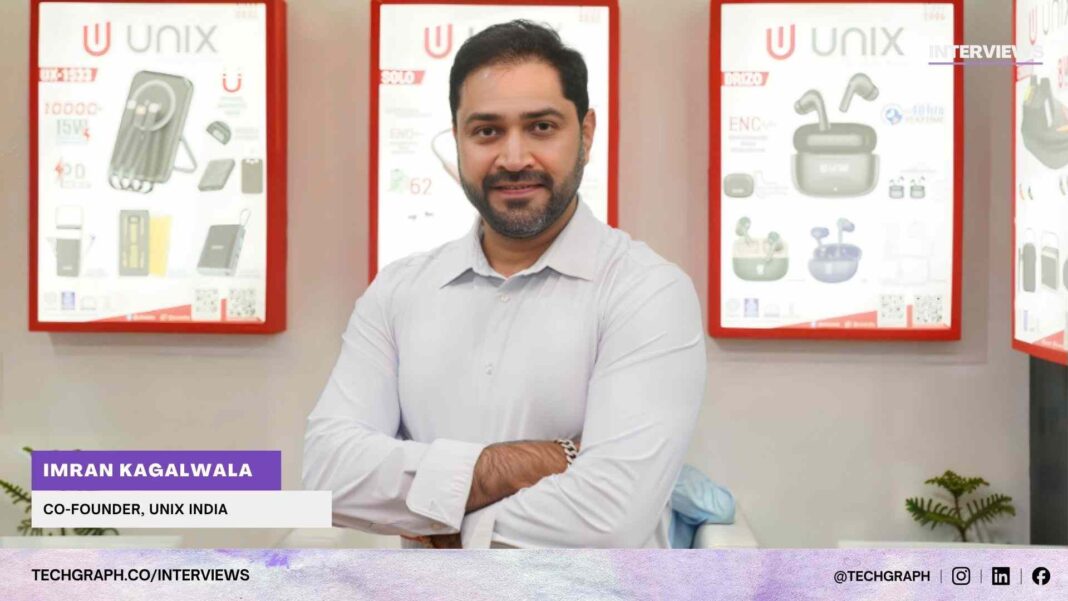
Speaking with TechGraph, Imran Kagalwala, Co-founder of Unix India, discussed how a crowded accessories market often leaves buyers comparing products without clarity on reliability, specifications, or long-term value, and how the company is responding by strengthening transparency in product details, communicating value more clearly, and reinforcing service commitments so that consumers feel informed and confident at the time of purchase.
He also spoke about how the expansion of manufacturing capacity, quality-focused production, and steady improvements in after-sales support form the core of Unix’s brand strategy, allowing the company to scale in a competitive market while maintaining reliability and a consistent ownership experience for consumers.

Read the full interview in detail:
TechGraph: The government’s decision to lower the Basic Customs Duty on mobile chargers has sparked discussions across the electronics sector. For Unix India, which has built a strong presence with a diverse range of mobile accessories and audio products, how do you see this move influencing your manufacturing strategy and overall growth roadmap?
Imran Kagalwala: On one hand, the government’s decision to lower the Basic Customs Duty makes charging solutions more affordable and accessible for consumers, which can boost overall demand in the accessories category.
On the other hand, it opens the door for an influx of low-cost imports, especially from countries with economies of scale. To truly strengthen the domestic manufacturing ecosystem, it is important for the government to implement strong anti-dumping duties, ensuring a level playing field where local players can compete fairly with overseas manufacturers.
TechGraph: Duty cuts can improve the economics of local production, yet they also make it easier for global competitors to enter with low-cost imports. How is Unix preparing to leverage this opportunity while safeguarding its position in a market that could become more aggressive?
Imran Kagalwala: Our strategy when it comes to competition is two-fold: strengthen our domestic ecosystem while building deeper consumer loyalty. At the manufacturing end, we are scaling up efficiencies in our Gujarat plant by investing in automation, increasing output, and securing more local suppliers.
On the brand side, we are doubling down on quality assurance, after-sales service, and trust-building, which are difficult for low-cost importers to replicate. The idea is to ensure that even in a crowded market, Unix stands out as the reliable choice for Indian consumers.
TechGraph: With over 600 SKUs, spanning everyday essentials like charging cables and power banks to higher-value products like TWS and speakers, what factors guide Unix’s decisions on which categories to double down on when external policies shift?
Imran Kagalwala: Our portfolio strategy is guided by a mix of consumer demand trends, long-term growth potential, and external policy dynamics. We approach our product mix strategically, balancing mass-volume essentials like charging cables and power banks with high-value, innovation-driven categories such as TWS and speakers, allowing us to stay agile and make informed investments even as policies evolve.
TechGraph: Even as India pushes for self-reliance, most accessory makers, including Unix, still rely on imported components. What steps are you taking to reduce this dependency, and what gaps in the ecosystem need to be addressed to make end-to-end manufacturing in India truly viable?
Imran Kagalwala: This is one of the most pressing challenges. We’ve started localising as much as possible, with plastics, moulding, packaging, and certain mechanical parts already being sourced domestically. We have also built our own PCB insertion plant for PCB assembly, thus significantly reducing our dependency on imports in this area. But for high-tech components like chips, batteries, and certain ICs, dependency on imports still remains.
For end-to-end self-reliance, India needs stronger component ecosystems like semiconductors, battery cell manufacturing, and other specialised materials. If the government can accelerate investment in these areas, companies like ours will be able to close the gap and truly make “Designed and Made in India” products.
TechGraph: Consumers often expect prices to fall the moment duties are reduced, though actual market dynamics are far more complex. How will Unix approach pricing and value communication to ensure consumers see both affordability and quality in your products?
Imran Kagalwala: Price is only part of the story. Consumers today look for trust, durability, and service in addition to affordability. While duty cuts may not always translate into dramatic price drops, we ensure that every Unix product communicates value clearly. We do this by offering reliable warranties, quality certifications, transparent packaging, and robust after-sales support.
TechGraph: Policy changes can disrupt supply chains and operational planning. What internal changes has Unix made to stay agile, control costs, and maintain efficiency while keeping product innovation at the forefront?
Imran Kagalwala: Over the last few years, we’ve invested in automation at our plant, streamlined supplier contracts to reduce volatility, and set up cross-functional teams to respond quickly to policy or market shifts. On the innovation front, our R&D cycle is tightly linked to consumer feedback loops wherein we test, adapt, and launch faster than many larger players. This combination of operational discipline and innovation agility helps us navigate uncertainty without losing momentum.
TechGraph: Looking ahead, what role do you see Unix playing in helping position India as a global hub for mobile accessories manufacturing, and what kind of industry or government support would help accelerate this vision?
Imran Kagalwala: We want to play a pioneering role in advancing India’s electronics manufacturing ecosystem by proving that Indian brands can deliver world-class products at scale. We’re doing that by strengthening domestic capacity and innovating across categories from chargers to wearables.
To accelerate this vision, we need government support in both component manufacturing (especially semiconductors and batteries) and MSME-focused incentives that don’t just favour large enterprises. With the right policy environment, India can evolve into a true design-and-manufacturing powerhouse.