

spot_img

Beyond Price Points: Unix India’s Imran Kagalwala on Redefining Consumer Expectations in the Mobile Accessories Market

Date:

Trending

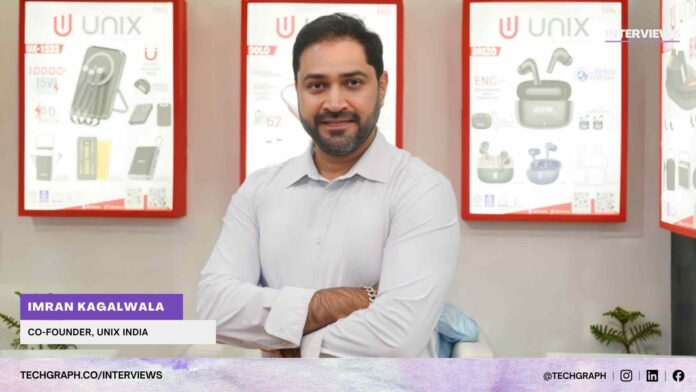
Speaking with TechGraph, Imran Kagalwala, Co-founder of Unix India, discussed how a crowded accessories market often leaves buyers comparing products without clarity on reliability, specifications, or long-term value, and how the company is responding by strengthening transparency in product details, communicating value more clearly, and reinforcing service commitments so that consumers feel informed and confident at the time of purchase.

- Advertisement -

He also spoke about how the expansion of manufacturing capacity, quality-focused production, and steady improvements in after-sales support form the core of Unix’s brand strategy, allowing the company to scale in a competitive market while maintaining reliability and a consistent ownership experience for consumers.

Read the full interview in detail:

- Advertisement -

TechGraph: The government’s decision to lower the Basic Customs Duty on mobile chargers has sparked discussions across the electronics sector. For Unix India, which has built a strong presence with a diverse range of mobile accessories and audio products, how do you see this move influencing your manufacturing strategy and overall growth roadmap?

Imran Kagalwala: On one hand, the government’s decision to lower the Basic Customs Duty makes charging solutions more affordable and accessible for consumers, which can boost overall demand in the accessories category.

On the other hand, it opens the door for an influx of low-cost imports, especially from countries with economies of scale. To truly strengthen the domestic manufacturing ecosystem, it is important for the government to implement strong anti-dumping duties, ensuring a level playing field where local players can compete fairly with overseas manufacturers.

- Advertisement -

TechGraph: Duty cuts can improve the economics of local production, yet they also make it easier for global competitors to enter with low-cost imports. How is Unix preparing to leverage this opportunity while safeguarding its position in a market that could become more aggressive?

Imran Kagalwala: Our strategy when it comes to competition is two-fold: strengthen our domestic ecosystem while building deeper consumer loyalty. At the manufacturing end, we are scaling up efficiencies in our Gujarat plant by investing in automation, increasing output, and securing more local suppliers.

On the brand side, we are doubling down on quality assurance, after-sales service, and trust-building, which are difficult for low-cost importers to replicate. The idea is to ensure that even in a crowded market, Unix stands out as the reliable choice for Indian consumers.

TechGraph: With over 600 SKUs, spanning everyday essentials like charging cables and power banks to higher-value products like TWS and speakers, what factors guide Unix’s decisions on which categories to double down on when external policies shift?

Imran Kagalwala: Our portfolio strategy is guided by a mix of consumer demand trends, long-term growth potential, and external policy dynamics. We approach our product mix strategically, balancing mass-volume essentials like charging cables and power banks with high-value, innovation-driven categories such as TWS and speakers, allowing us to stay agile and make informed investments even as policies evolve.

TechGraph: Even as India pushes for self-reliance, most accessory makers, including Unix, still rely on imported components. What steps are you taking to reduce this dependency, and what gaps in the ecosystem need to be addressed to make end-to-end manufacturing in India truly viable?

Imran Kagalwala: This is one of the most pressing challenges. We’ve started localising as much as possible, with plastics, moulding, packaging, and certain mechanical parts already being sourced domestically. We have also built our own PCB insertion plant for PCB assembly, thus significantly reducing our dependency on imports in this area. But for high-tech components like chips, batteries, and certain ICs, dependency on imports still remains.

For end-to-end self-reliance, India needs stronger component ecosystems like semiconductors, battery cell manufacturing, and other specialised materials. If the government can accelerate investment in these areas, companies like ours will be able to close the gap and truly make “Designed and Made in India” products.

TechGraph: Consumers often expect prices to fall the moment duties are reduced, though actual market dynamics are far more complex. How will Unix approach pricing and value communication to ensure consumers see both affordability and quality in your products?

Imran Kagalwala: Price is only part of the story. Consumers today look for trust, durability, and service in addition to affordability. While duty cuts may not always translate into dramatic price drops, we ensure that every Unix product communicates value clearly. We do this by offering reliable warranties, quality certifications, transparent packaging, and robust after-sales support.

TechGraph: Policy changes can disrupt supply chains and operational planning. What internal changes has Unix made to stay agile, control costs, and maintain efficiency while keeping product innovation at the forefront?

Imran Kagalwala: Over the last few years, we’ve invested in automation at our plant, streamlined supplier contracts to reduce volatility, and set up cross-functional teams to respond quickly to policy or market shifts. On the innovation front, our R&D cycle is tightly linked to consumer feedback loops wherein we test, adapt, and launch faster than many larger players. This combination of operational discipline and innovation agility helps us navigate uncertainty without losing momentum.

TechGraph: Looking ahead, what role do you see Unix playing in helping position India as a global hub for mobile accessories manufacturing, and what kind of industry or government support would help accelerate this vision?

Imran Kagalwala: We want to play a pioneering role in advancing India’s electronics manufacturing ecosystem by proving that Indian brands can deliver world-class products at scale. We’re doing that by strengthening domestic capacity and innovating across categories from chargers to wearables.

To accelerate this vision, we need government support in both component manufacturing (especially semiconductors and batteries) and MSME-focused incentives that don’t just favour large enterprises. With the right policy environment, India can evolve into a true design-and-manufacturing powerhouse.

THE SNAPSHOTS

Sign up to get quick snaps of everyday happening, directly in your inbox.

We don’t spam! Read our privacy policy for more info.

- Advertisement -
Krishna Mali
Krishna Mali
Founder & Group Editor of TechGraph.
Advertisement

More Latest Stories

More Articles

India’s AIF Shift: Steptrade Capital’s Kresha Gupta on the Evolution of Alternative Investments in India

Speaking with TechGraph, Kresha Gupta, Director and Fund Manager at Steptrade Capital, discussed how the Indian and global investment landscape is increasingly favouring alternative...

Vimal Singh on ReadyAssist’s Role in Modernising Roadside Assistance in India

Speaking with TechGraph, Vimal Singh, Founder of ReadyAssist, discussed how traditional roadside assistance models built around call centres and manual coordination have struggled to keep pace with modern mobility needs, and how the company is helping accelerate this transition by building a technology-led operating...

The Shift to Intelligent Hiring: HunarAI’s Krishna Khandelwal on How AI Is Reshaping Recruitment in India

In an interaction with TechGraph, Krishna Khandelwal, Founder and CEO of Hunar.AI, outlined how...

The Cost of Blind Trust: How Inadequate Verification Is Fueling India’s Data Scam Epidemic

India’s digital economy is expanding faster than ever. From gig platforms and financial services...

How Autonomous Infrastructure Will Shape the Future of Enterprise Technology in 2026

Autonomous infrastructure is moving from imagination to inevitability. With its strengths in anticipation, analysis,...

NVIDIA EVP Debora Shoquist Offloads 80,000 Shares for About $14.77 Mn

NVIDIA Corp. (NASDAQ: NVDA) Executive Vice President of Operations, Debora Shoquist has sold 80,000...

AI Infrastructure Wars: Do Nvidia, Amazon, and Microsoft Still Have Room to Run?

Indian investors are at a pivotal moment. While our domestic markets have seen meteoric...

Inside Channel Economy: Almonds AI CEO Abhinav Jain on Fixing the Blind Spot in India’s Distribution Ecosystem

Speaking with TechGraph, Abhinav Jain, Co-Founder and CEO of Almonds AI, outlined how India’s...

The Rise of Emotionally Intelligent AI: What It Means for Customer Experience

A shift is transpiring across customer touchpoints as digital systems start to understand the emotional cues that determine decisions. The change becomes evident the...

Kuwait Raises Income Tax Penalty Against IndiGo Operator, Company Plans Legal Action

IndiGo Airline's parent company, InterGlobe Aviation Limited disclosed it received an income tax demand...

Reimagining Live Sports Coverage: wTVision’s Divyajot Ahluwalia on How Robot Dog Champak Transformed IPL Broadcasting

Speaking with TechGraph, Divyajot Ahluwalia, Founder & Director of wTVision Solutions Pvt. Ltd., discussed...

Trump Says He Will Sue BBC Over Edited Broadcast of Jan 6 Speech

US President Donald Trump has said he plans to take legal action against the...

Beyond Instant Approvals: PayMe CEO Mahesh Shukla on Building Compliant Lending for India’s New Credit Economy

Speaking with TechGraph, Mahesh Shukla, Founder and CEO of PayMe, discussed how India’s digital...

Meta Declares Quarterly Cash Dividend Of $0.525 Per Share

Facebook parent company, Meta Platforms Inc. (NASDAQ:META) said its board of directors has declared a quarterly cash dividend of $0.525 per share on its...

Lok Sabha: Government releases ₹68K crore under MGNREGS; wage payments routed via DBT

New Delhi, India: Union Agriculture Minister Shivraj Singh Chouhan said the government has released 68,393.67 crore rupees to states and Union Territories under the Mahatma Gandhi National Rural Employment Guarantee Scheme (MGNREGS) in the current financial year 2025-26. In a written reply in the Lok...

The Evolving Classroom: Venkateshwar International School’s Pooja Sharma on Changing Role of Schools in Delhi’s CBSE Ecosystem

Speaking with TechGraph, Pooja Sharma, Vice Principal of Venkateshwar International School (VIS), discussed how...

Digital Generics: How AI is Redefining the Future of Affordable Medicine

It was with pride that global headlines described India as the world's pharmacy, supplying...

The Road to Equality in Tech: Women In Cloud’s Chaitra Vedullapalli on Reshaping Opportunity for Women Entrepreneurs Globally

In an interview with TechGraph, Chaitra Vedullapalli, Co-Founder of Women In Cloud, discussed how...

How AI is Improving Risk Management Among Crypto Traders

Over the past few years, the role of Artificial Intelligence in almost every sector...

The AI Advantage: How Intelligent Learning Solutions Are Rewriting Workforce Productivity in 2025 and Beyond

In 2025, artificial intelligence is no longer a futuristic concept — it’s the invisible...

Reimagining Creative Operations: ButtonShift’s Deepankar Das on Bringing Telemetry & Visual Intelligence to Modern Workflows

Speaking with TechGraph, Deepankar Das, Co-Founder and CEO of ButtonShift, discussed how traditional task...

Digit Life Insurance posts 31% rise in H1 FY26 revenue to ₹858 crore

India-based, Go Digit Life Insurance said its revenue for the first half of FY...

Debt Recovery Reinvented: Collectedge’s Ranjan Agarwal on Reshaping India’s Collections Ecosystem for Lenders

Speaking with TechGraph, Ranjan Agarwal, CEO and Co-Founder of Collectedge, discussed how India’s debt...

AI as a Growth Multiplier: How Smart Companies Accelerate Without Breaking

In today’s business environment, smart growth is just as important as any other form...

Trump Says He Will Sue BBC Over Edited Broadcast of Jan 6 Speech

US President Donald Trump has said he plans to take legal action against the...

Understanding What Makes Sunscreen Truly Effective

Many people pick a sunscreen merely based on its SPF, thus they think that...

Why NoSQL Databases Are the Future for Tech Startups

In today’s digital-first economy, tech startups continue to dominate the startup landscape. A startup...

The Future of Health Philanthropy: IGF India CEO Sundeep Talwar on Making Preventive Care Accessible for Underserved Communities

Speaking with TechGraph, Sundeep Talwar, CEO of IGF India, discussed the foundation’s decade-long journey...

The Rise of the AI Agent Economy: How Voice AI Agents Are Becoming the New Frontline Workforce For Call Centers

The work inside a call center has always depended on two things: speed and...

Beyond Instant Approvals: PayMe CEO Mahesh Shukla on Building Compliant Lending for India’s New Credit Economy

Speaking with TechGraph, Mahesh Shukla, Founder and CEO of PayMe, discussed how India’s digital...

Debt Recovery Reinvented: Collectedge’s Ranjan Agarwal on Reshaping India’s Collections Ecosystem for Lenders

Speaking with TechGraph, Ranjan Agarwal, CEO and Co-Founder of Collectedge, discussed how India’s debt...

Tech Skilling for All: How AI Will Reshape Campus Recruitment in India

Skilling either tech or non-tech skills is no longer a competitive advantage for any...

AI as a Growth Multiplier: How Smart Companies Accelerate Without Breaking

In today’s business environment, smart growth is just as important as any other form...