


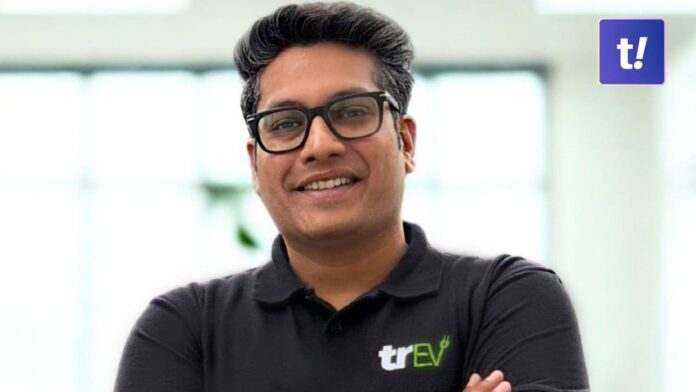

During an interview with TechGraph, Naveen Gupta, Founder & CEO of Trev Mobility, highlighted why customer expectations in premium mobility are increasingly shifting beyond vehicle availability and pricing toward service consistency and travel experience, and how this shift is creating opportunities for operators that can consistently deliver predictable service across longer-distance use cases in markets like Delhi-NCR.
Gupta also discussed how Trev Mobility has developed its operations around route predictability and vehicle performance visibility, allowing the company to strengthen customer confidence and maintain reliable service standards across recurring travel use cases where consistency plays a critical role in customer choice.
Read the interview in detail:
TechGraph: You are focusing on the SUV segment and mid to long-distance journeys, where reliability and range are often questioned in electric mobility. How has Trev Mobility built operational confidence around this model in a market like Delhi-NCR?
Naveen Gupta: We’ve been very clear from the beginning that EVs don’t need to do everything on day one; they just need to do certain use cases really well. For us, that meant focusing on pre-planned, mid- to long-to-long distance journeys where predictability is higher.
Operational confidence comes from controlling variables. We work with vehicles that offer higher real-world range, and we design routes and usage patterns to avoid uncertainty. Over time, we’ve also built internal data on range behaviour, charging cycles, and trip patterns, which helps us plan better.
In a market like Delhi NCR, once you start delivering consistently on these routes, user trust builds quickly. That’s been the biggest unlock for us.
TechGraph: Gurgaon and the wider NCR region bring a mix of dense urban traffic and long highway stretches. How has this geography shaped Trev Mobility’s fleet decisions, charging strategy, and overall service design?
Naveen Gupta: NCR is actually a very interesting market because it combines dense city movement with frequent intercity travel. A large part of our demand comes from airport transfers, business travel, and routes like Delhi to Gurgaon or Noida, and even outstation trips.
This has influenced three things for us. One, vehicle selection. We’ve leaned towards SUVs because they offer better range and comfort for these use cases.
Second, the charging strategy. Instead of relying on a single model, we use a mix of public infrastructure and planned charging cycles to ensure vehicles are always ready for the next trip.
And third, service design. A lot of our rides are pre-scheduled, which allows us to plan vehicle allocation and charging in advance rather than reacting in real time.
TechGraph: The premium ride-hailing space is becoming more competitive, with both established aggregators and EV-first players entering the segment. What differentiates Trev when it comes to the actual ride experience beyond being electric?
Naveen Gupta: Being electric gets you the first conversation, but it doesn’t win you the customer. What really matters is consistency. Users are choosing us because they know what to expect every time. That includes vehicle quality, driver behaviour, on-time arrivals, and a smoother ride experience.
We’re also seeing that in premium mobility, reliability is actually more valuable than price. If someone is paying for a certain standard, they expect it to be delivered every single time. That’s where we’ve focused our effort.
TechGraph: In the premium segment, customer expectations go beyond just getting from one point to another. What have you learned about user behaviour in this category, and how is Trev shaping the in-ride experience around those expectations?
Naveen Gupta: One clear shift is that users are thinking in terms of experience, not just transport. A large part of our demand comes from airport runs, business travel, and planned usage. These are not price-sensitive, last-minute decisions. Users care more about punctuality, comfort, and peace of mind.
We’re also seeing repeat usage patterns. Once a user has a reliable experience, they tend to come back for similar use cases. That repeated behaviour is a strong indicator that the model is working. For Trev, 52% revenue comes from repeat users.
TechGraph: Service quality in ride-hailing often comes down to the driver. With a premium positioning and an EV-based fleet, how are you approaching driver onboarding, training, and retention?
Naveen Gupta: In this category, the driver is a big part of the product. We focus on structured onboarding and training, especially around customer interaction, driving behaviour, and understanding EVs as a product. Since EVs are different from ICE vehicles, drivers also need to be comfortable with aspects like range awareness and charging.
On retention, the predictability of income matters a lot. When drivers see steady demand and structured operations, it improves both performance and retention. We have introduced some industry-first parameters to improve retention, such as loyalty hikes and insurance policies.
TechGraph: As electric mobility scales, questions around charging access, downtime, and cost economics become harder to ignore. How are you balancing sustainability with a business model that needs to work at scale?
Naveen Gupta: For EVs to scale, the model has to work economically, not just environmentally. The advantage of EVs is that, over time, operating costs become more predictable compared to fuel-based vehicles. That helps in building a more stable pricing structure.
At the same time, we are careful about utilisation. Higher utilisation is what makes the economics work. So the focus is not just on adding vehicles, but on ensuring each vehicle is used efficiently.
It’s a balance between cost discipline and service reliability. You can’t compromise on either.
TechGraph: Electric mobility in India is still heavily dependent on policy support, infrastructure buildout, and evolving consumer trust. What are the key risks or bottlenecks you believe could slow down adoption in the premium segment, and how is Trev preparing for them?
Naveen Gupta: The biggest challenge right now is not demand, it’s ecosystem readiness. Charging infrastructure is improving, but consistency across locations is still evolving. There are also gaps in service networks and standardisation, which matter more in a commercial setup than for personal use.
The second piece is consumer trust. While EVs are now accepted in cities, there is still hesitation for longer routes or higher-value use cases.
From our side, the approach has been to focus on use cases where EVs are already working well today, and expand gradually from there. That’s how the transition will realistically happen.


