


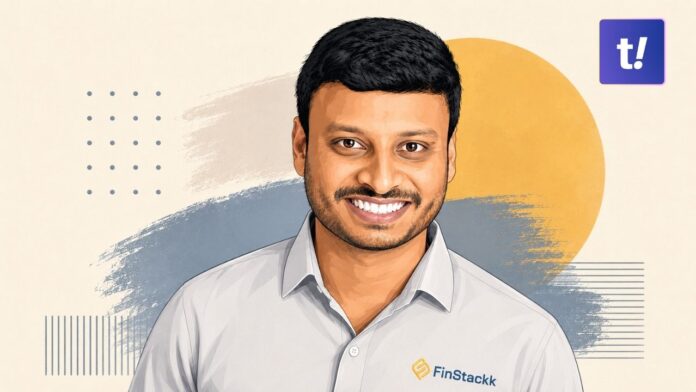

Speaking with TechGraph, Nithin Reddy, Co-founder & Chief Growth Officer at FinStackk, discussed how incorporating a business in the US has become increasingly accessible for global startups, while managing financial operations and regulatory compliance across fragmented systems continues to create operational complexity, and how the company is addressing this operational complexity through an integrated platform that unifies financial operations and regulatory management into a single system.
Reddy also spoke about how FinStackk is combining intelligent automation with CPA and compliance expertise to streamline financial operations, enabling founders to reduce operational complexity, maintain regulatory readiness, and build stronger foundations for sustainable global growth.
Read the interview in detail:
TechGraph: A growing number of Indian startups are looking to the US not just for fundraising but also to build a long-term operating presence. What structural friction in cross-border finance and compliance did you see that led to the creation of FinStackk?
Nithin Reddy: What we consistently saw was that incorporation was only the entry point, while the real challenge began in day-to-day operations where accounting, payroll, tax, legal, and compliance were being managed in silos through multiple vendors with no single source of truth. Founders were often running their US entities without real-time visibility into obligations across more than 50,000 federal, state, and local requirements, which naturally led to missed filings, inefficiencies, and hidden exposure that only became apparent during fundraising or due diligence.
That is exactly why FinStackk was created: to replace this fragmented setup with one integrated system that combines automation with expert oversight. It brings everything into a unified flow so founders can see their financial and compliance position in real time, reduce dependency on multiple providers, and operate in the US with clarity, predictability, and stronger investor confidence as they scale globally.
TechGraph: Founders often piece together separate vendors for accounting, payroll, tax, and compliance when expanding overseas. That approach tends to create inefficiencies and blind spots. How does an integrated platform change the way founders manage financial operations across jurisdictions?
Nithin Reddy: When financial operations are handled through separate vendors, founders end up managing coordination instead of control, which creates delays, inconsistent data, and limited visibility across jurisdictions. An integrated platform changes this by consolidating incorporation, accounting, payroll, tax, and compliance into a single operating layer where every transaction, obligation, and filing flows through one system.
This gives founders real-time clarity on financial health and regulatory standing instead of fragmented reports that do not align with each other. It also reduces dependency on multiple service providers, which typically leads to communication gaps and duplicated effort.
More importantly, it creates standardisation across geographies, so reporting, governance, and compliance follow a consistent structure even when rules differ locally. At FinStackk, this unified approach allows founders to operate with predictability, respond faster to regulatory changes, and focus more on scaling the business rather than managing operational complexity across markets.
TechGraph: Setting up in the US comes with regulatory complexity that many early-stage founders underestimate. Where do you see most startups getting it wrong in their first year, and how is FinStackk trying to correct that learning curve early on?
Nithin Reddy: Most early-stage startups struggle not because of intent but because they treat the first year in the US as a setup phase rather than an ongoing operating system. The common mistakes include weak bookkeeping discipline, delayed payroll compliance, inconsistent tax filings, and reliance on disconnected service providers who do not share a unified view of the business.
These gaps are not immediately visible, but they accumulate quietly and later surface during funding discussions or regulatory checks, where consistency matters as much as growth. At FinStackk, the focus is on correcting this from day one by building structured workflows for accounting, payroll, and compliance right at the point of incorporation itself.
With real-time dashboards and expert oversight built into the system, founders are guided to maintain clean financial records and predictable compliance behavior early, which significantly reduces downstream risk and helps them build investor-ready operations from the beginning.
TechGraph: There is a visible shift in Indian startups setting up or flipping to US entities at a much earlier stage. Given the regulatory scrutiny in both markets, how are you helping founders balance compliance requirements without slowing down business momentum?
Nithin Reddy: The shift toward earlier US presence is real, but it also raises the risk of founders getting pulled into operational complexity before they have the systems to handle it. The way we address this is by removing the need for founders to choose between speed and compliance. Instead of treating compliance as a parallel track, we embed it directly into the operating flow through automation supported by expert review.
This means incorporation, bookkeeping, payroll, tax, and ongoing filings move in sync with business activity rather than lagging behind it. Founders get real-time visibility into obligations and financial position, which allows them to make decisions quickly without waiting for manual reconciliation across vendors.
The objective is not to slow growth but to ensure growth is structurally clean, so companies can scale in the US with confidence, avoid regulatory surprises, and maintain readiness for fundraising or expansion at any stage.
TechGraph: Cross-border payroll and taxation bring not just technical challenges but also cultural and legal nuances. How has FinStackk built systems that can handle these variations while still keeping the experience simple for founders and finance teams?
Nithin Reddy: The complexity in cross-border payroll and taxation does not come only from rules, but from how differently they apply across jurisdictions and how quickly they keep evolving. What we have focused on at FinStackk is building a system that standardises the experience for founders while handling that variation in the background. Payroll, tax logic, and compliance workflows are configured to adapt to local regulations across US federal, state, and local layers, while the interface for founders remains simple and unified.
Instead of forcing teams to navigate multiple tools or interpret changing rules themselves, the platform translates these variations into structured workflows supported by automation and expert validation.
CPAs and compliance professionals ensure that edge cases and legal nuances are correctly interpreted, while the system maintains consistency in reporting and execution. This combination allows founders to operate across borders with a single, clean operational view without getting slowed down by underlying regulatory complexity.
TechGraph: As financial operations become more data-driven, what role do automation and AI play in managing cross-border accounting, payroll and compliance, and where do you still see the need for human oversight?
Nithin Reddy: Automation and AI are now central to how cross-border accounting, payroll, and compliance are managed because they bring speed, structure, and real-time visibility to processes that were earlier fragmented and manual. They help standardise data, track obligations as they arise, flag issues early, and give founders a continuous view of their financial and regulatory position across jurisdictions instead of delayed reports.
But the reality is that not everything can be solved by automation alone because financial and compliance decisions often depend on context, interpretation, and regulatory nuance that varies across federal, state, and local levels in the US.
That is where human oversight becomes essential. At FinStackk, we use automation to handle scale and accuracy while CPAs, attorneys, and compliance experts step in to interpret complex situations, validate decisions, and ensure nothing is misread. This balance is what makes the system both efficient and dependable for founders operating globally.
TechGraph: Trust becomes critical when startups outsource core financial operations to a platform. What measures have you put in place to ensure transparency, accuracy, and accountability, especially when dealing with multiple regulatory environments?
Nithin Reddy: Trust in financial operations comes from consistency, visibility, and clear ownership of outcomes, especially when startups are operating across multiple regulatory environments like the US. We address this by building transparency directly into the platform through real-time dashboards that show founders exactly where they stand on accounting, payroll, tax, and compliance at any point in time.
Every workflow is traceable, which means nothing happens in isolation or without a clear audit trail. Accuracy is reinforced through a combination of automation for standard processes and expert review by CPAs, attorneys, and compliance professionals who validate filings and decisions before they go live.
Accountability comes from having a single integrated system instead of multiple vendors, so there is always one clear point of responsibility for outcomes across jurisdictions. This structure ensures founders are not just outsourcing work, but actually gaining a controlled and verifiable financial operating system.
TechGraph: As more global founders look to operate across markets from day one, the expectation from financial infrastructure is evolving rapidly. Where do you see FinStackk positioning itself over the next few years in shaping how startups build and scale internationally?
Nithin Reddy: What we are really working towards is becoming the foundational financial layer that global startups can rely on right from incorporation all the way to scale, instead of them having to stitch together fragmented systems as they grow. The way companies are operating today is already shifting toward a global mindset from day one, so the expectation from financial infrastructure is no longer periodic support but a continuous, real-time system that works across accounting, payroll, tax, and compliance in every jurisdiction they operate in.
Our focus is to make that experience seamless by combining automation with expert oversight so that the complexity of different regulatory environments does not translate into operational stress for founders.
In the long run, the idea is that financial operations, compliance, and governance become embedded into how a company runs, so founders can expand into markets like the US without constantly rebuilding their back office and instead scale with clarity, control, and confidence.