


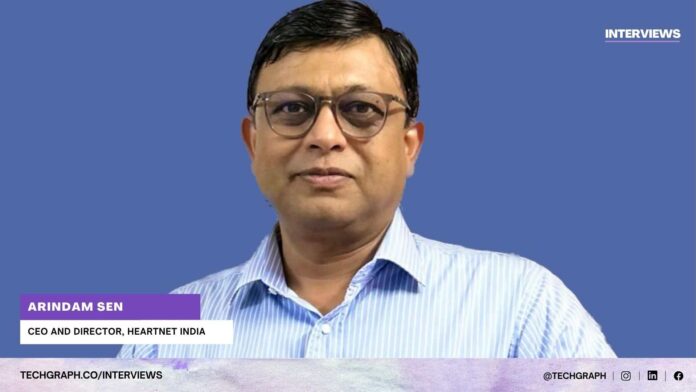

In conversation with TechGraph, Arindam Sen, CEO and Director of Heartnet India, spoke about how rise in sudden cardiac arrests among younger Indians is reshaping the country’s approach to heart health and how the company is deploying AI-driven, IoT-enabled ECG devices to enable early detection and connected diagnosis even when symptoms remain invisible.
He also discussed how the Heartbeat’s digital cardiac monitoring ecosystem supports doctors through real-time risk assessment, remote diagnostics, and teleconsultation, improving access to preventive care across semi-urban and rural regions while strengthening early intervention and post-treatment continuity.
Read the interview in detail:
TechGraph: India is witnessing a troubling rise in sudden heart attacks among younger people, often without any prior medical history. How is Heartnet India adapting its solutions to address this emerging demographic risk and enable early detection when symptoms remain invisible?
Arindam Sen: As recently as July 2025, 22 people under the age of 45 lost their lives in 40 days due to a sudden heart attack in Hassan district, Karnataka. And the main cause identified by the Union Ministry of Health and Family Welfare was the Lifestyle and pre-existing conditions. It highlighted the increasing number of heart attacks in young people.
At Heartnet India, the rise of cardiac diseases among younger people is often observed. To tackle this, Heartnet goes beyond the traditional methods to analyze and predict the risk of heart attacks. Preventive methods like ECG screening, Stress analysis, and lifestyle-based risk mapping are identified to detect the risk early. It helps doctors to address the symptoms and take action early.
The Heartnet platform is designed with a focus on demographic risk to bridge the gap in cardiac health screening in India, particularly in rural and remote areas. The Heartnet tools help cardiologists review the ECG scans and provide expert comments. With the focus of improving the cardiac health of women in rural areas, the Hridaya initiative was also created. We are making cardiac care smarter, earlier, and better because prevention is the best step to lower the risk.
TechGraph: One of the most pressing challenges in cardiac emergencies is the delay between the onset of symptoms and timely treatment. How then can real-time ECG monitoring and connected care platforms reduce this critical gap, particularly in semi-urban and rural India?
Arindam Sen: We constantly aim to bridge this gap between the onset of symptoms and treatment. Our portable IoT-enabled ECG devices allow local health to record a patient’s heart activity on the spot. The data is shared with cardiologists for review and analysis of the situation.
Instead of asking the patient to travel in that condition, our portable solution can help to share the data from villages to tier 1 city hospitals. If the local doctor is concerned, they can receive guidance through our Heartnet platform, enabling expert consultation via connected care easily. Through the usage of Heartnet’s innovative tools, doctors can leverage AI for instant risk assessments. It empowers real-time diagnostics at the point of care. These are the effective measures to tackle the issues in cardiac emergencies in semi-urban and rural India.
TechGraph: Cardiac rehabilitation and long-term follow-up are frequently overlooked after discharge, leading to repeat incidents. In what ways does Heartnet India extend its role beyond diagnosis to strengthen continuity of care and support lifestyle management for patients?
Arindam Sen: In the journey of a heart patient, the real challenge is when patients are discharged. Maintaining continuous observation, sticking to medications, and monitoring recovery becomes crucially important after discharge. At Heartnet India, we believe our responsibility goes beyond diagnosis. With ECG monitoring, regular digital check-ins, and teleconsultation, doctors can track the progress in health after discharging the patient.
The early detection of minor changes in heart rate and stress levels can reduce the risk of relapse. And keep patients connected with doctors after discharge. We also include the facility of mapping and counselling in our program. It is designed to help the families of patients understand diet, activities, and lifestyle changes after discharge.
TechGraph: Lifestyle and environmental factors such as air pollution, stress, and sedentary habits are increasingly linked to heart disease. Given that these risks extend far beyond hospital walls, how does Heartnet India plan to integrate such data into its predictive models to make monitoring more holistic?
Arindam Sen: Factors like pollution, stress, and sedentary habits silently worsen the condition of heart diseases. Ignoring these for a longer time could result in serious health effects. Heartnet India is working to make monitoring more predictive and holistic. Our connected platform gathers real-time physiological data through IoT-enabled ECG devices and remote diagnostics.
Heartnet India processes the patient’s data with advanced AI to assess risk and detect anomalies. We are working to add lifestyle and environmental inputs to this data. This will give doctors a wider and detailed view of the condition of the patient, including the details of the environment and habits affecting the heart health. It will help doctors to keep tracking the patient’s condition and make daily changes to the lifestyle of the patient.
TechGraph: With public hospitals facing a severe shortage of cardiologists and overburdened outpatient departments, how can digital monitoring solutions like Heartnet India meaningfully support doctors while maintaining accuracy and patient safety?
Arindam Sen: According to the Health Dynamics of India report (2022–2023), India has the largest number of villages, 664,235, but a critical shortage of 17,551 doctors is reported at Community Health Centres (CHCs) in rural areas. Hundreds of patients are seen by each cardiologist every day, making it difficult for individual attention to be given. Heartnet India’s digital monitoring solutions, like ECG monitors, let doctors gather reliable data without losing accuracy. That could filter the cases with urgent attention, becoming a solution for cardiologists and patients.
This helps treat the patient with a higher risk early and lowers any kind of serious risk. It connects patients with doctors, making cardiologists’ consultancy available digitally, and the Hridaya initiative focuses on women in rural and urban areas to detect cardiac diseases early.
TechGraph: While drug sales for cardiac care continue to surge, prevention still lags behind. How does Heartnet India envision its solutions shifting the focus from dependence on medication to proactive risk management supported by continuous insights?
Arindam Sen: The medication and prevention work together for recovery. We believe catching risks before they turn into diseases is important. Our IoT-enabled ECG and cardiac monitoring devices provide insights for doctors and patients to track their recovery. By tracking lifestyle factors, early warnings, and enabling regular check-ups, we make it possible to intervene with small changes in the activities and diet well before the medication becomes an option.
The Hridaya initiative enables teleconsultation to connect for prevention support and guidance. It also needs to be noticed that medication cannot be replaced by anything. Instead, over-reliance on medication is not effective. Medication with prevention provides better results.
TechGraph: Lastly, regulations for health tech are still evolving in India, particularly around patient data and medical device certification. What policy changes or regulatory clarity would most enable companies like Heartnet India to scale responsibly while ensuring safety and trust?
Arindam Sen: Ensuring regulation is a must for the safety and reliability of the patients. First, patient data should be stored safely to prevent access by anyone. People will only trust the digital health tools if they store their data privately and ensure safety. To allow safer and faster deployment of solutions like ECGs and telecardiology platforms, medical device certification and digital health approvals are important. Currently, the process is slow and fragmented. It will allow organisations like ours – Heartnet India to innovate while focusing on safety and accuracy.