


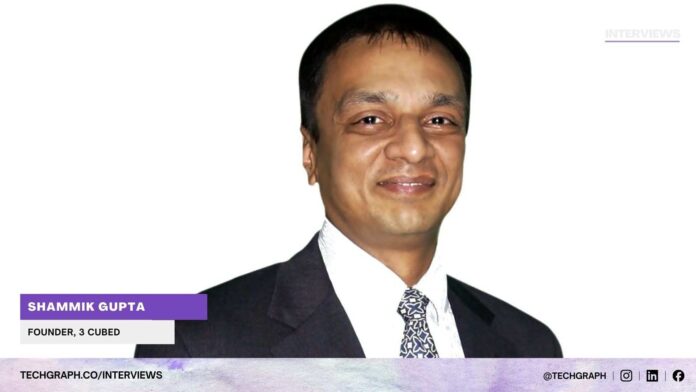

Speaking with TechGraph, Shammik Gupta, Founder of 3 Cubed, discussed how enterprises invested in ERP, BPM dashboards, and analytics to increase visibility, but still lack a unified explanation for why outcomes shift across functions, and how the company is addressing this gap through a digital twin model that maps these interactions in real time.
Gupta also spoke about how 3 Cubed’s first-principles approach helps organisations pinpoint where friction originates, understand how operational levers influence each other across cost, control, and experience, and evaluate the impact of improvements before implementation, making transformation decisions more confident and less dependent on fragmented assumptions.
Read the interview in detail:
TechGraph: Enterprises have chased process visibility for years through ERP, BPM, and countless dashboards, yet most leaders still complain of blind spots across functions. What gap did you see in the market that convinced you a digital twin of the enterprise was the missing link rather than just another analytics layer?
Shammik Gupta: Most leaders will know this story: years of adding visibility — ERP for transactions, BPM for flows, dashboards for metrics, mining for patterns, and now GenAI. Each layer helped, but leaders still struggled to explain why outcomes moved. Every system showed a slice of the operation. None showed how the slices fit together.
A large bank’s KYC process made this real. Visibility showed the work; only interactions explained the delays. Volumes looked stable, controls were documented, and staffing looked adequate — yet approvals slipped. The model showed the real sequence: work bounced between teams, QC sat too late, and arrival spikes didn’t match shift windows. Dashboards weren’t wrong; they were narrow.
Cost, Control, and Client Experience move together because they are trade-offs across the six PROFIT domains — Process, Risk, Operations, Finance, and IT Teams. When Operations accelerates, Risk tightens; when Finance reduces cost, IT adjusts workflows; when Teams change staffing, client experience shifts. A digital twin exposes these interactions so leaders see how one decision reshapes another. It’s when visibility turns into understanding.
TechGraph: Many vendors promise cost and control optimisation, yet CFOs and COOs still say that silos between processes, risk, finance, IT, and teams slow down transformation. How does 3 Cubed bring these domains into a single operational picture without asking enterprises to overhaul their tech stack or data foundations?
Shammik Gupta: Silos persist because enterprises are designed around them. Finance optimises cost. Operations push speed. Risk protects compliance. IT protects stability. Teams ensure staffing. Each function is right individually; together they create friction.
A consumer product company’s AP team ran into this firsthand. Leaders blamed volume and vendor mix. The model showed something else: duplicate checks, unnecessary exceptions, and high-skill staff doing low-risk work. Each tool showed activity. Only the interaction model revealed the cause. Silos don’t fail because they’re wrong — they fail because they can’t see each other.
The answer isn’t unified data; it’s unified logic. 3 Cubed works from metadata — process maps, key controls, demand patterns, and basic staffing data — rather than months of transactional data. Unlike data-hungry twins, our first-principles algorithms convert metadata into unified cost, experience, and control metrics. They don’t need accounting-level precision because the logic drives the outcome.
Leaders see how changes propagate without waiting for an IT or data integration program. For enterprises that already have aggregate data from process mining or workflow analytics, we offer APIs; for those that don’t, the algorithms work just as well with knowledgeable assumptions — demonstrating the power of logic over data volume.
Each function holds part of the truth. The algorithms pull these parts together into one coherent view.
TechGraph: Several transformation platforms succeed in pilot implementations but lose momentum once deployed across business units and geographies. What enables 3 Cubed to remain resilient at scale, and what have been the most striking learnings from enterprises that rolled it out across banking, telecom, and healthcare?
Shammik Gupta: Pilots work because the environment is controlled. One team. One process. One context. They show whether a concept is useful, not how it behaves under full operational stress. A simple analogy: a pilot is like staging a model apartment. Scale is when real families move into the building.
3 Cubed is scaled because the algorithms are built from first principles. They don’t depend on historical patterns or local datasets; they rely on universal operational relationships — how work flows, how queues form, how controls influence rework, and how teams absorb variation.
We saw this early, and it caught us by surprise. Our earliest models were in banking — KYC, mortgage underwriting, credit operations — each with different issues, but the same interaction dynamics beneath them: timing mismatches, capacity swings, control placement effects, and skillmix constraints.
As our clients explored other industries, they saw the same underlying connections in insurance claims, healthcare scheduling, telecom fulfilment, retail operations, and enterprise services — without needing any change in the underlying algorithms. Different industries, different objectives, and different processes — yet the same system mechanics shaped outcomes. After 1,500+ projects, that repeatability proved the strength of first-principles logic over pattern recognition.
The technology scaled quickly. People, naturally, took longer. System-level thinking is new to many teams, and adoption needs comprehension, not just output. That’s why we’re investing heavily in interpretation: clearer UX, plain-language explanations, and walkthroughs that help teams build confidence without external facilitation. This is the last mile of adoption — making people and algorithms part of the same transformation fabric.
TechGraph: Human in the loop has become a popular phrase, although on many platforms, it translates to little more than manual sign-offs. What does it mean in practical terms within your model, and how does it guard against over-reliance on AI when decisions hold financial and operational risk?
Shammik Gupta: System-level thinking only works when people genuinely understand the model, the diagnosis, and the solutions. That’s why Human in the Loop becomes essential. HITL matters because decisions only stick when people trust the logic behind them. AI can assemble and compute the model; only humans can confirm whether it reflects how the work actually runs.
People must recognise the operation. They check arrival patterns, responsibilities, routing paths, and exceptions.
People must accept the causes. Interactions often reveal issues leaders didn’t expect — skill mix drives rework, timing drives queues.
People must choose feasibility. AI identifies what is desirable. Humans decide what is practical given contracts, culture, and risk.
HITL adds time, but it is focused time. The system computes instantly. HITL turns logic into shared insight and consensus. People don’t resist logic; they resist surprises. HITL works because understanding is the real adoption curve. HITL removes the surprises.
TechGraph: One of the strongest criticisms of transformation technology is that ROI becomes subjective and framed as a narrative instead of a measurable impact. How do you quantify success for customers, and which metrics prove that gains in cost control and customer experience come directly from the platform rather than external market conditions?
Shammik Gupta: ROI blurs when causes overlap. HITL gives teams clarity and gets everyone on the same page. Once the logic is clear, simulation turns shared understanding into measurable evidence by making the full chain explicit.
Take a bank’s KYC process, moving QC earlier reduced rework, unlocked capacity, and enabled parallel processing — supporting a 24×5 model. Or take telecom fulfilment, removing routing loops reduced effort and flattened peaks — enabling capability-based staffing. These weren’t interpretations; the model computed the sequence end-to-end.
Across industries, each predicted result in the twin maps directly to the chosen ideas — the uplift from synergy where levers reinforce each other and the adjustments where they collide.
Once the chain is visible, benefit attribution stops being guesswork and becomes clear. ROI stops being a debate and becomes a sequence you can point to. Leaders can see which ideas drive impact, which complement each other, and where trade-offs appear. Controls, rules, allocation, automation, and skills can each be simulated in minutes. The model recalculates cycle time, rework, accuracy, utilisation, cost, and control coverage.
A digital twin is always available. When market conditions or regulations shift, teams update the assumptions, and the model recalculates — fast. It doesn’t need real-time monitoring to stay useful; it just needs to be refreshed when something material changes.
The twin works like a mentor: brief it when the context shifts, and it shows the consequences, filters out noise and suggests the next best move.
TechGraph: Looking ahead, enterprises are about to enter a period where every decision is expected to be data-backed and revenue-linked. What role do you expect digital twins and AI-driven operational intelligence to play in shaping the next five years of enterprise competitiveness?
Shammik Gupta: Processes will get leaned, people will get hired or realigned, tasks will get automated, and dashboards will multiply — the usual cycle leaders have seen for years. None of that will differentiate enterprises. Advantage will come from understanding interactions — the ability to design and steer the operation as a system.
Three shifts will define this:
Designing the whole system. Process with Risk. Operations with Finance. Teams with IT.
Alignment that lasts. Shared metrics and consistent trade-offs internally; transparent logic externally.
Clarity before action. Leaders will test scenarios in simulation before committing — the same discipline used in infrastructure planning.
Firms that optimise functions separately will continue facing friction. In complex operations, speed comes from coherence, not intensity. Firms that understand interactions will move faster, with fewer surprises.
Most enterprises don’t struggle because of a lack of data or talent. They fail because they cannot see how one decision affects the next. Digital twins and AI do not replace judgment. They give leaders a causal view of the operation they’re steering.
In a world where doing is easy and deciding is hard, organisations that model decisions will move faster, argue less, and deliver more — because they finally see the system, not just the symptoms.