




The Indian real estate sector has lauded Union Finance Minister Nirmala Sitharaman’s proposed budget, which includes a Rs 10 lakh crore allocation for the Prime Minister’s urban housing plan. The budget also introduces incentives for states to reduce stamp duties and provisions to simplify Foreign Direct Investment (FDI) rules while promoting the use of the Rupee for overseas investments which are expected to attract more foreign capital into the sector.
Read the reactions from the housing and real estate sector in detail:
Manish Aggarwal, CEO & Founder, FINQY

The allocation of Rs 10 lakh crore for the Prime Minister’s urban housing plan is commendable. Encouraging states to reduce stamp duties is a positive development for aspiring homeowners, as lower stamp duties will make homeownership more affordable and stimulate the housing market. In my view, these initiatives will also significantly boost the home loan industry as a beneficial side effect.
Pushpank Kaushik, CEO, Jassper Shipping

Building on the interim budget’s foundation, Budget 2024-25 will significantly boost infrastructure investments. We particularly look forward to the development of the Gaya Node along the Amritsar-Kolkata route which will provide major support to the Eastern Dedicated Freight Corridor. Ports in Eastern India will see a direct benefit over the medium term for sure. This will increase the efficiency of freight movement by reducing transit times and improving logistics. Additionally reduced congestion with smoother traffic flow.
Priyesh Chheda, Founder, Arbour Investments

The Union Budget 2024 has introduced several noteworthy measures that could significantly impact the real estate sector. The focus on infrastructure development, with a substantial allocation of ₹2.66 lakh crore for rural development and housing under the PM Awas Yojana, is commendable. This initiative, aiming to construct 3 crore additional houses, will likely boost the housing market, especially in rural and semi-urban areas, making homeownership more accessible to a larger population.
Additionally, the proposed reduction in stamp duties by states and the further reductions in duties for properties purchased by women are steps in the right direction. These measures are expected to drive demand and foster inclusive growth in the sector. The Finance Minister announced that long-term capital gains on all financial and non-financial assets will attract a tax rate of 12.5%. Additionally, the limit of exemption for capital gains will be set at ₹1.25 lakh per year, which is expected to encourage more investments in real estate.
Moreover, the simplification of Foreign Direct Investment (FDI) rules and the emphasis on using the Rupee for overseas investments can attract more foreign investments into the real estate sector. The development of transit-oriented projects in 14 large cities and rental housing initiatives for industrial workers under the Public-Private Partnership (PPP) mode will enhance urban infrastructure and address housing shortages. The emphasis on the digitization of land records using GIS technology will enhance transparency, reduce disputes, and streamline the land acquisition process, benefiting developers and buyers alike.
Furthermore, the fast-tracking of changes in the Insolvency and Bankruptcy Code (IBC) with additional tribunals and an integrated tech platform will ensure quicker resolution of insolvency cases, improving liquidity and stability in the real estate market. Overall, the Budget 2024 reflects a balanced approach, aiming to stimulate both supply and demand in the real estate market, which could lead to sustained growth and stability in the sector.
Rajeev Sikka, Real Estate Investor and Consultant, Property Point
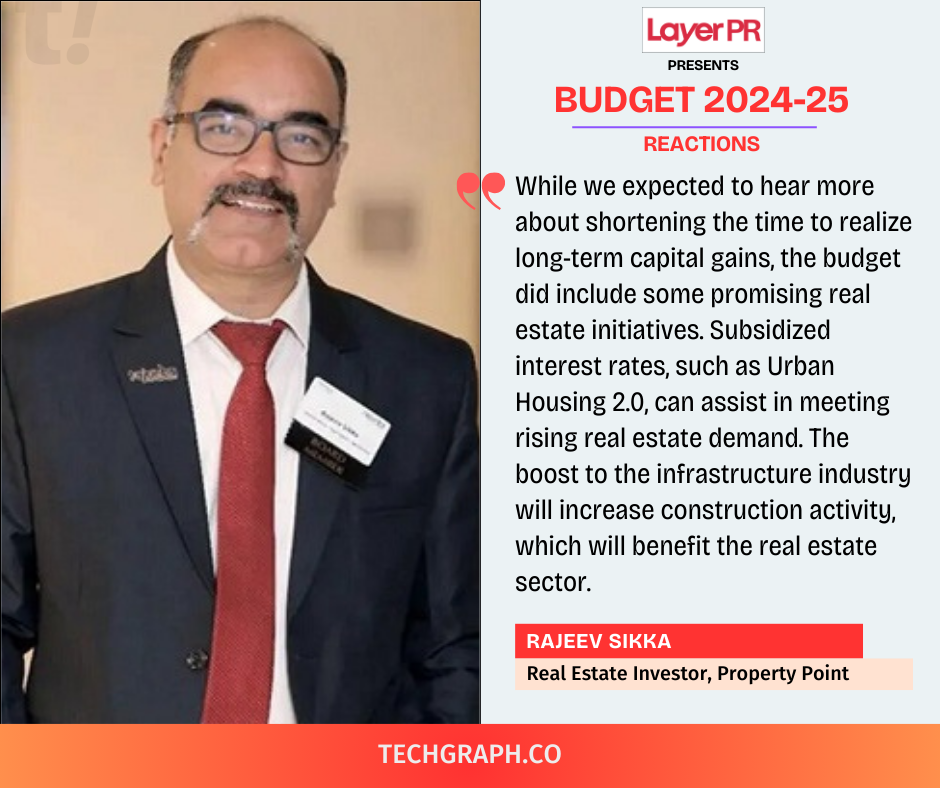
While we expected to hear more about shortening the time to realize long-term capital gains, the budget did include some promising real estate initiatives. Subsidized interest rates, such as Urban Housing 2.0, can assist in meeting rising real estate demand. The boost to the infrastructure industry will increase construction activity, which will benefit the real estate sector.
Additionally, with the improvement of road connectivity to the Eastern region, the underdeveloped areas will become more accessible and receive the attention they deserve, thereby driving real-estate growth due to the openness and attractiveness of those regions to investment. Moreover, the incentivizing of women-led housing projects will spur demand for microfinance loans and open opportunities within the real estate sector toward inclusivity and diversity in housing development.”
Darshan Govindaraju, Director, Vaishnavi group

The Indian real estate sector’s bull run has been further powered by the announcements in the Union Budget which identifies urban planning and development as one of the nine priority areas along with laying thrust on Pradhan Mantri Aawas Yojna, Rental housing, and Transit-oriented development. The allocation of Rs 10 lakh crore for rental housing for industry workers in line with the development of Rs.3 crore affordable homes, industrial parks, and e-commerce export hubs will greatly spur demand for developers and partners across the country. These initiatives will help accelerate our collective efforts to ensure housing for all while boosting investments in the sector.
Furthermore, reforms in land planning and management, the proposed reduction in stamp duty for property purchased by women, and brownfield redevelopment of existing cities will create significant demand for real estate services across the board.
More importantly, the benefit of personal income tax through an increase in standard deductions and rationalization of tax slabs will encourage fence-sitters to invest in the fast-growing real estate market. We are quite bullish on the rapid growth prospects of the sector given these developments which will lead to simplification of process and help build more transparency and trust in the sector.
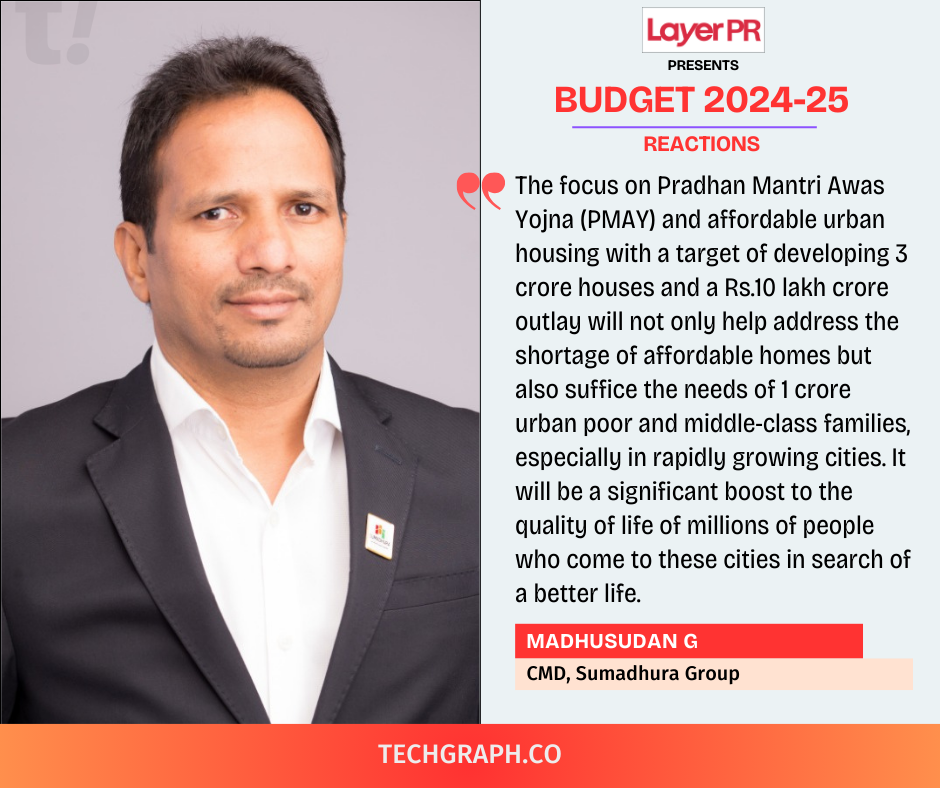
Madhusudan G, CMD, Sumadhura Group
India’s rapid urbanization has fueled a significant real estate boom, with the housing sector at its core. While the overall market has thrived, with record sales of up to about 5 lakh units in FY23-24, the affordable housing segment has continued to exhibit signs of struggle.
The focus on Pradhan Mantri Awas Yojna (PMAY) and affordable urban housing with a target of developing 3 crore houses and a Rs.10 lakh crore outlay will not only help address the shortage of affordable homes but also suffice the needs of 1 crore urban poor and middle-class families, especially in rapidly growing cities. It will be a significant boost to the quality of life of millions of people who come to these cities in search of a better life.
Post-pandemic, the affordable housing market has experienced a significant downturn from more than 22% in 2022 to around 20% in Q1 2024. Bridging the gap between the general real estate market and the affordable segment is an essential component for achieving the government’s ‘Housing for All’ vision. In the pursuit of ‘Viksit Bharat’ (a ‘Developed India’), it is imperative to ensure that housing is accessible to all income segments. A robust affordable housing ecosystem will contribute to overall economic growth and social equity.
Priyatham Kumar, Founder, Homes247

The allocation of Rs. 2.66 lakh crore for the development, and three crore additional houses under the Pradhan Mantri Awas Yojana will significantly uplift the housing sector in urban and rural India. It will accelerate the growth of the affordable housing sector, enhancing the overall standard of living and easing the financial burden.
The Finance Minister also announced the moderation of high stamp duty rates. Additionally, further reductions in duties for properties purchased by women will be considered. This would ultimately improve the residential real estate sector, streamlining project approvals and reducing the complex bureaucratic hurdles.
Ashish Narain Agarwal, Founder & CEO, PropertyPistol

The 2024 budget seems balanced, with a renewed focus on urban development, infrastructure, and housing. The government will spend ₹11.11 lakh crore on infrastructure in 2024-25. To boost housing, the finance minister has provided an outlay of ₹10 lakh crore, aiming for 3 crore houses under the Pradhan Mantri Awaas Yojana (PMAY)-Urban 2.0 to meet the housing needs of poor and middle-class families.
The Interest Subsidy Scheme for affordable urban housing loans and plans to reduce stamp duty for women buyers can sustain growth in the realty sector. The digitization of land records and GIS mapping will greatly benefit the sector. Overall, the budget presents a positive picture of India’s economic growth and a favorable outlook for the future.