

Decarbonizing Maritime Energy: Jassper CEO Pushpank Kaushik on Building a Viable Alternative Fuel Ecosystem for Shipping

Date:

Trending

- Advertisement -

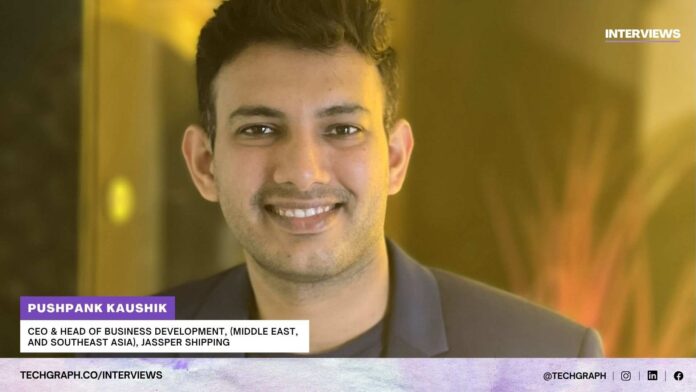
Speaking with TechGraph, Pushpank Kaushik, CEO and Head of Business Development (Subcontinent, Middle East, and Southeast Asia) at Jassper Shipping, discussed how Jassper Fuels represents the company’s new business model focused on aligning the maritime industry’s decarbonization goals with operational realities by promoting transitional fuels such as LNG that fit existing infrastructure while supporting the long-term shift toward hydrogen and ammonia.

He further explained how this model combines fuel supply expertise with collaboration across ports, regulators, and technology providers to build a cleaner and commercially viable marine fuel ecosystem that enables the industry to meet emission targets while maintaining operational and financial efficiency.

Read the interview in detail:

TechGraph: The shipping industry is under growing pressure to decarbonize, yet fuel remains both its largest cost and its biggest environmental challenge. How do you see Jassper Fuels positioning itself in this transition, where cost competitiveness and sustainability are equally at stake?


Pushpank Kaushik: Fuel remains shipping’s largest cost and its biggest environmental challenge but Jassper Fuels is turning this challenge into an opportunity. With decades of global shipping experience,we are aiming to help shipping operators manage costs while providing cleaner, greener fuel alternatives.

With initiatives like the National Green Hydrogen Mission, the Green Tug Transition Programme, the Harit Sagar Green Port Guidelines, and a ₹25,000 crore marine Development Fund that supports alternative fuels and green infrastructure, India is leading the way in a marine revolution.

- Advertisement -

Jassper Fuels enables shipping firms to cut emissions, streamline operations, and promote a cleaner, smarter maritime future by balancing cost effectiveness with sustainability.


TechGraph: Alternative fuels such as LNG, methanol and ammonia are being tested globally, but infrastructure gaps and scalability remain major hurdles. From your perspective in Asia and the Middle East, which of these fuels do you believe are most commercially viable in the near term?


Pushpank Kaushik: Shipping carries about 80% of the world’s goods but also produces 2–3% of global greenhouse gas emissions, over a billion tonnes a year as per The World Economic Forum. Traditional ship fuels are very polluting, with sulfur levels thousands of times higher than diesel. To reduce emissions, the industry needs alternative fuels.

Right now, the most practical option for shipping in Asia and the Middle East is LNG. LNG can cut CO₂ emissions by about 20 to 25 percent, and the great thing is it works with the infrastructure we already have. But looking further ahead, zero-emission fuels like green hydrogen and e-ammonia are really going to be important too, they just need a lot of investment and new infrastructure. So for now, LNG acts as a lower-emission bridge while the industry moves toward fully sustainable fuels.


TechGraph: Many ship owners remain hesitant to commit to new fuel technologies because of the risk of stranded assets. How is Jassper supporting clients in navigating these investment decisions with greater confidence?


Pushpank Kaushik: Jassper supports ship owners in making smarter, safer investment decisions. We guarantee our clients cost certainty even in uncertain markets by offering Fixed Price Agreements (FPA) and actionable data on fuel technology. As a result, they may cut emissions, streamline processes, and welcome the future of transportation without taking on needless operational or financial risk.


- Advertisement -

TechGraph: Regulatory frameworks are tightening, from IMO’s decarbonization targets to regional carbon taxes. How is Jassper Fuels aligning its strategy with these timelines, and do you see regulation as a catalyst for innovation or more of a constraint on the industry?


Pushpank Kaushik: Regulations are pushing the shipping industry to change faster than ever, and at Jassper Fuels, we see this as an opportunity. We combine financial strength, risk management, and operational expertise to help clients navigate uncertainty.

From providing bunker and lube oil at over 3,000 locations worldwide to offering Fixed Price Agreements that protect against price swings, we help clients focus on their business with confidence. For us, regulations aren’t a limit—they drive smarter fuel choices, better planning, and a faster move toward cleaner, more efficient shipping.


TechGraph: Building a reliable alternative fuel ecosystem requires more than supply alone. What kinds of partnerships or collaborations do you believe will be most critical in making that ecosystem commercially viable?


Pushpank Kaushik: Building a strong alternative fuel system is more than just supplying fuel. It needs the right equipment, technology, and trust. At Jassper, we work closely with port authorities, tech companies, and shipping operators. By partnering with governments, regulators, fuel producers, and storage experts, we ensure clean fuels are safe, reliable, and cost-effective for shipping.


TechGraph: Energy transition in shipping depends not only on technology but also on trust in execution. How is Jassper leveraging its established network of over 500 owners and operators to instill confidence in new fuel solutions among clients?


Pushpank Kaushik: Energy transition in shipping isn’t just about adopting new fuels—it’s about delivering them reliably and consistently. At Jassper, our network of over 500 owners and operators allows us to do exactly that. We combine operational reach with financial strength and risk management tools to provide clients with safe, dependable fuel supply, even in volatile markets.

From ensuring bunker oil and lube oil delivery at the right time and place, to offering Fixed Price Agreements that give cost certainty, we make it easy for clients to trust and adopt new fuel solutions. Our scale, experience, and commitment turn innovation into confidence.


TechGraph: Looking ahead to 2030, what role do you envision Jassper Fuels playing in shaping Asia’s shipping fuel market, and what would success in this transition mean for you personally?


Pushpank Kaushik: We at Jassper Fuels aim to be the go-to provider for alternative and sustainable fuels across Asia. Our role will be to ensure reliability, efficiency, and cost-effectiveness for shipping operators adopting new technologies. Success means leading the market in decarbonization while helping clients grow their businesses sustainably.

THE SNAPSHOTS

Sign up to get quick snaps of everyday happening, directly in your inbox.

We don’t spam! Read our privacy policy for more info.

- Advertisement -
Krishna Mali
Krishna Mali
Founder & Group Editor of TechGraph.

More Latest Stories

More Articles

How Air Can Become Urban India’s New Water Source

India's cities are running dry. Chennai nearly ran out of groundwater in 2019. Bengaluru's lakes are shrinking. Delhi's borewells are drawing from depths unimaginable...

The Human Algorithm: Why the Future of Digital Marketing Belongs to Empathetic Strategists

The modern marketing department is quieter than it used to be. The frantic tapping of copywriters racing against deadlines and the loud debates of creative directors have largely been replaced by the hum of servers processing natural language. Today, an enterprise can generate ten...

How AI is Rewriting the Economics of India’s $300 Bn IT Services Sector

When Microsoft CEO Satya Nadella recently disclosed that artificial intelligence now generates nearly 30...

Bounce House Rental vs Inflatable Slides: Which Option Delivers More Excitement?

Planning a family gathering or a children's party often involves finding the perfect entertainment...

How Hiring a Qualified Plumber Solves Major Household Issues

For many homeowners, maintaining a functional and safe home is a top priority. Plumbing...

Why India Must Own Its Education Intelligence Stack

India has rapidly digitised large parts of its education ecosystem over the last decade....

Why Micro Learning at 3 Minutes Works Better Than Lectures at 3 Hours

In the fast-moving world of digital education, there is one myth that continues to...

More Than Just a Scratch: The Importance of Windshield Care

Maintaining your vehicle’s windshield often appears as a seemingly minor task that can easily...

How Choosing A Licensed Plumber Ensures Quality Repairs

When it comes to maintaining a safe and comfortable home, the quality of plumbing repairs can significantly impact your daily life. From leaky faucets...

The world’s largest crypto market is building in the dark

India remains one of the few significant economies without a comprehensive crypto and stablecoin...

How Location Data Storage Technology is Making City Travel Smoother

India’s mobility ecosystem is undergoing a quiet but powerful transformation, driven not just by...

India Is Building Cities Without Building the Systems That Make Them Work

India is in the middle of the largest urban expansion in its history. By 2050,...

Why Cyber Resilience Is Replacing Cybersecurity as a Boardroom Priority

Traditionally, cybersecurity was hard-wired to be a technology concern that was only taken care...

Infrastructure 4.0: How AI & Predictive Analytics Are Transforming Real Estate

The new era of technology and innovation has changed operations in many industries. The integration of artificial intelligence in different industries is making processes...

The Rise of Integrated Solar Tech Ecosystems in India

India’s clean energy is all about building an ecosystem that is interconnected with various elements and goes beyond just installing solar panels at scale. Renewable energy generation, storage, digital intelligence, manufacturing, financing, and grid infrastructure work together within the said ecosystem in a coordinated...

Beyond Nvidia: The Hidden Winners of the AI Stock Rally

Nvidia stock (NASDAQ:NVDA) has returned roughly 1,200% since ChatGPT launched in late 2022. Most...

What PM Modi’s Appeal to Avoid Gold Buying Could Mean for India’s Jewellery Economy

When Prime Minister Narendra Modi recently urged citizens to avoid purchasing gold for a...

How Agentic AI Is Personalising the End to End Salon Experience

Walk into a salon today, and more often than not, the experience still depends...

From Black Box to Trusted AI: Why Defence Needs Constitutional AI Models

For decades, the defence and intelligence agencies have followed one non-negotiable rule: trust nothing...

Apple Reports $111.18 Billion Revenue in Q2 FY26, Net Profit Rises to $29.6 Bn

Apple Inc. (NASDAQ:APPL) has reported its financial results for the quarter ended March 28,...

Hermès vs MetaBirkin: The NFT Case That Redefined Ownership on Ethereum

The NFT boom of 2021 and early 2022 pushed digital assets into the mainstream,...

Bihar Police, Vehant Technologies Partners to Deploy Screening Systems Across 40 Courts

In a bid to enhance safety and security across court premises for judges, lawyers,...

Rethinking Hospital Security: TrioTree Technologies CEO Surjeet Thakur on Securing Fragmented Hospital IT Environments

In an interaction with TechGraph, Surjeet Thakur, Founder and CEO of TrioTree Technologies, outlined...

What the Next Phase of Growth Looks Like for Indian and Global E-commerce Players

For close to a decade, metrics for evaluating the growth of e-commerce included customer...

India Is Building Cities Without Building the Systems That Make Them Work

India is in the middle of the largest urban expansion in its history. By 2050,...

“Budget should focus on reducing taxes on capital gains,” Says Abhishek Gupta of Hex N Bit

Speaking in the upcoming Union Budget 2021, Abhishek Gupta, Founder, and CEO, Hex N...

“China is a Global thief” Rep. Tom Rice on Uyghur Forced Labor Prevention Act

Speaking at the House on Uyghur Forced Labor Prevention Act, Rep. Tom Rice (R-SC)...

Borade AI Founder Shiv Kumar Borade on Building an AI Growth Engine for Small Businesses

Speaking with TechGraph, Shiv Kumar Borade, Founder & CMD of Borade.AI, discussed how many...

When AI-Generated Documentation Hurts More Than Helps

AI-generated documentation has quickly become a selling point for modern SaaS and developer platforms,...

Why Cyber Resilience Is Replacing Cybersecurity as a Boardroom Priority

Traditionally, cybersecurity was hard-wired to be a technology concern that was only taken care...

Alphabet Discloses $2.14 Billion in Public Equity Holdings as of June 30

Alphabet Inc. disclosed $2.14 billion in equity securities held across 39 positions as of...

Gaming for Good: Boosting the Indian Gaming Community through Technology

The Indian gaming industry is transforming remarkably, driven by technological advancement and a growing...

India to generate $100 bn from telephonic investments

India expects to attract $100 billion in investments in the telecom sector, a union...