


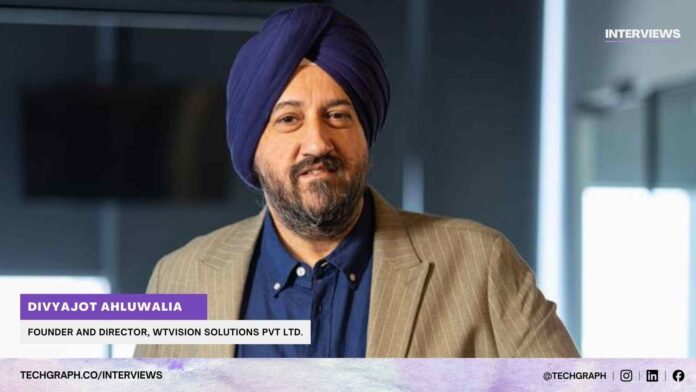

Speaking with TechGraph, Divyajot Ahluwalia, Founder & Director of wTVision Solutions Pvt. Ltd., discussed how the growing demand for immersive, ground-level sports coverage created an opportunity for bold experimentation in live broadcasting, and how the debut of Champak, the robotic dog introduced during the Indian Premier League (IPL 2025), transformed the viewing experience by navigating the stadium with ease and bringing fans closer to the action in ways traditional cameras could not.
He further explained how the robot’s stabilised camera system, adaptive mobility, and crowd-friendly design showed the potential for robotics to move beyond purely technical functions and become part of the broadcast narrative, capturing unique visual angles and emotional interactions, prompting strong interest from production houses looking to integrate similar robotic elements into future live sports and entertainment events.
Read the interview in detail:
TechGraph: The debut of the Champak robot during the IPL caught global attention because it brought the camera to the ground in a way fans had never experienced before. What was the idea that convinced your team at wTVision that this was worth attempting in such a high-profile tournament?
Divyajot Ahluwalia: The advancement in the sports industry has always surprised people, and yet somehow they have always adapted to the new transformations taking place in the broadcast of sports. While we did see mascots playing an important role in major tournaments, we thought of bringing this robotic dog to life.
Considering that the IPL is an iconic tournament, we wanted to provide viewers with an enhanced experience of watching the IPL and create something to remember this event by.
TechGraph: Cricket stadiums are challenging environments for any robot, with uneven outfields, crowded sidelines, and the pressure of quick match turnarounds. What were the biggest hurdles in making sure Champak could perform reliably under those conditions?
Divyajot Ahluwalia: The biggest challenge with Champak was simply making sure it could perform the way we thought it would. It needed to be stable and agile enough for uneven outfields, reliable enough to navigate crowded sidelines without a hitch, and fast enough to keep up with the action.
We needed something truly advanced, a design that instantly adapted to varying grass, sudden blockages, and the constant, unpredictable flow of people. We also made sure the robot stayed durable, and it could operate for long hours under different conditions, which was another challenging obstacle for us, but relentless testing helped us create this iconic robot.
TechGraph: Viewers noticed that Champak became more than just a moving camera. It shook hands, greeted players, and even interacted with the crowd. Was it always part of the plan to turn the robot into a character in the broadcast rather than keeping it purely technical?
Divyajot Ahluwalia: Yes, even though it was not a necessity to create a robot that had movements and actions like a real-life dog. However, the idea stemmed from curiosity and a drive to create a robot that people can connect to. Sports are an immersive universe, and they captivate human attention, so entertaining elements take this experience to the next level. As long as we continue to make such innovations, the future of sports broadcasting will be creative with advanced technology.
TechGraph: One reason the robot impressed fans was how smooth the footage looked even when it was moving quickly across the ground. What kind of design and stabilisation work went into delivering that level of consistency?
Divyajot Ahluwalia: Champak’s smooth footage comes from smart engineering and precise stabilisation. We integrated a compact gimbal and pan-tilt system that absorbs shocks from fast movement, paired with a well-balanced quadruped design to minimise vibration.
The video link is so quick that our remote operators can frame every shot without making sudden, jarring movements. With the expert control of our trained crew, the footage stays consistent and broadcast-ready, even as Champak flies across rough stadium turf.
TechGraph: The IPL is a global showcase, but India also has a packed calendar of sports and entertainment events. How does wTVision view the scope for robotic broadcast solutions in India compared to other markets?
Divyajot Ahluwalia: Given its packed calendar of sports and entertainment events, India offers immense potential for next-generation camera technology in broadcasting. Champak’s success at the IPL proved that the market is enthusiastic for innovation that genuinely elevates the fan experience.
While established markets prioritize automation and slower, deep-rooted system changes, India seeks agility, immediate visibility, and maximum cost efficiency. This means wTVision’s focus is on creating tough, adaptable camera solutions and actively collaborating with local partners to match the lightning-fast pace and immense scale of Indian live productions.
TechGraph: After Champak made headlines during the IPL, what kind of feedback or requests did you receive from Indian broadcasters and production houses? Were they more interested in its technical possibilities or in the way it connected with audiences?
Divyajot Ahluwalia: Indian broadcasters and production houses greeted Champak’s debut at the IPL with huge enthusiasm. Its reliable speed and steady camera work captivated them, along with the unique, low-angle shots it captured. The true revelation was Champak’s undeniable charisma and the powerful, immediate affinity it created with the viewers.
This led broadcasters to recognize that the camera was more than simple hardware; it was a dynamic presence that could actively shape the narrative, transcending its designation as a mere tool. This impactful mix of new technology and charm has already generated significant interest in using similar solutions for future live events.
TechGraph: Looking ahead, do you think robotic elements like Champak will eventually become a regular part of Indian live productions, or will they remain as special features tied mainly to mega-events such as the IPL?
Divyajot Ahluwalia: We anticipate that innovative devices such as Champak will continue to see keen interest. The success demonstrated at large-scale events like the IPL already underscores their considerable value in both creating compelling visual content and improving operational efficiency.
As development costs decrease and the expertise of our operators expands, we fully expect this technology to be adopted more widely across various leagues, concerts, and televised shows. The early visibility gained from mega-events is important, but the long-term objective is seamless, everyday integration within the broader Indian broadcast sector.