


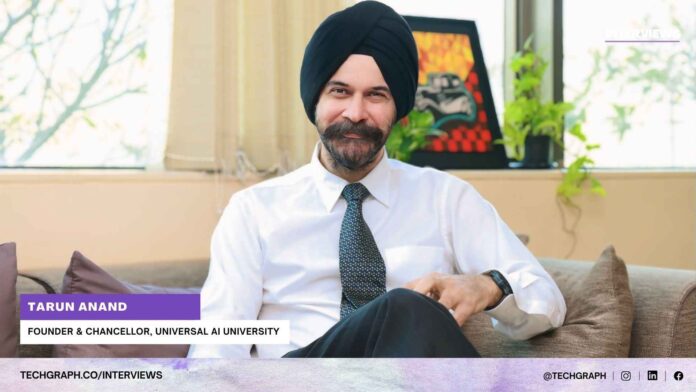

During an interview with TechGraph, Tarun Anand, Founder and Chancellor of Universal AI University, talked about how India’s higher education system is evolving to meet the demands of an AI-driven global economy and how the university is integrating artificial intelligence across disciplines such as technology, management, and liberal arts to equip students with future-ready skills and cross-domain agility.
Anand further explained how Universal AI University is bridging academia and industry by combining AI-driven pedagogy, real-world projects, and sustainability-led initiatives, including applied research through its in-house company “Univitt AI Technologies” to prepare graduates who can blend technical fluency with ethical and multidisciplinary thinking.
Read the interview in detail:
TechGraph: AI University positions itself as India’s first AI-focused institution with a broad spectrum of programs from technology to liberal arts. In a higher education landscape still dominated by traditional models, what convinced you that this multidisciplinary approach is the way forward?
Tarun Anand: Universal AI University is India’s only AI-focused institution built truly on the concept of “for the corporate, by the corporate. We are among Asia’s first universities to have 60 leading CEOs on our advisory board, who guide us on the evolving skill sets that industry demands. This strong industry-academia integration ensures that our multidisciplinary programs, ranging from technology and AI to management and liberal arts, are future-ready and aligned with global standards.
To make students truly employable, we run a dedicated skill development department that conducts AI-driven mock interviews, group discussions, and certifications. Every student must also complete a CMAPS (Cumulative Multidisciplinary Approach to Problem-Solving) project, which involves working directly on live industry challenges. With our “no student left behind” initiative, placement and internships are compulsory so that every graduate is job-ready. Our alumni are already success stories at top organizations like EY, McKinsey, Google, Goldman Sachs, and Federal Bank.
TechGraph: The rise of AI has intensified debates about employability, reskilling, and the future of work. How is your university ensuring that its graduates are not just technically competent but also industry-ready in a fast-shifting job market?
Tarun Anand: The swift growth of AI has revolutionized our perceptions of employability, reskilling, and the job landscape of the future. Universal AI University bridges this gap by developing an integrated ecosystem wherein students, teachers, and corporates alike are empowered to cope with the world powered by AI. We have a dedicated AI Cell where our faculty members engage in expert workshops, training programs, and industry associations that keep our community one step ahead.
For students, employability is more than just technical competence. We incorporate industry projects, AI-based mock tests, and compulsory internships to expose them to practical applications. Each program is crafted with an emphasis on critical thinking, problem-solving, and adaptability skills employers seek in an increasingly fast-changing job market.
Additionally, we are also upskilling teachers and corporate professionals with AI-centric interventions and AI-based solutions, which is making our institute a center of lifelong learning through the wholly owned AI solutions company Univitt AI Technologies Pvt. Ltd, which is located on campus. This holistic strategy ensures our graduates are technically competent as well as employable.
TechGraph: India is pushing hard to become a global AI hub, yet there are gaps in research funding, infrastructure, and policy clarity. Where do you see a university like yours fitting into this larger national ambition?
Tarun Anand: India’s aspiration to become a global AI hub is not only in need of policy support and infrastructure but also institutions capable of bridging research, application, and talent generation. In contrast to most universities, which view AI as an isolated subject of study in the curriculum, we have integrated AI into the very culture of our pedagogy. At Universal AI University, close to 50% of all learning, both academic and non-academic, is done using AI tools and methods, so students not only learn about AI, but they also experience it.
This model produces two divergent currents of value that is technologists and engineers constructing advanced AI models, and management, liberal arts, psychology, and other professionals becoming proficient in using AI in practical contexts. Merging producers and consumers of AI within one ecosystem, we are constructing multidisciplinary talent pipelines that serve India’s vision to become a leader in AI globally.
TechGraph: Many universities are racing to bolt AI into existing curricula, often in a superficial way. What makes your model structurally different, and how do you guard against the risk of AI education being reduced to a buzzword?
Tarun Anand: At Universal AI University, AI is not a value-added offering on top of current courses since it is the cornerstone of our educational model. While most schools only add AI as one subject, we have transformed the entire pedagogy around AI. From classroom instruction through projects and evaluations, AI methods and technologies go deeply, and thus, it becomes a mode of learning instead of a subject to learn.
We have mandated in our academic policies and research that students can use up to 75% of AI tools compared to the UNESCO guideline of just 15%. By embedding AI in multidisciplinary learning, we safeguard it against becoming a buzzword. Rather, it is a dynamic, day-to-day instrument that readies our graduates to be responsible leaders in an AI world.
TechGraph: Since the institution is promoted by India’s first Green B-School, sustainability seems to be part of its DNA. Given the heavy energy footprint of AI, how do you balance the push for cutting-edge technology with the responsibility to operate sustainably?
Tarun Anand: Sustainability is central to our philosophy, and we recognize the responsibility of balancing AI innovation with environmental stewardship. As India’s first Green B-School, this ethos is embedded in our practices. We are deploying AI itself as a solution to minimize its own footprint using AI-powered energy management systems to optimize consumption, improve workload placement, and cut energy costs across our infrastructure, including ensuring that 50% of our energy needs are serviced by solar power plants, the maximum allowable in Maharashtra.
Our data centers run on energy-efficient servers, supported by renewable energy sources and eco-friendly cooling methods. We also use AI to reduce workloads, adopt efficient processors, and employ foundational models to reduce computational intensity. Beyond infrastructure, sustainable practices such as recycling, refurbishing technology, and promoting local computing help reduce e-waste and energy use, along with rainwater harvesting to enable there is sufficient water to cool the energy systems.
Importantly, we extend this philosophy outward using AI in predictive maintenance, energy demand forecasting, and sustainability monitoring to support industries and communities. This way, AI at our university becomes both a driver of innovation and a force for sustainability.
TechGraph: Collaborations with industry are often the bridge between academic vision and real-world impact. What kind of partnerships are you prioritising, and how are you measuring their effectiveness for students as well as the ecosystem?
Tarun Anand: Industry partnerships are at the core of integrating academic aspiration with practical contribution within Universal AI University. Our collaboration with LTI Mindtree for our engineering courses is a case in point. The entire B.Tech course has been co-designed by LTI Mindtree so that it mirrors current industry trends and offers six months of on-the-job work experience in the eighth semester. This practical exposure enables students to make a smooth transition from the classroom to professional settings and save an entire year of being productive as compared to other engineering colleges.
Furthermore, our partnership with Vitti Foundation, the premier systems laboratory for R&D in AI & Robotics, allows our students to work on hands-on AI projects on campus at Univitt Ai Technologies Pvt. Ltd., whilst pursuing their B.Tech.
Likewise, our School of Music partners with Sound Ideas, an industry legacy name whose alumni have worked on films such as PK, Titli, and Lagaan. This collaboration brings industry inputs to our faculty’s academic direction, allowing us to introduce India’s first B.Tech in Sound Engineering, UGC and AICTE approved.
We evaluate the effectiveness of these collaborations through student results, internship performance, placement success, and the establishment of programs that serve not just our students but also contribute to the broader ecosystem by providing industry-ready, highly skilled talent.
TechGraph: Looking ahead, AI will inevitably reshape not just business and technology but also creativity, ethics, and governance. How then do you see Universal AI University’s role evolving in shaping leaders who can navigate this wider cultural and societal transformation?
Tarun Anand: Universal AI University views itself as playing a much broader role than technical education. However, AI is revolutionizing business, technology, creativity, ethics, and governance. We wish our leaders to understand how to succeed in the complexities of a fast-changing world. Through a multidisciplinary education, we ensure that students not only possess skills in AI and technology but also have knowledge of its cultural, ethical, and societal complexities.
With interdisciplinary studies that blend liberal arts, management, psychology, and design with AI, students are given the ability to apply technology responsibly and mindfully. Industry collaboration, CMAPS projects, and practical projects build critical thinking, leadership, and problem-solving capacities.
We also involve educators and business leaders in ongoing discussions regarding the social implications of AI, developing a forward-thinking and socially responsible learning ecosystem. In creating technically proficient, ethically sensitive, and creatively empowered graduates with a global mindset, Universal AI University is positioned as a center for developing the next generation of leaders with the ability to utilize AI responsibly to create positive impact across industries and society.