


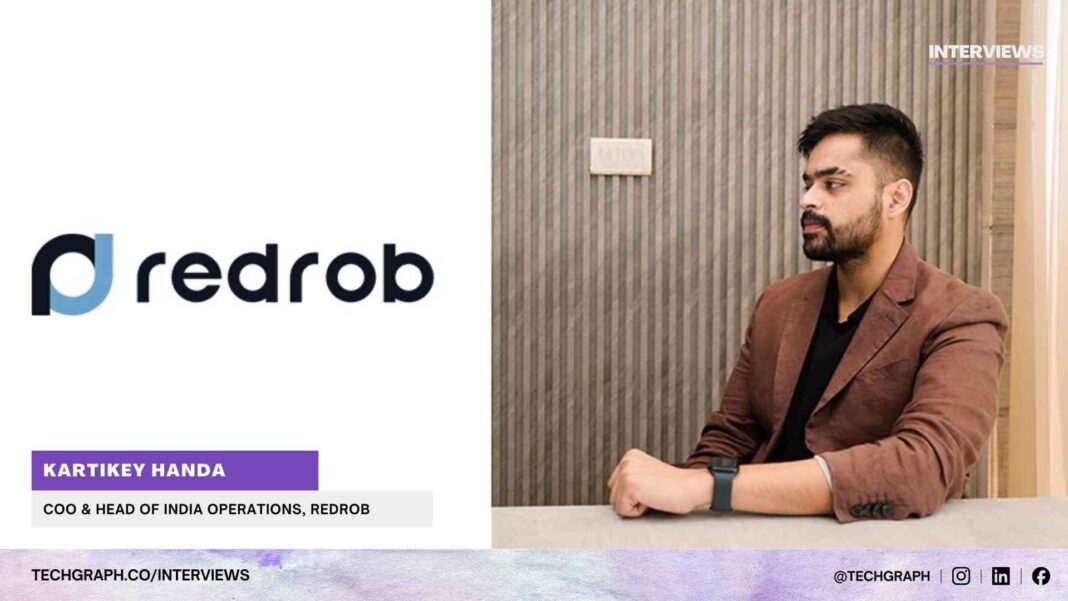
Speaking with TechGraph, Kartikey Handa, Chief Operating Officer and Head of India Operations at Redrob, discussed how India’s AI adoption has been constrained less by a lack of interest and more by affordability barriers created by global pricing models, and how the company is addressing this gap by building free and open access AI systems designed specifically for students operating in a rupee-based economy.
Handa also explained how Redrob is structuring its India operations around localisation, cost-efficient model design, and mobile-first delivery so that students across metros and remote districts can access consistent AI-driven learning support, while laying the foundation for an India-first AI ecosystem that prioritises reach, trust, and long-term capability building.

Read the interview in detail:
TechGraph: Redrob speaks about democratizing AI in a country where access to advanced technology remains uneven and shaped by socio-economic gaps. What shift in India’s AI landscape convinced you that building free and open access models for millions of students was not just aspirational but a necessary step for the country’s digital future?
Kartikey Handa: The turning point was when our own data showed that India’s AI story was being shaped less by interest and more by affordability. As Redrob reached millions of students across hundreds of universities, we saw the same pattern: incredible curiosity and serious academic use, blocked by dollar-priced paywalls that, in local terms, look like a monthly salary.
At that point, “free and open access” stopped being a nice ideal and became an infrastructure question: either AI stays a luxury export, or we build models that are priced and designed for a rupee economy. Redrob’s role is to make the second path real.
TechGraph: India’s linguistic diversity and varied learning environments make it difficult to build AI systems that perform consistently across regions. How are you designing localisation so that the quality of responses remains stable for a child in a metro classroom as well as for a student in a remote district?
Kartikey Handa: For us, localisation starts from how Indian students actually speak and learn, not from a translation checklist. We train and evaluate on code-mixed, informal, exam-style language, so the model is comfortable with Hinglish, regional terms, and shifting between languages in one conversation.
On top of that, we tune for grade level and board type, so a 9th grader in a state-board school and a college student in a metro don’t get the same abstraction or difficulty. Finally, we design the stack for low-bandwidth, mobile-first environments so the quality of explanation stays consistent, even if the network doesn’t.
TechGraph: Most AI companies raise capital to scale commercial products, while Redrob secured global investment for a mission rooted in open access. What strategic clarity helped you earn this confidence, and how does it influence your roadmap for India operations?
Kartikey Handa: We were very explicit that open access is our go-to-market strategy, not a CSR line item. India and Southeast Asia are the largest underserved AI markets, not because people don’t want AI, but because global pricing assumes a very different income profile.
If we become the default AI layer for students and young professionals here, that distribution and trust is a massive long-term asset. That’s why our India roadmap keeps the student-facing layer free or ultra-affordable, while monetising through APIs, institutions, and partners who want a reliable, India-first AI backbone.
TechGraph: Cost-efficient AI infrastructure is essential for a country where usage could reach billions of queries a day. What have been the toughest engineering choices in balancing performance, affordability, and responsible AI practices for such a broad user base?
Kartikey Handa: The hardest decision was to step off the “biggest model wins” treadmill and optimise instead for reach and unit economics. We focus on well-optimised, mid-sized models combined with retrieval, distillation, and aggressive inference optimisation so that a student feels high quality, but our per-query cost stays compatible with massive free usage.
We also trade a bit of ideal latency for sustainability in peak and low-bandwidth conditions, because a slightly slower answer is better than a model we can’t afford to keep online. And on safety, we’ve had to design filters that are strict on harm but still let students ask real, sometimes uncomfortable questions and get age-appropriate, honest answers.
TechGraph: Providing free LLM access to 300 million students brings sharp questions around safety, content filtering, and ethical boundaries. How are you shaping responsible AI frameworks that can manage India’s scale without weakening openness or learning outcomes?
Kartikey Handa: We think in layers: protect the child, protect learning, and protect the public sphere. That means hard lines on abuse, exploitation, self-harm, and hate, while still allowing factual, multi-perspective discussion of sensitive topics.
In education specifically, we are biased toward explanation and scaffolding instead of auto-completing every assignment, and we give teachers and institutions levers to tune how “assistive” the system is.
The goal is that students feel safe asking anything they’re genuinely curious about, but the system keeps nudging them back to understanding, not shortcuts.
TechGraph: Redrob is positioning India as a contender in AI research at a time when global markets are consolidating around a handful of heavyweight players. How do you intend to carve out room for India-based innovation in a space dominated by companies with far deeper compute and capital resources?
Kartikey Handa: We’re not trying to outspend the frontier labs on raw compute; we’re trying to be the best in the world at “AI for India” problems. Things like code-mixed language, exam-centric reasoning, multilingual classrooms, and low-bandwidth inference aren’t edge cases here, they’re the norm – and solving them well has global value.
By turning our large student base into builders, giving them APIs, datasets, and tools, and by contributing India-centric benchmarks and research back to the ecosystem, we can build a different kind of moat: one around local relevance, distribution, and intellectual contribution rather than GPU count.
TechGraph: As global AI leaders push ahead on model sophistication and infrastructure scale, India is still strengthening its foundational layers. Where do you see Redrob’s role in shaping the country into an AI innovation hub, and what milestones will signal that India is shifting from consumer to creator in this field?
Kartikey Handa: Right now, much of AI in India is imported: powerful, but priced and shaped elsewhere. Redrob’s first job is to erase the access gap so that any student with a basic smartphone can have a genuinely capable AI companion; we’ll know we’re close when tens of millions of students use it regularly with measurable learning gains.
The second job is to turn those users into creators—students using our stack to build apps, research projects, and startups, and universities standardising on us for hands-on AI education.
The final marker of success is when Indian teams, often building on Redrob, start setting global benchmarks in Indian-language AI, education-focused models, and low-resource inference, and those ideas are adopted far beyond India.