


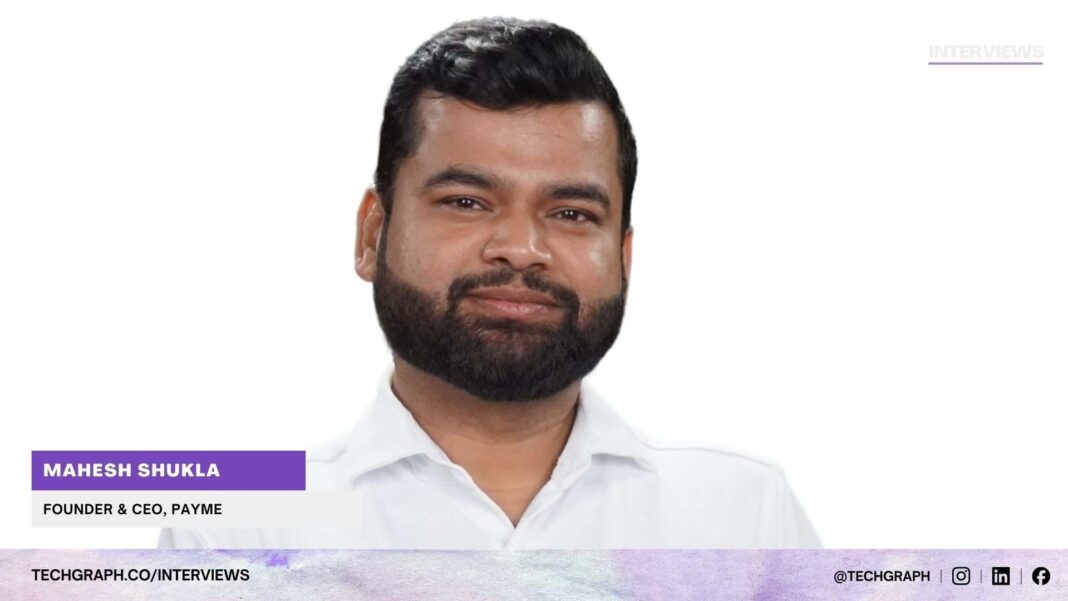
Speaking with TechGraph, Mahesh Shukla, Founder and CEO of PayMe, discussed how India’s digital lending landscape is evolving from instant disbursal models to frameworks that balance speed with regulatory discipline, and how PayMe is shaping this transition by embedding automation, risk intelligence, and customer protection protocols into every stage of the credit journey to deliver fast yet responsible access to short-term liquidity for India’s emerging workforce.
He further explained how PayMe’s AI-led underwriting models, behavior-driven risk filters, and continuous portfolio oversight help the company identify genuine creditworthiness, sustain low NPAs, and grow responsibly, while ensuring that every borrower interaction remains transparent, fair, and aligned with RBI norms to build long-term trust in an increasingly crowded lending market.

Read the interview in detail:
TechGraph: Instant digital lending has often walked a tightrope between financial inclusion and reckless disbursal. How has PayMe managed to maintain lending speed while ensuring strong compliance and borrower protection in such a highly scrutinized segment?
Mahesh Shukla: PayMe has been able to deliver instant lending without compromising compliance or borrower protection by designing speed into its systems, not by bypassing guardrails. Our entire backend is fully automated, from KYC and bureau pulls to income assessment, which eliminates manual delays and ensures decisions are both fast and data-backed.
We adhere to the RBI’s Digital Lending norms to the letter, with transparent disclosures, multi-layered customer consent, strict data privacy protocols, and a secure technology infrastructure. Importantly, risk filters are embedded throughout the loan journey so that only eligible borrowers progress to approval.
In other words, the disbursal is quick because the system has already pre-validated all parameters. This allows us to balance lending agility with responsible practices, ensuring borrowers are protected, and the business remains fully compliant in a highly scrutinized category.
TechGraph: AI-led underwriting is reshaping how creditworthiness is assessed, especially for India’s salaried and gig workforce. Could you explain how your technology identifies responsible borrowers who might otherwise be invisible to traditional credit systems?
Mahesh Shukla: Our AI-led underwriting is designed specifically for today’s evolving borrower profile, especially salaried individuals with limited credit history and gig professionals who often fall outside traditional scoring models. Instead of relying solely on bureau data, our models evaluate real financial behaviour. We analyse cash-flow patterns, employment stability, spending discipline, inflow consistency, EMI behaviour, and even spending spikes to build a far more accurate alternative credit profile.
What makes our system stronger is that it is trained on PayMe’s own historical performance datasets. This reduces the misclassification of creditworthy borrowers who might otherwise be deemed “high risk” by conventional systems. At the same time, we maintain a strong human-in-the-loop framework. Our expert underwriters review edge cases to ensure fairness, contextual understanding, and the elimination of automated bias.
This combination of AI-driven insights and human judgment helps us identify genuinely responsible borrowers who are often invisible to traditional credit systems, enabling broader, smarter, and more inclusive lending.
TechGraph: With a 44 percent year-on-year growth rate and NPAs below 2.3 percent, PayMe stands out in a market where delinquency often climbs with scale. What operational and data governance disciplines have helped you achieve this balance?
Mahesh Shukla: At PayMe, we’ve built our growth strategy on the foundation of strong credit discipline and robust data governance. We follow a ‘responsible scaling’ philosophy, expanding only in segments and geographies where the data consistently shows healthy risk behaviour, rather than chasing volumes for vanity metrics.
A big contributor to our low NPAs is our real-time fraud detection framework, which uses multi-layer validation to ensure that high-risk or fraudulent applications never enter the system in the first place. Once a customer is onboarded, our continuous portfolio monitoring allows us to spot early signs of stress and take timely corrective action.
We also maintain conservative and behaviour-led credit policies, whether it’s ticket size, tenure, or customer limits. These are aligned to repayment patterns we see on the ground, ensuring we don’t overextend a borrower. Together, these pillars help us sustain strong growth without compromising asset quality.
TechGraph: As the regulatory environment around digital lending evolves rapidly, how do you align PayMe’s innovation roadmap with compliance frameworks without slowing down your product velocity?
Mahesh Shukla: At PayMe, we see innovation and compliance as complementary, not conflicting priorities. As the regulatory landscape around digital lending evolves rapidly, our product velocity stays strong because compliance is built into our development DNA.
To ensure this, our compliance team works hand-in-hand with the product and tech teams from the very beginning of every feature cycle. Every new initiative undergoes a regulatory impact check before rollout, so we’re never retrofitting compliance after the fact. We also conduct regular internal audits and gap assessments to make sure our systems remain ahead of RBI’s evolving guardrails.
Most importantly, we believe that strong regulation actually strengthens customer trust and market credibility. So our innovation roadmap is intentionally shaped with long-term stability, transparency, and responsible lending at its core. This approach allows us to introduce new products quickly without compromising on regulatory integrity at any stage.
TechGraph: The demand for short-term personal credit is surging among India’s middle-income professionals. How do you ensure that instant loans, while solving liquidity gaps, do not lead borrowers into cycles of dependency or over-leverage?
Mahesh Shukla: The demand for short-term personal credit is undoubtedly rising among India’s middle-income professionals, but responsible lending remains at the core of our approach. We ensure borrowers don’t fall into over-leverage by assessing disposable income, existing fixed obligations, and overall financial capacity before approving any loan, preventing any form of excessive lending. Every customer receives complete repayment visibility through clear schedules with no hidden charges or complex structures.
To further support healthy credit behavior, our PayMe Credit Assist feature proactively nudges users about upcoming EMIs, tracks repayment patterns, and shares insights on their credit health. This reduces anxiety around repayments and encourages disciplined financial habits. Additionally, we enforce strict eligibility rules that prevent customers from taking a new loan before clearing ongoing EMIs, which effectively breaks the possibility of repeat borrowing cycles. Our goal is to solve liquidity gaps without ever creating long-term dependency.
TechGraph: The digital lending space has become increasingly competitive, with neobanks and fintechs targeting similar audiences. What strategic differentiators give PayMe an edge in both customer experience and risk management?
Mahesh Shukla: In the digital lending space, where neobanks and fintechs often target the same customer segments, PayMe stands apart through a set of strong strategic differentiators that enhance both customer experience and risk management.
To begin with, our pricing is completely transparent. We ensure customers are fully aware of charges, with no hidden fees or last-minute surprises. This clarity has not only strengthened trust but also improved long-term customer relationships.
Secondly, our underwriting approach blends AI-driven precision with human intelligence. While our algorithms help us assess risk with speed and accuracy, human judgment steps in for contextual evaluation, allowing us to optimize both turnaround time and portfolio quality.
We are also a technology-first organisation, which helps us deliver faster approvals and a frictionless journey across onboarding, loan management, and repayment. This efficiency is a core differentiator in a market where customer expectations for speed are very high.
Finally, our focus on relationship-led lending sets us apart. By maintaining clear communication, offering predictable experiences, and ensuring fairness at every stage, we see significantly higher customer satisfaction and retention compared to peers.
Together, these strengths position PayMe as a digital lender built on trust, speed, and responsible risk management, giving us a durable edge in an increasingly competitive landscape.
TechGraph: Looking ahead, as AI models become more sophisticated, how do you see the role of human oversight evolving in PayMe’s credit operations to ensure fairness, accountability, and long-term trust?
Mahesh Shukla: As AI continues to advance, human oversight will remain at the core of PayMe’s credit operations. While AI helps us surface deeper insights and make faster assessments, every critical decision still goes through trained experts who bring contextual judgment and accountability. We see this hybrid approach strengthening over time.
Regular audits of our AI models will continue to be a non-negotiable practice, helping us identify and eliminate any emerging biases while ensuring complete transparency in how decisions are made. Alongside this, we are building clear escalation paths and robust grievance-redressal mechanisms so that customers always have access to human intervention when they need it.
Ultimately, the future of AI-driven credit lies in the balance between automation for speed and scale, and human judgment for fairness, ethics, and long-term trust. That’s the principle guiding PayMe as we evolve our credit operations.