


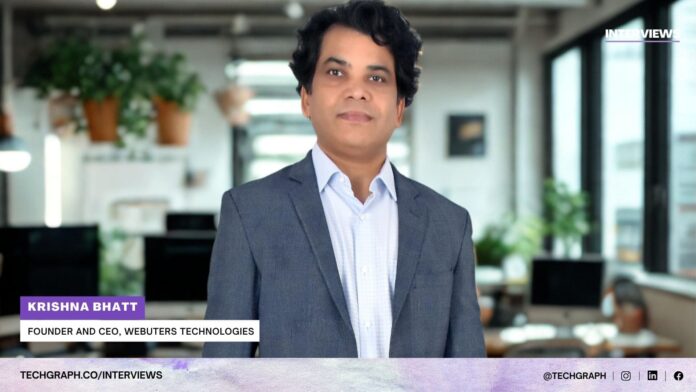

Speaking with TechGraph, Krishna Bhatt, Founder and CEO of Webuters Technologies, discussed how the company integrates responsible AI principles into its enterprise solutions, embedding transparency and bias mitigation features within its OfficeIQ platform to ensure fair and compliant automation.
He added that by linking ethical design with measurable ROI and partnering with global platforms like Salesforce and AWS, Webuters is helping organizations accelerate AI adoption responsibly, reduce rework costs, and build long-term trust through AI-driven automation and accessible no-code tools.
Read the interview in detail:
TechGraph: Every firm today talks about digital transformation, but many businesses feel they are just buying new tools without real change. How do you ensure your clients’ investments in AI and cloud translate into measurable outcomes rather than inflated expectations?
Krishna Bhatt: Webuters ensures measurable outcomes by aligning AI and cloud solutions with clients’ specific goals, avoiding generic tools. Our OfficeIQ platform delivers AI agents, copilots, and no-code solutions, driving 30–40% operational cost reductions and enhanced productivity. We start with tailored assessments, using composable architectures for seamless integration with existing systems. Partnerships with Salesforce and AWS enable scalable deployments, while our focus on multilingual, user-centric designs ensures accessibility.
For example, our Salesforce-driven non-profit digitization projects show tangible impact. We set clear KPIs for faster decision-making, revenue growth, and tracked them from day one. Our ethical AI approach mitigates risks, ensuring sustainability over hype. By prioritizing measurable results, like streamlined workflows in education and healthcare, we help clients like The Excellence Hub achieve transformative success. Our vision to democratize AI ensures every investment delivers real change, not just promises, setting us apart in a market of inflated expectations.
TechGraph: AI adoption is often sold as seamless, yet most enterprises run into hidden costs and integration hurdles. What are the frictions you see most often in this space, and how do you help businesses move past them without burning budgets?
Krishna Bhatt: Common AI adoption frictions include legacy system incompatibilities, data silos, and hidden scaling costs. Enterprises often face budget overruns from poor integrations or regulatory missteps. Webuters tackles these with OfficeIQ’s composable architecture, enabling plug-and-play integration with AWS and Microsoft ecosystems, minimizing rework. Our no-code OfficeIQ Studio empowers non-technical teams, reducing specialist costs. We use phased pilots to catch issues early, ensuring budget control.
Multilingual designs and compliance-focused frameworks address global needs without costly retrofits. In insurance, we’ve resolved data silos, delivering 30–50% efficiency gains. Our India Insurtech Association involvement informs cost-effective strategies, while MedIQ and InsuIQ target sector-specific challenges. By anticipating hurdles and leveraging partnerships with Shopify and Salesforce, we streamline deployments, keeping costs predictable. This proactive approach ensures businesses adopt AI smoothly, turning potential budget drains into strategic wins with measurable impact.
TechGraph: The debate around AI ethics is getting louder, but in boardrooms, the pressure is usually on speed and savings. How do you convince leaders to take responsible AI practices seriously when the commercial temptation is to cut corners?
Krishna Bhatt: Webuters convinces leaders that responsible AI drives long-term value, not just compliance. We highlight risks like fines, reputational damage from cutting corners, using data showing ethical AI saves up to 40% by avoiding rework. OfficeIQ embeds bias mitigation and transparency in AI copilots, balancing speed with fairness. We present case studies, like our Indian-language AI empowering rural communities, proving that ethics expand markets. Partnerships with Microsoft and Salesforce reinforce our credibility, showing that responsible integrations enhance productivity. In boardroom discussions, we use ROI-focused workshops to quantify ethical gains versus shortcut risks.
As India Insurtech Association members, we align with industry standards, framing ethics as a competitive edge. By linking responsible practices to measurable outcomeslike trust-driven growth in healthcare, we persuade leaders to invest in sustainable AI, ensuring speed and savings don’t compromise integrity.
TechGraph: Cloud platforms are evolving faster than most businesses can absorb. Do you think enterprises are at risk of being locked into a cycle of constant catch-up, and if so, how do you shield your clients from that trap?
Krishna Bhatt: Enterprises risk a catch-up cycle as cloud platforms evolve rapidly, causing fragmented systems and rising costs. Webuters shields clients with OfficeIQ’s modular architecture, enabling seamless adaptation to updates from AWS or Salesforce without overhauls. Our no-code tools empower teams to customize solutions, reducing skill gaps. We conduct proactive audits to align deployments with business pace, not vendor schedules. Partnerships with Shopify and Microsoft provide insights into cloud trends, ensuring smooth migrations.
In sectors like government, we’ve streamlined integrations for scalability. Our MedIQ platform exemplifies adaptability in healthcare, avoiding obsolescence. By embedding multilingual support, we prepare clients for global shifts. Our focus on ethical AI includes continuous training, turning updates into opportunities. This strategic foresight breaks the catch-up cycle, positioning clients to lead with sustainable, innovative cloud solutions tailored to their needs.
TechGraph: Consulting is no longer about simply plugging in solutions; it is about anticipating where industries are heading. What signals are you watching right now that could reshape how businesses use AI and cloud in the next few years?
Krishna Bhatt: Webuters tracks signals like agentic AI for autonomous workflows, edge computing for real-time analytics, and stricter data sovereignty laws. We monitor multimodal AI advancements and quantum-cloud hybrids for complex tasks. Industry trends include AI-driven personalized medicine, predictive insurance models, and adaptive education platforms. APAC’s digital growth and EMEA’s regulatory shifts demand multilingual, compliant solutions. Web3’s rise and green AI initiatives signal decentralized, sustainable tech.
Our partnerships provide early trend insights, while India Insurtech Association involvement highlights insurtech needs. Collaborations like university AI programs signal talent pipelines. Our MedIQ and InsuIQ launches anticipate healthcare and insurance convergence. By analyzing these, we deploy scalable OfficeIQ solutions, ensuring clients stay ahead with ethical, adaptable AI and cloud strategies that reshape industries inclusively.
TechGraph: Technology often races ahead of company culture. In your experience, what blind spots in leadership derail transformation projects most often, and how do you navigate those tough conversations with clients?
Krishna Bhatt: Leadership blind spots like neglecting change management, siloed decision-making, and prioritizing short-term ROI derail transformations. These cause resistance, misalignment, and skill gaps. Webuters navigates this by engaging leaders early, using data from our 25,000+ user base showing 20–30% productivity losses from cultural oversights. We foster buy-in with stakeholder workshops, aligning OfficeIQ’s user-centric AI tools with organizational values.
In education, we’ve bridged resistance with inclusive training. We frame tough conversations around shared goals, using examples like our non-profit digitization to show that cultural alignment drives success. Our approach emphasizes long-term gains. By integrating ethical AI education, we address skill gaps, ensuring sustainable change. This empathetic, evidence-based dialogue turns blind spots into strengths, guiding clients to holistic transformation.
TechGraph: With startups and tech giants alike flooding into AI consulting, the market is noisy. Beyond the standard claims of efficiency and innovation, what do you believe truly sets Webuters apart?
Krishna Bhatt: In a crowded AI consulting market, Webuters distinguishes itself by delivering tailored, ethical AI ecosystems that create measurable impact, not just tools adding to the noise. Our OfficeIQ platform, serving over 25,000 users, is scalable, multilingual, and inclusive, supporting local languages to reach underserved communities. Its composable architecture ensures seamless integration with platforms like Salesforce and AWS, offering flexibility as needs evolve. Industry-specific solutions like InsuIQ for insurance, AI TryOn for retail, and MedIQ for healthcare that address unique challenges, reducing manual processes, cutting operational costs by 40%, and enabling faster decision-making.
Beyond technology, our commitment to partnerships, including collaborations with universities and leadership in initiatives like The Excellence Hub and the India Insurtech Association, underscores our focus on shaping industries. Ethics and trust are foundational, ensuring responsible AI adoption. Clients see us not as vendors but as long-term partners, empowering scalable, human-centered transformation worldwide.
TechGraph: Lastly, as AI and cloud continue to reshape industries at speed, what future role do you see Webuters playing in how businesses adopt these technologies, and how are you preparing the company for that shift?
Krishna Bhatt: As AI and cloud reshape industries, Webuters envisions itself as a trusted architect, enabling inclusive, sustainable AI and cloud ecosystems for businesses of all sizes. Our OfficeIQ platform drives measurable outcomes through AI agents, copilots, and no-code solutions, impacting sectors like healthcare, retail, and education. Industry-specific tools like MedIQ and InsuIQ tackle unique challenges in healthcare and insurance, showcasing targeted innovation.
To prepare, we’re scaling our 100+ member team with expertise in ethical AI and cloud, enhancing interoperability via partnerships with Salesforce, Microsoft, Shopify, and AWS for seamless integration. Collaborations with universities build talent pipelines, while our role in the India Insurtech Association shapes responsible industry standards. By prioritizing measurable, equitable outcomes, Webuters will guide businesses to lead transformations, ensuring AI and cloud drive sustainable industry evolution.